
Free Inspection & Test Plan (Landscaping Civil Works) Template
Download our free Inspection & Test Plan (ITP) for Landscaping Civil Works. This DOCX & PDF template helps ensure quality and manage risks on your projects.
Free Inspection & Test Plan (Landscaping Civil Works) Template
DOCX • 138 KB + PDF
Updated Oct 2026
No signup required
Purpose of the Free Inspection & Test Plan (Landscaping Civil Works) Template
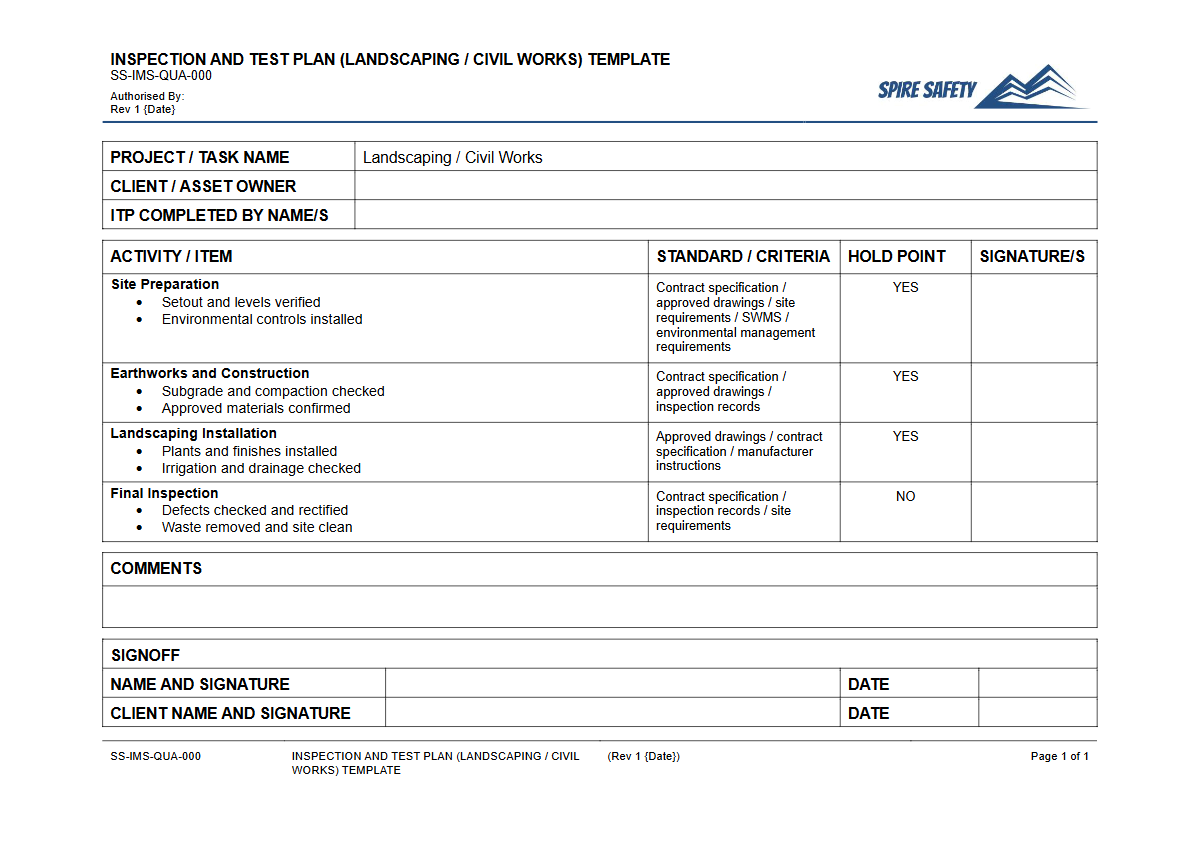
This free Inspection & Test Plan (Landscaping Civil Works) Template provides a structured framework for outlining the quality control and verification activities required for your civil landscaping projects. An Inspection and Test Plan (ITP) is a formal document that details all inspection points, tests, and checks to be performed at various stages of work to supports your compliance efforts with project specifications, design drawings, and relevant standards.
It serves as a roadmap for quality assurance, helping to prevent defects, reduce rework, and provide auditable evidence that all requirements have been met.
Using an ITP is fundamental to demonstrating due diligence and is a cornerstone of effective quality management. It translates project requirements into a logical sequence of verification steps, covering everything from material receival and initial site clearing to final handover.
This structured approach ensures that critical activities like earthworks, drainage installation, paving, soil preparation, and planting are systematically checked and approved. Integrating these quality checks is also a key component of robust WHS management systems, as it helps confirm that work is performed to a safe and compliant standard.
Video walkthrough
How to use the Free Inspection & Test Plan (Landscaping Civil Works) Template
This ITP template provides a comprehensive starting point for your project's quality planning. It includes columns for detailing each work activity, the type of inspection required (e.g., visual, measurement, material test), the acceptance criteria that must be met, the governing documents (like Australian Standards or client specifications), and the records to be generated.
It also defines responsibilities and identifies specific hold points and witness points.
Important: This document is a template only. It must be customised to address the specific scope of work, materials, site conditions, and contractual requirements of your individual landscaping project.
You must review and adapt every section to align with your project's risks and quality benchmarks. We are not liable for any action taken or not taken based on the use of this template.
A generic ITP that hasn't been tailored to the job is ineffective and may fail to meet client or regulatory expectations.
Key Terms in the ITP
- Hold Point: A mandatory verification point where work must stop until a formal inspection and approval are granted by the designated person (e.g., client representative, superintendent). Work cannot proceed past a hold point without a formal sign-off.
- Witness Point: A point in the process where the designated person must be notified that an inspection or test is about to occur. They have the option to witness the activity, but work can proceed if they choose not to attend.
- Review: A check of documentation (e.g., material certificates, survey reports) to verify compliance.
When to use an Inspection & Test Plan
An ITP should be developed during the project planning phase, well before any physical work commences on site. It is a proactive quality tool, not a reactive one.
The plan is then implemented throughout the project lifecycle, with inspections and tests carried out at the predetermined stages of construction. It acts as a live document, guiding site personnel on what to check, when to check it, and how to record the results.
This ensures that any non-conformances are identified and rectified early, preventing them from being buried by subsequent work.
Managing significant hazards is a parallel process. Civil works can involve major earthworks, excavation, or quarrying activities, which require their own specific controls.
Understanding your obligations under documents like Principal Mining Hazard Management Plans is crucial where these activities fall under mining safety legislation.
Who should use this ITP Template
This template is designed for use by various personnel involved in managing and executing landscaping and civil construction projects. Key users include:
- Project Managers: To oversee the development and approval of the ITP and ensure it aligns with overall project goals.
- Site Engineers & Supervisors: To implement the ITP on a day-to-day basis, coordinate inspections, and ensure all checks are completed by the site team and subcontractors.
- Quality Assurance (QA) / Quality Control (QC) Personnel: To develop, manage, and audit the ITP process, ensuring its integrity and effectiveness.
- Forepersons and Leading Hands: To understand the specific quality requirements for the tasks their crews are performing.
The ITP is a critical communication tool that ensures all parties, including subcontractors and clients, are aligned on the quality expectations for the project. The records generated from the ITP are essential for final project handover and can be a key focus during a formal WHS compliance auditing process to verify that procedures were followed.
Proper maintenance of the plant and equipment used in landscaping civil works is also critical to both safety and quality outcomes. For heavy and light vehicles used on site, regular safety checks are essential.
A dedicated WHS inspection template for vehicle workshops can help formalise the maintenance and safety verification process for your fleet.
This ITP template is one of many documents designed to help you build a safer and more organised workplace. For other forms and checklists covering a wide range of industries and tasks, browse our complete free WHS resources library.
Common mistakes
Common mistakes to avoid
- Using a generic template without customising it for the specific project scope and materials.
- Defining vague acceptance criteria like 'neat finish' instead of measurable standards (e.g., 'level tolerance +/- 5mm over 3m').
- Failing to clearly assign responsibility for each inspection, leading to missed checks.
- Inadequate record-keeping, making it impossible to prove that quality checks were completed and approved.
Legal references
Legal considerations
The following legal requirements may be relevant to this type of work.
- Work Health and Safety Act (Harmonised) — Provides the primary duties for protecting workers and other people from work health and safety risks.
- Work Health and Safety Regulations (Harmonised) — Sets out requirements supporting the management of workplace hazards and risks.
The following codes may be relevant to this type of work.
- Managing WHS Risks Code of Practice — Provides practical guidance on identifying hazards, assessing risks and applying effective controls.
- Work Health and Safety Consultation, Cooperation and Coordination Code of Practice — Provides practical guidance on consulting workers and coordinating with other duty holders.
- Managing the Work Environment and Facilities Code of Practice — Provides practical guidance on safe work environments, workplace facilities and related controls.
Did you know
Quality Planning Reduces Costs
Studies in the construction industry have shown that effective quality planning using tools like ITPs can significantly reduce costs associated with rework, which can account for up to 10-15% of total project costs.
Manufacturing Origins
The concept of the Inspection and Test Plan originated in the manufacturing sector, where precise, repeatable quality control is essential. The construction industry adopted and adapted the methodology to manage the unique, non-repetitive nature of building projects.
FAQ
Frequently asked questions
01What is the difference between an ITP and a Safe Work Method Statement (SWMS)?
02How detailed should an Inspection and Test Plan for landscaping be?
03Is an ITP a mandatory document for Australian civil works?
04Can this ITP template be used for small residential landscaping jobs?
Share this resource
Free Inspection & Test Plan (Landscaping Civil Works) Template
Browse Categories
How To Use It
- 1Download and open in Word or PDF.
- 2Replace the placeholders with your business details.
- 3Get it reviewed by a WHS specialist before rollout.
Need it customised?
Our WHS consultants can adapt this template to your site, run a gap analysis, or audit what you already have in place.
Book a Free Consultation WHS consulting servicesor call 1300 156 382
Related templates
- Free Inspection & Test Plan (Lift Elevator Installation) Template
- Free Inspection & Test Plan (Light Gauge Steel Framing) Template
- Free Inspection & Test Plan (Loading Dock Construction) Template
- Free Inspection & Test Plan (Mechanical Ventilation) Template
- Free Inspection & Test Plan (Metal Roof Sheeting) Template
- Free Inspection & Test Plan (Mosaic Feature Tiling) Template