
Free Inspection & Test Plan (Metal Roof Sheeting) Template
Formalise your roofing projects with our Free Inspection & Test Plan (Metal Roof Sheeting) Template. A structured starting point for quality control.
Free Inspection & Test Plan (Metal Roof Sheeting) Template
DOCX • 137 KB + PDF
Updated Oct 2026
No signup required
Purpose of the Free Inspection & Test Plan (Metal Roof Sheeting) Template
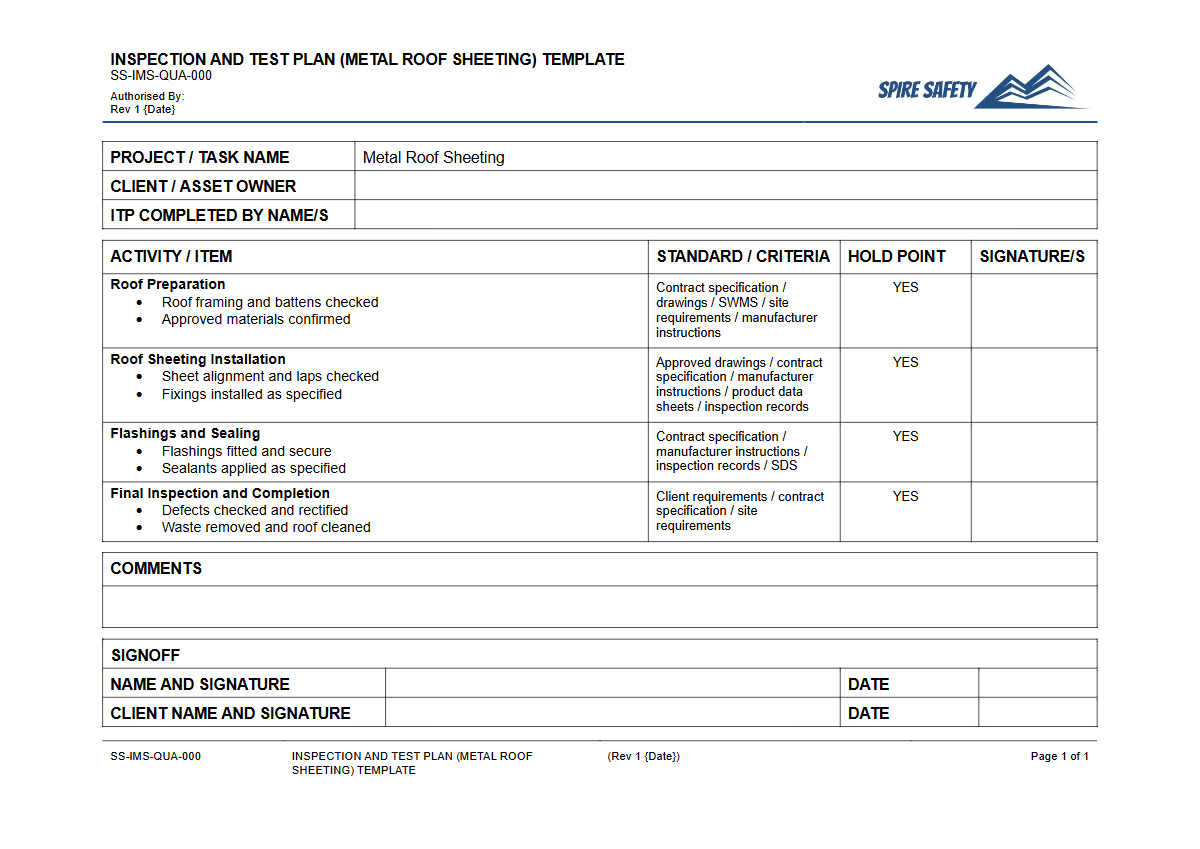
An Inspection and Test Plan (ITP) is a critical quality assurance document used in construction to ensure that work is performed and verified in a structured, sequential manner. Our Free Inspection & Test Plan (Metal Roof Sheeting) Template provides a framework for contractors and project managers to systematically check that the installation of metal roofing meets all project specifications, manufacturer's requirements, and relevant Australian Standards.
Using this template helps formalise the quality control process, providing clear evidence that each stage of the roofing installation has been inspected and approved. This not only minimises the risk of defects and rework but also provides auditable records for clients, builders, and regulatory bodies.
Properly implemented, an ITP is a cornerstone of effective quality management, demonstrating a commitment to delivering a compliant and durable end product. This proactive approach to quality is a fundamental part of building robust WHS management systems on any project.
Video walkthrough
How to use the Free Inspection & Test Plan (Metal Roof Sheeting) Template
This template is structured to guide you through the key stages of a metal roof installation, from material delivery to final handover. It outlines specific inspection activities, acceptance criteria, verification methods, and responsibilities. The plan typically includes different types of inspection points:
- Hold Points: A mandatory verification point where work cannot proceed without formal approval from a designated person (e.g., supervisor, client representative).
- Witness Points: A point where the designated person should be notified of an upcoming inspection but their presence is not mandatory for work to continue.
- Surveillance: General, ongoing monitoring of the work.
To use the template effectively, review each item and adapt it to your specific project. This includes adding or removing checkpoints, defining acceptance criteria based on project drawings and standards (like AS 1562.1), and assigning responsibilities to your team.
The result should be a project-specific document that becomes a live record of your quality assurance activities. The data gathered is invaluable during any formal WHS compliance auditing process.
IMPORTANT: This is a template, not a finished document. We have designed it as a starting point, but you MUST customise it to reflect the specific requirements of your project, site conditions, materials, and relevant Australian Standards and building codes.
When to use an Inspection & Test Plan
An ITP for metal roof sheeting should be developed during the project planning phase, well before any installation work begins. It should be reviewed and approved by relevant stakeholders, such as the principal contractor and client, as part of the initial project documentation.
It is then used as a live document throughout the construction phase, with inspections and sign-offs occurring at each defined checkpoint.
It is particularly crucial for large-scale commercial, industrial, and civil projects where quality assurance requirements are stringent. However, it's also valuable for complex residential builds or re-roofing projects to ensure a high standard of work.
Whether the project involves a new commercial warehouse or large new structures on a farm, the principles of documented quality control remain the same. For projects in rural settings, you might also require a specific WHS inspection for agricultural sites.
Who should use it
This template is designed for use by a range of personnel involved in the management and execution of construction projects. Key users include:
- Project Managers: To oversee the overall quality assurance process and ensure contractual obligations are met.
- Construction/Site Managers: For day-to-day management and coordination of inspections on site.
- Quality Assurance/Quality Control (QA/QC) Officers: Responsible for implementing the ITP, conducting inspections, and maintaining records.
- Site Supervisors & Forepersons: To ensure their teams are working to the required standards and that witness/hold points are respected.
- Roofing Contractors: To manage their own quality control and provide evidence of compliant installation to the principal contractor or client.
On larger projects, contractors might operate their own maintenance facilities for company vehicles and equipment. Ensuring these areas are also safe and compliant is vital, which can be managed with a dedicated WHS inspection for vehicle workshops.
Upon project completion, waste materials like off-cuts and packaging must be managed according to site environmental plans. This process can be formalised using documents such as a WHS inspection for resource recovery facilities. This ensures that the entire project lifecycle, from material delivery to final clean-up, is handled professionally. You can find more templates like this one in our library of free WHS resources.
Common mistakes
Common mistakes to avoid
- Failing to customise the template to reflect specific project drawings, materials, and site conditions.
- Treating the ITP as a 'tick-and-flick' exercise without conducting genuine verification activities.
- Not clearly referencing the specific acceptance criteria, such as clauses from an Australian Standard or manufacturer's installation guide.
- Poor record-keeping, leading to an incomplete or untraceable quality history for the project.
Legal references
Legal considerations
The following legal requirements may be relevant to this type of work.
- Work Health and Safety Act (Harmonised) — Provides the primary duties for protecting workers and other people from work health and safety risks.
- Work Health and Safety Regulations (Harmonised) — Sets out requirements supporting the management of workplace hazards and risks.
The following codes may be relevant to this type of work.
- Managing WHS Risks Code of Practice — Provides practical guidance on identifying hazards, assessing risks and applying effective controls.
- Work Health and Safety Consultation, Cooperation and Coordination Code of Practice — Provides practical guidance on consulting workers and coordinating with other duty holders.
- Managing the Work Environment and Facilities Code of Practice — Provides practical guidance on safe work environments, workplace facilities and related controls.
Did you know
Australian Standards
Australian Standard AS 1562.1:2018 provides minimum design and installation requirements for sheet roof and wall cladding, forming a critical reference for any roofing ITP.
Material Expansion
Metal roofing can expand and contract significantly with temperature changes. An ITP helps verify that correct fastening techniques and expansion joints have been used to accommodate this movement and prevent future issues.
FAQ
Frequently asked questions
01What is the difference between an ITP and a checklist?
02Does this template include working at heights safety procedures?
03Is this metal roofing ITP suitable for both commercial and residential projects?
04What are 'hold points' and 'witness points' in an Inspection & Test Plan?
Share this resource
Free Inspection & Test Plan (Metal Roof Sheeting) Template
Browse Categories
How To Use It
- 1Download and open in Word or PDF.
- 2Replace the placeholders with your business details.
- 3Get it reviewed by a WHS specialist before rollout.
Need it customised?
Our WHS consultants can adapt this template to your site, run a gap analysis, or audit what you already have in place.
Book a Free Consultation WHS consulting servicesor call 1300 156 382
Related templates
- Free Inspection & Test Plan (Mosaic Feature Tiling) Template
- Free Inspection & Test Plan (O&M Manual Handover) Template
- Free Inspection & Test Plan (Painting) Template
- Free Inspection & Test Plan (Passive Fire Protection Firestopping) Template
- Free Inspection & Test Plan (Pavement Road Base) Template
- Free Inspection & Test Plan (Piling and Pier Installation) Template