
Free Inspection & Test Plan (Painting) Template
Get your free Inspection & Test Plan (Painting) Template. This structured DOCX & PDF helps manage quality and safety for painting projects. Download today.
Free Inspection & Test Plan (Painting) Template
DOCX • 140 KB + PDF
Updated Oct 2026
No signup required
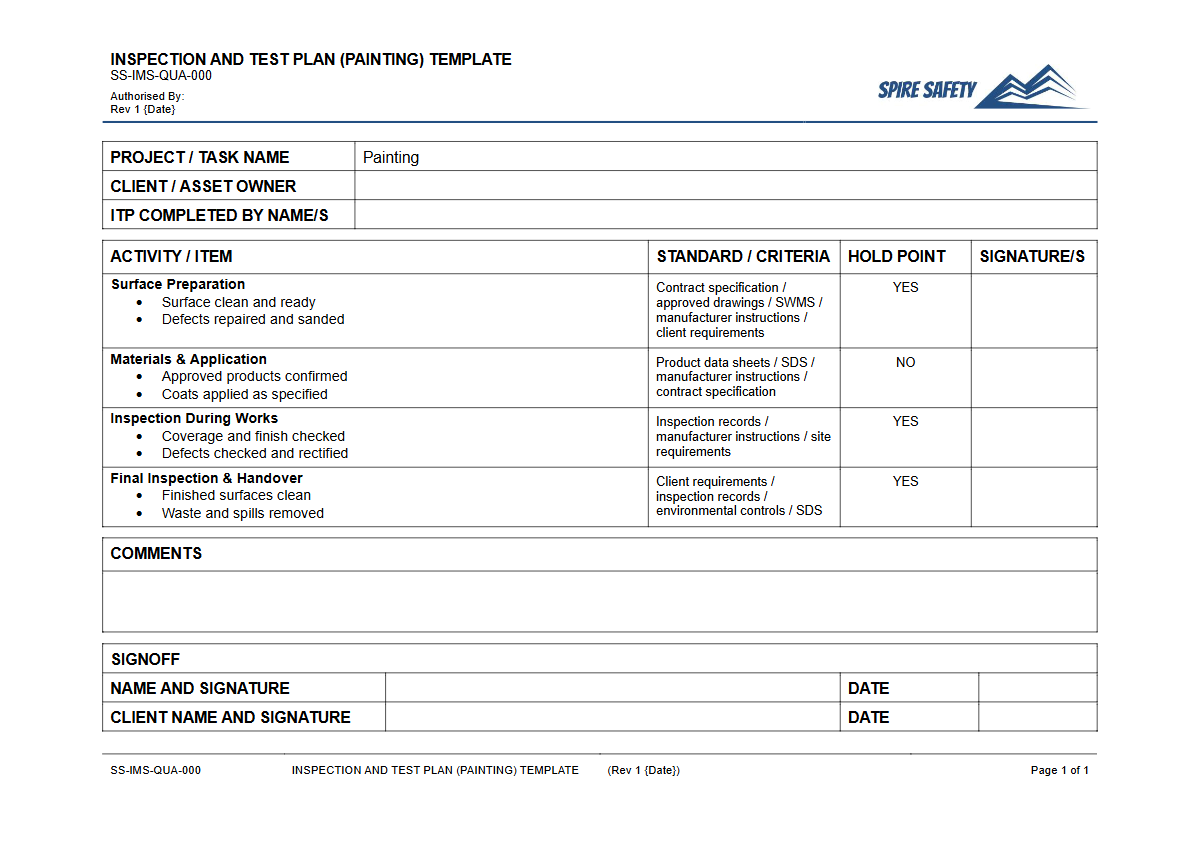
Purpose of the Free Inspection & Test Plan (Painting) Template
An Inspection and Test Plan (ITP) is a crucial quality assurance document that maps out the entire sequence of inspections and tests for a specific work process. This Free Inspection & Test Plan (Painting) Template provides a structured framework to ensure all painting activities, from surface preparation to final coating application, meet project specifications and Australian standards.
It serves as a formal record that demonstrates due diligence, verifies quality at critical stages, and ensures the finished product is durable and fit-for-purpose. By outlining checkpoints, responsibilities, and acceptance criteria upfront, it prevents defects, reduces rework, and provides clear evidence of compliance for clients and regulators.
A well-executed ITP is a cornerstone of effective project management and quality control. It integrates seamlessly into broader WHS management systems by formalising the verification and validation process.
The plan identifies 'Witness Points', where work can be observed by inspectors, and 'Hold Points', which are mandatory stops requiring formal sign-off before work can continue. This methodical approach ensures that no step is missed and that all materials and application techniques conform to the agreed-upon standards, such as AS/NZS 2311: Guide to the painting of buildings.
Video walkthrough
How to use the Free Inspection & Test Plan (Painting) Template
This template is provided as a starting point to help you build a project-specific ITP for your painting works. It includes typical stages found in commercial and industrial painting projects, such as pre-surface inspection, checks for environmental conditions (temperature, humidity), verification of paint batch numbers, wet and dry film thickness (WFT/DFT) measurements, and final visual inspection.
To use the document, simply download the DOCX file and adapt it to your operational context.
IMPORTANT: This is a template only and must be customised to your specific workplace, project requirements, paint system, and relevant Australian Standards. We recommend a competent person reviews and amends the document to ensure all critical control points are identified and addressed.
You should add details such as project names, specific locations, the standards you are working to, and the names or roles of personnel responsible for each inspection. Integrating this process into a certified framework may also be beneficial, and our team can assist with ISO 45001 consulting to formalise your systems.
When to use it
A painting ITP should be developed during the project planning phase, before any work commences. It is essential for any project where coating quality and longevity are critical, including industrial facilities, commercial buildings, infrastructure projects like bridges, and high-end residential work.
The ITP is a live document used throughout the project lifecycle to guide supervisors and workers, record inspection outcomes, and capture sign-offs. It becomes a key part of the project handover documentation, providing the client with verifiable proof that the work was completed to specification.
This documentation is invaluable during any future WHS compliance auditing activities.
Who should use it
This template is designed for a range of personnel involved in managing and executing painting projects. It is particularly useful for:
- Project Managers: To plan and oversee quality control processes.
- Site Supervisors & Foremen: To manage daily quality checks and ensure crews follow the specified procedures.
- Quality Assurance/Quality Control (QA/QC) Officers: To conduct and document formal inspections and tests.
- Painting Contractors: To demonstrate a professional approach to quality management and meet contractual obligations.
- Principal Contractors: To ensure subcontractors are meeting the required quality and safety standards.
Using an ITP clarifies roles and provides a single source of truth for the entire team. In environments where painting is a regular activity, such as in maintenance facilities, it helps standardise the quality of work.
For instance, it can be used alongside a specific WHS inspection for a vehicle workshop to ensure that spray painting and finishing tasks are consistently performed to a high standard.
Key Checkpoints in a Painting ITP
While your customised ITP will be unique, it should cover several critical stages. Ensure you include detailed acceptance criteria for each point.
- Surface Preparation: Verification of surface cleanliness (e.g., free from oil, grease, dust), abrasive blast class (e.g., Sa 2.5), and surface profile or roughness. This is the most critical stage for coating adhesion and performance.
- Environmental Conditions: Recording ambient temperature, surface temperature, relative humidity, and dew point before and during application to prevent paint failure.
- Material & Mixing: Checking that the correct paint is being used, verifying batch numbers, and ensuring it has been mixed according to the manufacturer’s technical data sheet. Proper procedures for managing hazardous substances should also be verified at this point.
- Application: Monitoring wet film thickness (WFT) during application to ensure the final dry film thickness (DFT) will be within specification.
- Post-Application & Curing: Measuring DFT once cured, performing adhesion tests if required, and conducting a final visual inspection for defects like runs, sags, or holidays.
You can discover more templates and safety resources like this one in our complete free WHS resources library, covering a wide range of tasks and industries.
Common mistakes
Common mistakes to avoid
- Using the template without customising it for specific project standards, paint systems, and environmental conditions.
- Treating 'Hold Points' as 'Witness Points', and proceeding with work without gaining the required formal approval from the client or inspector.
- Failing to record objective evidence, such as photos, calibration records for gauges, or batch numbers, alongside the ITP.
- Ignoring ambient conditions like temperature, humidity, and dew point, which can lead to coating failure.
Legal references
Legal considerations
The following legal requirements may be relevant to this type of work.
- Work Health and Safety Act (Harmonised) — Provides the primary duties for protecting workers and other people from work health and safety risks.
- Work Health and Safety Regulations (Harmonised) — Sets out requirements supporting the management of workplace hazards and risks.
The following codes may be relevant to this type of work.
- Managing WHS Risks Code of Practice — Provides practical guidance on identifying hazards, assessing risks and applying effective controls.
- Work Health and Safety Consultation, Cooperation and Coordination Code of Practice — Provides practical guidance on consulting workers and coordinating with other duty holders.
- Managing the Work Environment and Facilities Code of Practice — Provides practical guidance on safe work environments, workplace facilities and related controls.
Did you know
Surface Preparation is Key
Industry studies show that over 75% of all coating failures are due to inadequate or improper surface preparation, not the paint itself. A thorough ITP helps ensure this critical first step is done correctly.
VOCs in Paint
Many paints contain Volatile Organic Compounds (VOCs) that can be harmful to health and the environment. Using an ITP helps ensure ventilation, PPE, and handling controls are verified during application.
FAQ
Frequently asked questions
01What is the primary purpose of an Inspection and Test Plan for painting?
02Can I adapt this painting ITP for specialised coatings like intumescent or epoxy paints?
03Who is typically responsible for signing off hold and witness points in a painting ITP?
04How does this ITP relate to a Safe Work Method Statement (SWMS) for painting?
Share this resource
Free Inspection & Test Plan (Painting) Template
Browse Categories
How To Use It
- 1Download and open in Word or PDF.
- 2Replace the placeholders with your business details.
- 3Get it reviewed by a WHS specialist before rollout.
Need it customised?
Our WHS consultants can adapt this template to your site, run a gap analysis, or audit what you already have in place.
Book a Free Consultation WHS consulting servicesor call 1300 156 382
Related templates
- Free Inspection & Test Plan (Passive Fire Protection Firestopping) Template
- Free Inspection & Test Plan (Pavement Road Base) Template
- Free Inspection & Test Plan (Piling and Pier Installation) Template
- Free Inspection & Test Plan (Pipeline Installation) Template
- Free Inspection & Test Plan (Planter Box Waterproofing) Template
- Free Inspection & Test Plan (Plasterboard Lining) Template