
Free Inspection & Test Plan (Pipeline Installation) Template
Ensure project quality and safety with our free Inspection & Test Plan for pipeline installation. A structured starting point for Australian projects.
Free Inspection & Test Plan (Pipeline Installation) Template
DOCX • 139 KB + PDF
Updated Oct 2026
No signup required
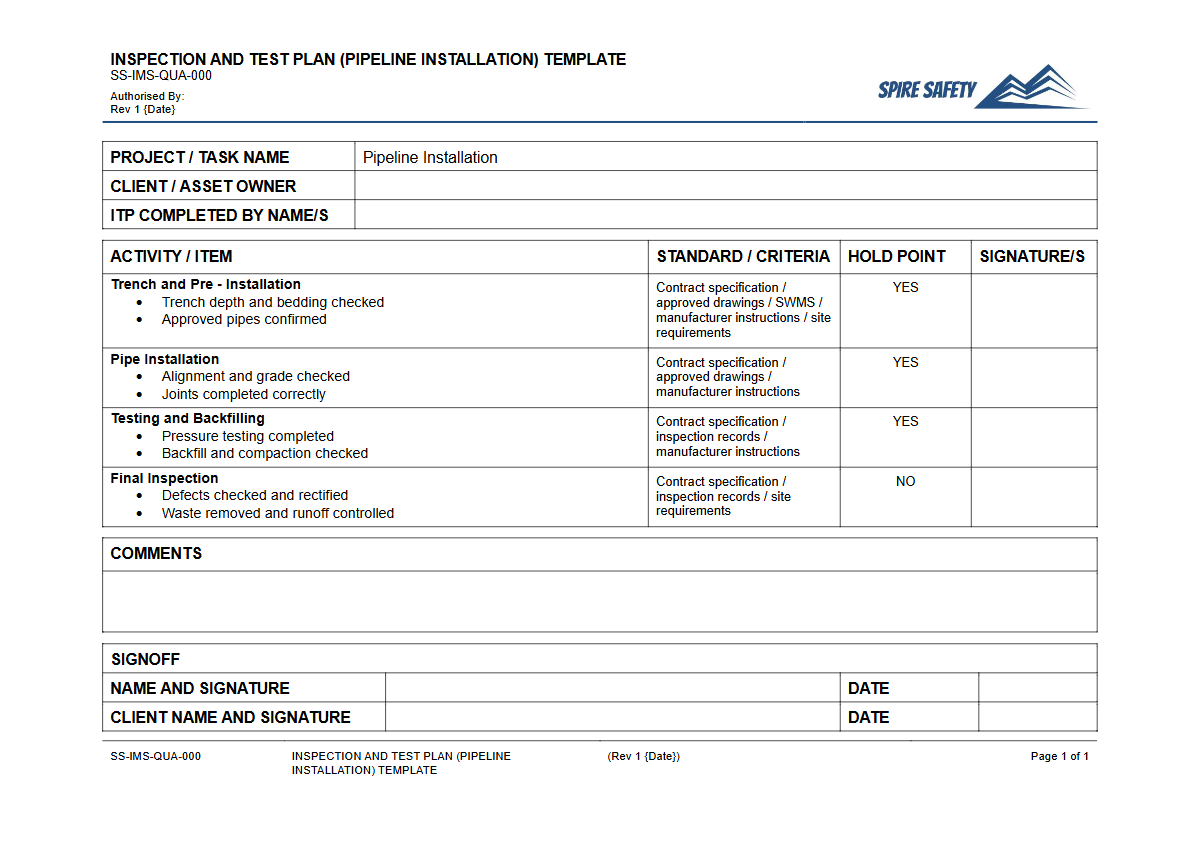
Purpose of the Free Inspection & Test Plan (Pipeline Installation) Template
An Inspection and Test Plan (ITP) is a critical quality assurance document used in construction and engineering to ensure that a product, structure, or installation meets all design specifications and regulatory standards. Our Free Inspection & Test Plan (Pipeline Installation) Template provides a structured framework for outlining the specific checks, tests, and verification stages required throughout the pipeline construction process.
Its primary purpose is to systematically control quality, provide objective evidence of compliance, and prevent defects before they escalate.
By defining key hold points, witness points, and surveillance checks, this ITP helps coordinate activities between project managers, contractors, and clients. It serves as a roadmap for quality control, detailing everything from material verification upon delivery to final pressure testing and commissioning. Properly implemented, it forms a vital component of your overall project quality plan and is a key document for demonstrating due diligence within your broader WHS management system.
Video walkthrough
How to use the Free Inspection & Test Plan (Pipeline Installation) Template
This template is designed to be a comprehensive starting point. It is organised into columns that prompt you to detail each construction activity, the characteristics to be checked, the acceptance criteria (often referencing Australian Standards like AS 2885), the type of inspection, and the party responsible for signing off on completion.
It also includes columns for referencing procedures and recording the final outcome.
To use the template effectively, you must adapt it to your project's unique requirements. This includes specifying the exact materials (e.g., steel, HDPE, concrete), welding procedures, coating specifications, and environmental controls relevant to your worksite. For projects in particularly hazardous environments, such as mining, you may need to integrate controls from other key safety documents, which is a core principle in developing principal mining hazard management plans.
IMPORTANT: This document is a template only. We have designed it as a structured starting point, but you must customise it to reflect the specific risks, materials, equipment, legal requirements, and operating procedures of your pipeline installation project.
The responsibility for ensuring it is fit for purpose rests entirely with the user.
When to use this Inspection & Test Plan
An ITP for pipeline installation is a live document used across the entire project lifecycle. It is not a one-off checklist but a continuous record of quality assurance activities. Key stages where this ITP should be actively used include:
- Procurement and Receiving: Verifying that all pipes, fittings, valves, and materials meet the specified standards and are free from damage upon arrival.
- Pre-construction: Confirming surveyor set-out, trench excavation dimensions, and soil stability before pipe is laid. Checking pre-start records for major plant, which can be managed with tools like our free WHS inspection for vehicle workshops.
- Installation: Monitoring pipe laying, bedding and backfill, welding activities (including welder qualifications and consumables), and coating application and repairs.
- Testing: Documenting all required tests, such as non-destructive testing (NDT) of welds, coating thickness tests (DFT), and culminating in the critical hydrostatic or pneumatic pressure test.
- Commissioning and Handover: Compiling the completed ITP and all supporting records into a Manufacturer's Data Report (MDR) for the client. This final package is essential for operational handover and is often a focus of third-party WHS compliance audits.
Who should use this Inspection & Test Plan
The development and implementation of an ITP is a collaborative effort involving several key roles on a construction project. Individuals who will use and contribute to this document include:
- Project Managers: For overall oversight of quality, schedule, and budget.
- Construction/Site Managers: For day-to-day execution and ensuring work on the ground aligns with the ITP.
- QA/QC Managers and Inspectors: As the primary owners of the document, responsible for conducting inspections, witnessing tests, and managing all quality-related records.
- Site Engineers: For providing technical input, interpreting specifications, and resolving any non-conformances.
- Supervisors and Forepersons: For ensuring their crews understand the quality requirements for each task.
For organisations that lack dedicated internal QA/QC personnel, engaging external professionals can provide the necessary expertise to develop and implement a robust ITP. This is a common area where teams seek specialist WHS consulting support to ensure their project frameworks are sound.
Common mistakes
Common mistakes to avoid
- Failing to tailor the template to the specific project scope, materials, and Australian Standards.
- Using generic 'pass/fail' criteria instead of specific, measurable acceptance standards (e.g., 'weld profile acceptable' vs. 'weld reinforcement height 1.5–3.0mm').
- Not clearly assigning responsibility for each inspection or test, leading to missed checks.
- Poor record-keeping, making it impossible to prove that required checks were completed.
Legal references
Legal considerations
The following legal requirements may be relevant to this type of work.
- Work Health and Safety Act (Harmonised) — Provides the primary duties for protecting workers and other people from work health and safety risks.
- Work Health and Safety Regulations (Harmonised) — Sets out requirements supporting the management of workplace hazards and risks.
The following codes may be relevant to this type of work.
- Managing WHS Risks Code of Practice — Provides practical guidance on identifying hazards, assessing risks and applying effective controls.
- Work Health and Safety Consultation, Cooperation and Coordination Code of Practice — Provides practical guidance on consulting workers and coordinating with other duty holders.
- Managing the Work Environment and Facilities Code of Practice — Provides practical guidance on safe work environments, workplace facilities and related controls.
Did you know
Material Traceability
A key function of a pipeline ITP is ensuring full material traceability. Every pipe, fitting, and weld must be tracked from the manufacturer to its final installed location, often via heat numbers or unique identifiers.
The Cost of Rework
Industry studies show that rework due to poor quality control can account for 5-15% of a construction project's total cost. A robust ITP helps minimise these preventable expenses by catching issues early.
FAQ
Frequently asked questions
01What is the difference between a witness point and a hold point in an ITP?
02Does this ITP template cover hydrostatic testing for pipelines?
03Can I use this template for both steel and HDPE pipeline installations?
04How does an Inspection and Test Plan relate to a Safe Work Method Statement (SWMS)?
Share this resource
Free Inspection & Test Plan (Pipeline Installation) Template
Browse Categories
How To Use It
- 1Download and open in Word or PDF.
- 2Replace the placeholders with your business details.
- 3Get it reviewed by a WHS specialist before rollout.
Need it customised?
Our WHS consultants can adapt this template to your site, run a gap analysis, or audit what you already have in place.
Book a Free Consultation WHS consulting servicesor call 1300 156 382
Related templates
- Free Inspection & Test Plan (Planter Box Waterproofing) Template
- Free Inspection & Test Plan (Plasterboard Lining) Template
- Free Inspection & Test Plan (Plastering Rendering) Template
- Free Inspection & Test Plan (Plumbing Drainage) Template
- Free Inspection & Test Plan (Plumbing Rough-In (First Fix)) Template
- Free Inspection & Test Plan (Plumbing Second Fix Fit off) Template