
Free Inspection & Test Plan (Plastering Rendering) Template
Streamline quality control for plastering and rendering projects with our structured Inspection & Test Plan template. Download your free DOCX & PDF today.
Free Inspection & Test Plan (Plastering Rendering) Template
DOCX • 140 KB + PDF
Updated Oct 2026
No signup required
Purpose of the Free Inspection & Test Plan (Plastering Rendering) Template
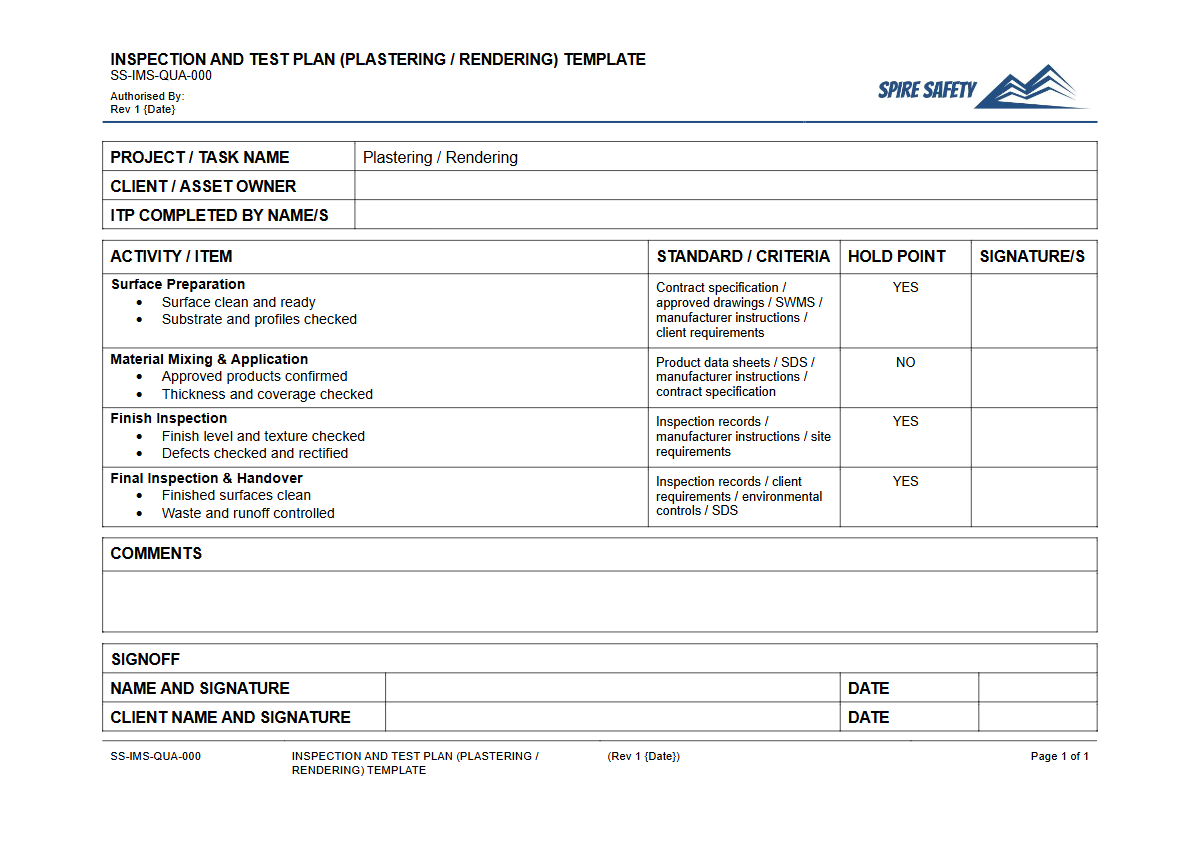
An Inspection and Test Plan (ITP) is a crucial quality assurance document used in construction to ensure that work meets specified standards and technical requirements. This Free Inspection & Test Plan (Plastering Rendering) Template provides a structured framework for outlining the sequence of inspections, tests, and verification activities required throughout the plastering and rendering process.
It helps formalise quality control by defining what will be checked, who is responsible, what acceptance criteria apply, and what records must be kept. Implementing a robust ITP helps prevent rework, ensures client satisfaction, and demonstrates a commitment to delivering a high-quality finish.
This template is designed to cover key stages from pre-commencement to final handover. It prompts you to consider material verification (e.g., checking plaster types, sand, additives), substrate preparation, mixing procedures, application techniques, and final finish quality.
Using this plan consistently helps site supervisors and project managers maintain control over workmanship and systematically verify that all project specifications are met. This structured approach is a core component of effective WHS management systems, integrating quality assurance directly with operational safety.
Video walkthrough
How to use the Free Inspection & Test Plan (Plastering Rendering) Template
This resource is available in both DOCX and PDF formats for your convenience. The DOCX file is fully editable, allowing you to adapt the plan to the specific scope of your project.
You can add, remove, or modify inspection points, assign responsibilities to your team members, and define the unique acceptance criteria required by your client or architectural specifications. The PDF version is a ready-to-print document for immediate use in site meetings or for reference.
Important: This is a template that provides a starting point. It must be customised to suit the specific requirements of your project, materials, work environment, and relevant Australian Standards.
We are not liable for any action taken based on this document. A generic plan is insufficient for ensuring compliance and quality; a detailed, project-specific ITP is essential for success.
This customisation process ensures the plan is relevant and effective for your specific operational context.
When to use an Inspection & Test Plan
An ITP for plastering and rendering should be implemented before any work begins and used continuously throughout the project lifecycle. It is not a one-off checklist but a dynamic document that guides quality control from start to finish.
Key phases for its use include the pre-commencement stage for checking material compliance and substrate readiness, the in-process stage for monitoring application thickness and technique, and the post-completion stage for final inspection of the finish, crack assessment, and handover.
Regular reviews of the ITP during toolbox talks or site meetings ensure the entire team understands the quality expectations at each stage. It also serves as a critical document during project audits.
A well-maintained ITP provides objective evidence that processes were followed correctly, which can be reviewed during a WHS compliance auditing process to verify procedural adherence and identify areas for improvement in your quality management system.
Who should use this ITP
This Inspection & Test Plan is designed for use by various personnel involved in construction and trade projects. This includes Project Managers, who oversee overall quality and compliance; Site Supervisors and Foremen, who are responsible for daily on-the-ground execution; and Quality Assurance/Quality Control (QA/QC) officers, who formally verify that work meets the required standards.
The plastering and rendering teams themselves should also be familiar with the ITP to understand the benchmarks their work will be judged against.
Furthermore, managing the risks associated with plastering, such as exposure to respirable crystalline silica from dry mixing or sanding, is critical. While an ITP focuses on quality, it complements safety documents like Safe Work Method Statements (SWMS).
For high-risk hazards like silica, organisations may need to develop comprehensive strategies similar in principle to Principal Mining Hazard Management Plans to ensure worker health is protected. It is also vital to ensure that adequate first aid provisions are in place, which can be standardised using a Free First Aid Procedure Template.
By clearly defining checkpoints and standards, the ITP promotes accountability and provides a clear, documented record of quality management activities. For those looking to expand their safety documentation, our free WHS resources library offers a wide range of templates and guides to support your safety management system.
Common mistakes
Common mistakes to avoid
- Using a generic ITP without customising it for project-specific materials and standards.
- Failing to define clear, measurable acceptance criteria, leading to subjective and inconsistent assessments.
- Not training the work crew on the ITP requirements, resulting in a disconnect between planning and execution.
- Poor record-keeping, which undermines the ITP's purpose as a formal quality assurance document.
Legal references
Legal considerations
The following legal requirements may be relevant to this type of work.
- Work Health and Safety Act (Harmonised) — Provides the primary duties for protecting workers and other people from work health and safety risks.
- Work Health and Safety Regulations (Harmonised) — Sets out requirements supporting the management of workplace hazards and risks.
The following codes may be relevant to this type of work.
- Managing WHS Risks Code of Practice — Provides practical guidance on identifying hazards, assessing risks and applying effective controls.
- Work Health and Safety Consultation, Cooperation and Coordination Code of Practice — Provides practical guidance on consulting workers and coordinating with other duty holders.
- Managing the Work Environment and Facilities Code of Practice — Provides practical guidance on safe work environments, workplace facilities and related controls.
Did you know
Silica Risk
Many cement-based renders and plaster compounds contain crystalline silica. When cut, sanded, or dry-mixed, this can release respirable dust, a hazardous substance linked to serious lung diseases like silicosis.
Ancient Origins
Plastering is an ancient craft, with evidence of gypsum-based plaster used in Egyptian pyramids over 4,000 years ago. The Romans later perfected lime-based plasters, which were so durable that many examples survive today.
FAQ
Frequently asked questions
01What is an Inspection & Test Plan (ITP) in construction?
02What key stages should a plastering and rendering ITP cover?
03Is an ITP a legal requirement in Australia?
04How does an ITP differ from a Safe Work Method Statement (SWMS)?
Share this resource
Free Inspection & Test Plan (Plastering Rendering) Template
Browse Categories
How To Use It
- 1Download and open in Word or PDF.
- 2Replace the placeholders with your business details.
- 3Get it reviewed by a WHS specialist before rollout.
Need it customised?
Our WHS consultants can adapt this template to your site, run a gap analysis, or audit what you already have in place.
Book a Free Consultation WHS consulting servicesor call 1300 156 382
Related templates
- Free Inspection & Test Plan (Plumbing Drainage) Template
- Free Inspection & Test Plan (Plumbing Rough-In (First Fix)) Template
- Free Inspection & Test Plan (Plumbing Second Fix Fit off) Template
- Free Inspection & Test Plan (Polished Concrete Floor) Template
- Free Inspection & Test Plan (Post-Tensioned Slab) Template
- Free Inspection & Test Plan (Practical Completion Inspection) Template