
Free Inspection & Test Plan (Plumbing Drainage) Template
Download our free Inspection & Test Plan (Plumbing Drainage) template. This DOCX & PDF resource helps plumbers and contractors formalise quality control.
Free Inspection & Test Plan (Plumbing Drainage) Template
DOCX • 139 KB + PDF
Updated Oct 2026
No signup required
Purpose of the Free Inspection & Test Plan (Plumbing Drainage) Template
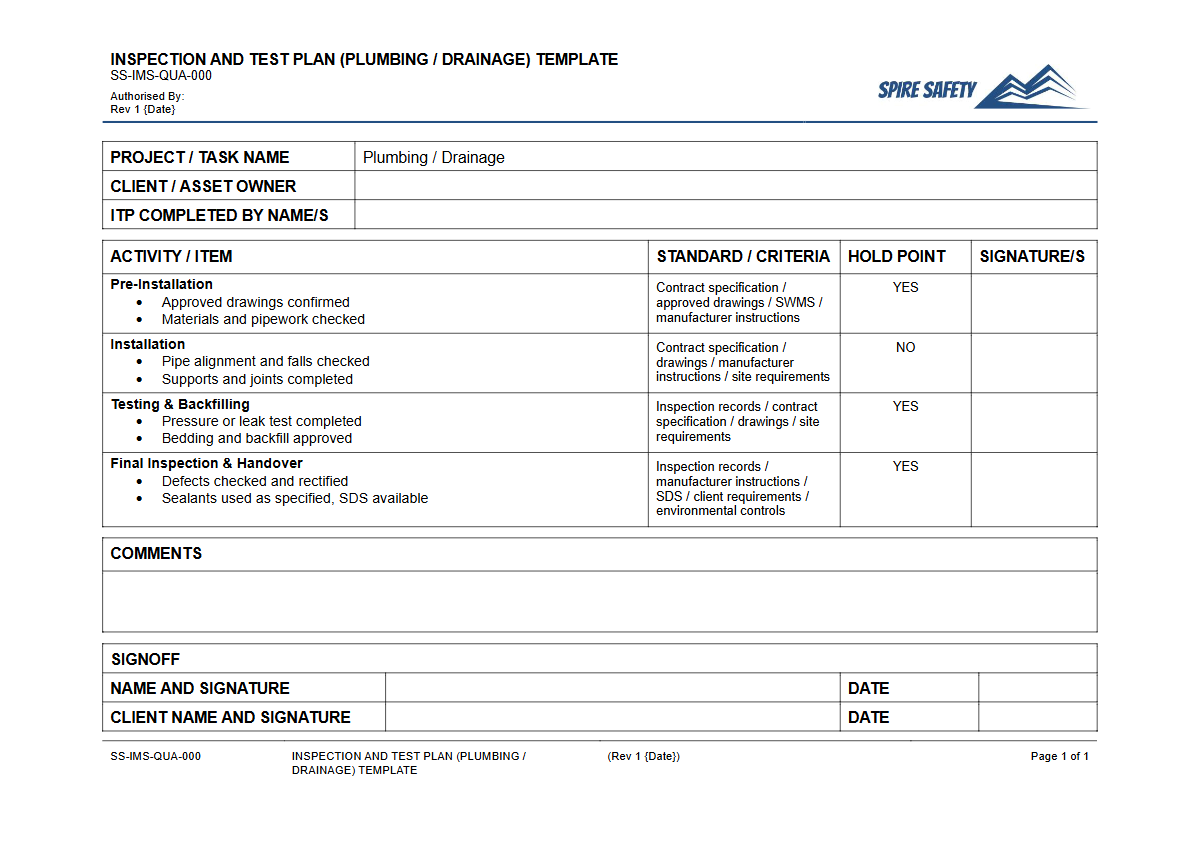
An Inspection and Test Plan (ITP) is a crucial quality assurance document used in construction and trade services to ensure work meets all required standards and specifications. Our Free Inspection & Test Plan (Plumbing Drainage) Template provides a structured framework for systematically planning, conducting, and documenting quality checks throughout a plumbing and drainage project.
By outlining key stages, inspection points, responsibilities, and acceptance criteria, this template helps verify that all work complies with the project design, Australian Standards (like AS/NZS 3500), and the National Construction Code.
Using an ITP demonstrates a commitment to quality, reduces the risk of costly rework, and provides auditable records of compliance for clients and regulators. It formalises the quality control process, moving beyond ad-hoc checks to a planned, preventative approach.
This document is a key component for any business looking to implement or improve its comprehensive WHS management systems, as it integrates quality verification directly into the project workflow.
Video walkthrough
How to use the Free Inspection & Test Plan (Plumbing Drainage) Template
This template is designed for straightforward implementation on your next plumbing and drainage project. Start by downloading the DOCX file and opening it in your preferred word processor.
The plan is structured in a table format, allowing you to detail each activity, the type of check required (e.g., surveillance, witness point, hold point), the standards to be met, and who is responsible for inspection and sign-off. You should populate the ITP during the project planning phase, before any physical work begins.
Integrate the ITP into your project schedule, ensuring all personnel understand their roles and the required quality checks at each stage. It can also serve as a useful communication tool during pre-start meetings or site briefings. To enhance team communication on project-specific hazards and controls, consider using it alongside our Plumbing Safety Toolbox Talk template.
Important: This document is a template and must be customised. We have provided a structured starting point, but you must adapt it to the unique requirements of your project, site conditions, client specifications, and relevant state or territory regulations.
Its effectiveness depends on its accurate customisation to your specific operational context.
When to use an Inspection & Test Plan
An ITP for plumbing and drainage should be used throughout the entire project lifecycle, from initial setup to final handover. It is not a document to be completed at the end of a job; it is a live document used to manage quality in real-time. Key implementation points include:
- Pre-construction: To plan all quality control activities and establish clear benchmarks for success.
- During construction: At critical milestones or 'hold points' where work cannot proceed until an inspection is passed. Examples include trench inspection before pipe laying, testing pipe joins, and verifying correct fall before backfilling.
- Post-construction: To conduct final checks, complete all documentation, and create a comprehensive handover package for the client. This record is invaluable during any future WHS compliance auditing as evidence of due diligence.
Who should use this Inspection & Test Plan
This template is beneficial for a wide range of roles within the construction and plumbing industries in Australia. It provides a standardised method for managing and recording quality outcomes, ensuring all stakeholders are aligned. Individuals and organisations who will find this resource useful include:
- Licensed Plumbers and Drainers
- Civil Contractors
- Project Managers and Site Supervisors
- Quality Assurance / Quality Control (QA/QC) Officers
- Principal Contractors overseeing subcontractors
For organisations aiming for certification against international standards, integrating ITPs into daily operations is a fundamental step. This practice aligns well with the principles of quality management detailed in frameworks like ISO 9001 and the process-oriented approach of ISO 45001.
If your business is pursuing this level of formalisation, our ISO 45001 consulting services can provide expert guidance.
This document is just one of many resources designed to support Australian trades and construction businesses. For more templates, checklists, and guides, browse our complete free WHS resources library.
Common mistakes
Common mistakes to avoid
- Failing to customise the template for specific project requirements and local regulations.
- Using generic 'Pass/Fail' criteria instead of referencing specific standards or measurable tolerances.
- Not clearly assigning responsibility for each inspection and sign-off, leading to missed checks.
- Treating the ITP as a paperwork exercise at the end of the job, rather than an active, real-time quality tool.
Legal references
Legal considerations
The following legal requirements may be relevant to this type of work.
- Work Health and Safety Act (Harmonised) — Provides the primary duties for protecting workers and other people from work health and safety risks.
- Work Health and Safety Regulations (Harmonised) — Sets out requirements supporting the management of workplace hazards and risks.
The following codes may be relevant to this type of work.
- Managing WHS Risks Code of Practice — Provides practical guidance on identifying hazards, assessing risks and applying effective controls.
- Work Health and Safety Consultation, Cooperation and Coordination Code of Practice — Provides practical guidance on consulting workers and coordinating with other duty holders.
- Managing the Work Environment and Facilities Code of Practice — Provides practical guidance on safe work environments, workplace facilities and related controls.
Did you know
Cost of Rework
Studies in the construction industry show that rework caused by poor quality management can account for 5–15% of a project's total contract value. A well-executed ITP is a primary tool for minimising these preventable costs.
FAQ
Frequently asked questions
01What is the difference between an ITP and a SWMS?
02What standards should a plumbing drainage ITP reference?
03What are 'hold points' in an Inspection & Test Plan?
04Can this template be used for both commercial and residential projects?
Share this resource
Free Inspection & Test Plan (Plumbing Drainage) Template
Browse Categories
How To Use It
- 1Download and open in Word or PDF.
- 2Replace the placeholders with your business details.
- 3Get it reviewed by a WHS specialist before rollout.
Need it customised?
Our WHS consultants can adapt this template to your site, run a gap analysis, or audit what you already have in place.
Book a Free Consultation WHS consulting servicesor call 1300 156 382
Related templates
- Free Inspection & Test Plan (Plumbing Rough-In (First Fix)) Template
- Free Inspection & Test Plan (Plumbing Second Fix Fit off) Template
- Free Inspection & Test Plan (Polished Concrete Floor) Template
- Free Inspection & Test Plan (Post-Tensioned Slab) Template
- Free Inspection & Test Plan (Practical Completion Inspection) Template
- Free Inspection & Test Plan (Precast Panel) Template