
Free Inspection & Test Plan (Plumbing Rough-In (First Fix)) Template
Download a free Inspection & Test Plan (Plumbing Rough-In) Template. This DOCX and PDF helps establish quality checkpoints for first fix plumbing.
Free Inspection & Test Plan (Plumbing Rough-In (First Fix)) Template
DOCX • 137 KB + PDF
Updated Oct 2026
No signup required
Purpose of the Free Inspection & Test Plan (Plumbing Rough-In (First Fix)) Template
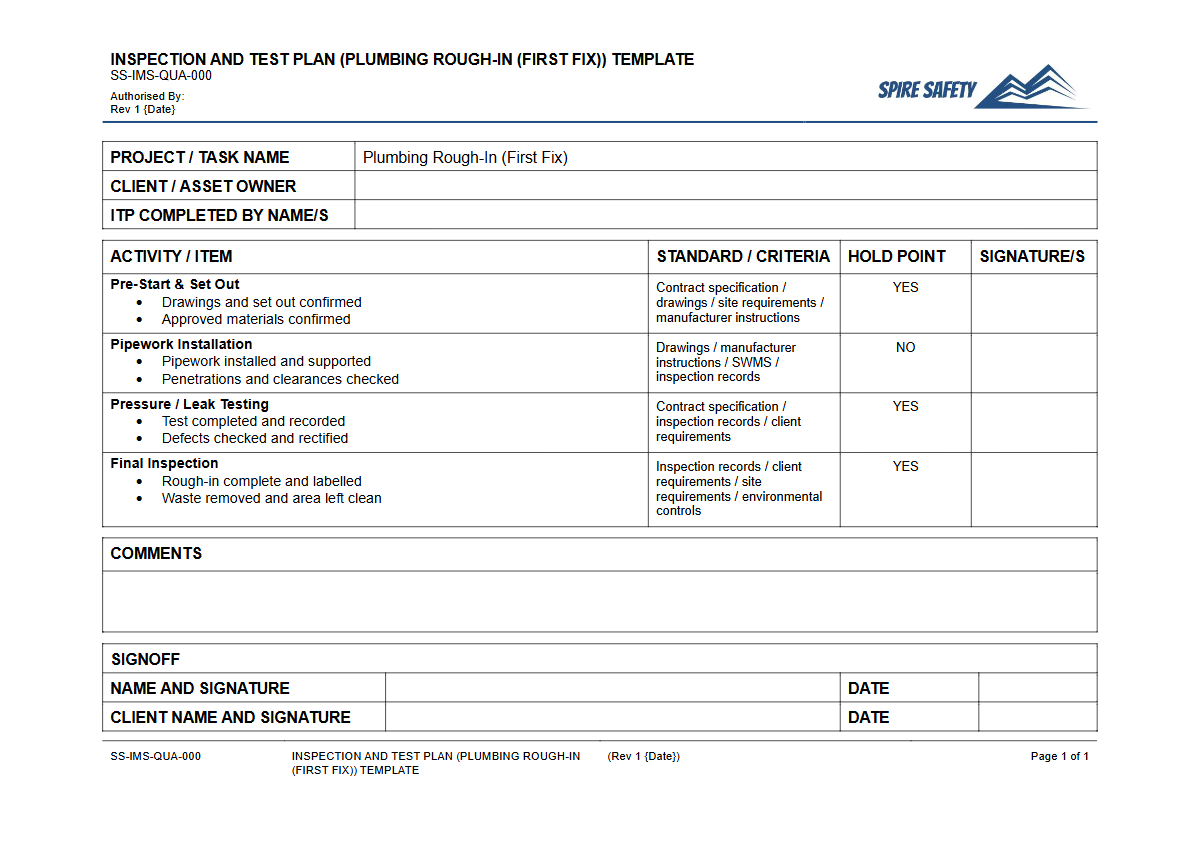
This Free Inspection & Test Plan (Plumbing Rough-In (First Fix)) Template provides a structured framework for documenting and verifying the critical stages of plumbing installation before walls, floors, and ceilings are closed up. Its primary purpose is to ensure that all 'first fix' plumbing work—including drainage, water lines, and in-wall components—is completed in accordance with the project specifications, the Plumbing Code of Australia (PCA), and relevant Australian Standards.
By implementing a formal ITP, project managers and supervisors can systematically confirm that materials, installation methods, and testing procedures meet the required quality benchmarks. This proactive approach to quality assurance helps prevent costly defects, rework, and potential water damage that can arise from faulty installations.
It serves as a permanent record of due diligence, providing clear evidence that each stage of the rough-in was correctly installed and inspected. Ensuring safety on site is also paramount, and this should be supported by clear communication through tools like plumbing safety toolbox talks.
Benefits of a Formal Plumbing ITP
- Reduced Defects: Catches non-conformances early, before they become major, expensive problems.
- Improved Compliance: Creates a clear, auditable trail demonstrating adherence to the National Construction Code (NCC) and other regulations.
- Clear Communication: Establishes defined quality expectations for plumbers, builders, and supervisors, reducing ambiguity about standards.
- Enhanced Project Handover: Provides documented proof of quality for clients, certifiers, and subsequent trades.
- Risk Mitigation: Minimises the risk of leaks, drainage failures, and other issues that can lead to significant structural damage or health hazards. For any incidents that do occur, having robust first aid procedures is essential.
Video walkthrough
How to use the Free Inspection & Test Plan (Plumbing Rough-In (First Fix)) Template
This template is available as a DOCX file for easy customisation and a PDF for straightforward viewing and printing. To use it effectively, you should first review all project-specific documentation, including architectural and engineering drawings, the hydraulic services specification, and any local council requirements.
The checkpoints listed in the template are a general guide and must be adapted to your project's unique context.
Please note: This document is a template and must be customised to suit the specific requirements of your project, site conditions, and relevant regulations. We provide it as a starting point, not a finished, document.
Its use should form part of your overall quality and safety management processes.
Key Sections of the ITP
The template guides you to define the necessary checks at each stage. Key columns you will need to complete include:
- Activity/Task: A description of the specific work being inspected (e.g., 'Install sanitary drainage under slab').
- Inspection/Test Type: The nature of the check, such as a Hold Point (work cannot proceed without sign-off), Witness Point (inspector must be notified), or Surveillance (random spot check).
- Acceptance Criteria: The standard the work must meet (e.g., 'Pipe grade to be 1:60 as per AS/NZS 3500.2').
- Verification Records: The documentation required to prove compliance (e.g., photos, test certificate, sign-off sheet).
Integrating such detailed procedures is a hallmark of strong comprehensive WHS management systems, linking quality control directly to safe and compliant work outcomes.
When to use it
An Inspection & Test Plan for plumbing rough-in should be developed and approved before any first fix plumbing work commences on a construction site. It is a live document used throughout the rough-in phase of a project, from initial under-slab drainage installation to the pre-lining inspection of all in-wall water and sanitary lines.
It is an essential tool for residential, commercial, and industrial construction projects.
The completed ITP records serve as crucial evidence during project milestones and are often required for stage-gate approvals or certification. These records are invaluable during formal WHS compliance auditing, as they provide tangible proof that processes were followed and standards were met.
Who should use it
This template is designed for use by various personnel involved in the construction and oversight of plumbing works. It helps ensure accountability and a shared understanding of quality requirements across the project team. Key users include:
- Licensed Plumbers & Plumbing Contractors: To guide their work and self-verify installations against project standards.
- Site Supervisors & Foremen: To manage quality control on-site and sign off on completed stages.
- Project Managers: To oversee the quality assurance process and ensure project milestones are met without defects.
- Builders & Principal Contractors: To fulfil their responsibility for the overall quality and compliance of all subcontracted work.
- QA/QC Personnel: To formally conduct inspections and manage non-conformance reporting.
For organisations looking to embed such processes more deeply into their operations, engaging with specialist WHS consulting can help align documentation with broader safety and quality objectives.
Common mistakes
Common mistakes to avoid
- Failing to reference the correct version of the Plumbing Code of Australia (PCA) or relevant Australian Standards.
- Inadequate photographic evidence of completed work, especially for stages that will be covered up.
- Proceeding past a designated 'Hold Point' without obtaining the required sign-off from the supervisor or inspector.
- Not checking that pipe grades for drainage are correct before backfilling or enclosing.
Legal references
Legal considerations
The following legal requirements may be relevant to this type of work.
- Work Health and Safety Act (Harmonised) — Provides the primary duties for protecting workers and other people from work health and safety risks.
- Work Health and Safety Regulations (Harmonised) — Sets out requirements supporting the management of workplace hazards and risks.
The following codes may be relevant to this type of work.
- Managing WHS Risks Code of Practice — Provides practical guidance on identifying hazards, assessing risks and applying effective controls.
- Work Health and Safety Consultation, Cooperation and Coordination Code of Practice — Provides practical guidance on consulting workers and coordinating with other duty holders.
- Managing the Work Environment and Facilities Code of Practice — Provides practical guidance on safe work environments, workplace facilities and related controls.
Did you know
Water Hammer
Incorrectly secured pipes are a primary cause of 'water hammer' – a noisy, damaging hydraulic shockwave that occurs when water flow is suddenly stopped. A proper rough-in inspection verifies that all pipes are adequately clipped and supported.
The Cost of Leaks
A small, undetected leak from a single pipe joint can cause thousands of dollars in water damage to framing, plasterboard, and flooring. ITPs help catch these potential issues before they are sealed within walls or floors.
FAQ
Frequently asked questions
01What is the difference between a 'Hold Point' and a 'Witness Point' in an ITP?
02Is this ITP template suitable for both drainage and water supply rough-in?
03Does this template cover gas fitting?
04What happens if an inspection fails at a checkpoint?
Share this resource
Free Inspection & Test Plan (Plumbing Rough-In (First Fix)) Template
Browse Categories
How To Use It
- 1Download and open in Word or PDF.
- 2Replace the placeholders with your business details.
- 3Get it reviewed by a WHS specialist before rollout.
Need it customised?
Our WHS consultants can adapt this template to your site, run a gap analysis, or audit what you already have in place.
Book a Free Consultation WHS consulting servicesor call 1300 156 382
Related templates
- Free Inspection & Test Plan (Plumbing Second Fix Fit off) Template
- Free Inspection & Test Plan (Polished Concrete Floor) Template
- Free Inspection & Test Plan (Post-Tensioned Slab) Template
- Free Inspection & Test Plan (Practical Completion Inspection) Template
- Free Inspection & Test Plan (Precast Panel) Template
- Free Inspection & Test Plan (Reinforcement Steel Fixing) Template