
Free Inspection & Test Plan (Practical Completion Inspection) Template
Download our free Inspection & Test Plan for Practical Completion Inspections. This DOCX template helps standardise your construction project handovers.
Free Inspection & Test Plan (Practical Completion Inspection) Template
DOCX • 139 KB + PDF
Updated Oct 2026
No signup required
Purpose of the Free Inspection & Test Plan (Practical Completion Inspection) Template
A Practical Completion Inspection is a critical milestone in any construction or engineering project. It marks the point where the works are deemed complete, allowing for handover to the client.
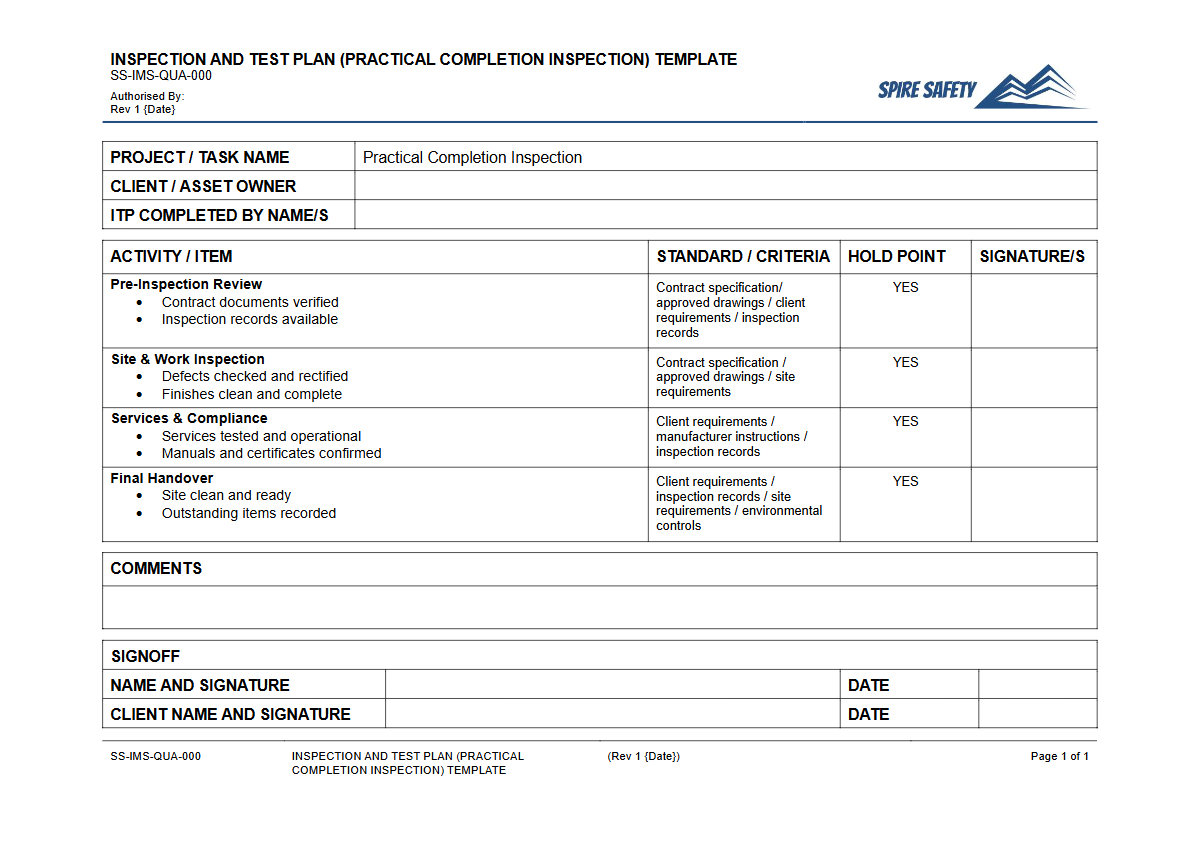
This free Inspection & Test Plan (Practical Completion Inspection) Template provides a structured framework for verifying that all project specifications, quality standards, and safety requirements have been met before this handover occurs. Using a formal ITP ensures a systematic, documented approach to final inspections, reducing the risk of disputes and demonstrating due diligence.
The template helps translate project requirements into a series of checkable items, each with defined acceptance criteria, verification methods, and responsibilities. It formalises the process of confirming that everything from structural integrity to final finishes complies with the contract and relevant Australian Standards.
Implementing such a plan is a core part of effective WHS management systems, linking quality control directly to safety outcomes.
Video walkthrough
How to use the Free Inspection & Test Plan (Practical Completion Inspection) Template
This template is provided in an easily editable DOCX format to allow for full customisation. To use it effectively, follow these steps:
- Review Project Specifications: Begin by thoroughly reviewing all contractual documents, architectural drawings, engineering specifications, and applicable building codes or standards.
- Customise Inspection Items: Populate the ITP with specific line items for every element that needs to be inspected. This could include structural components, electrical systems, plumbing, HVAC, fire safety systems, finishes, and external works.
- Define Criteria and Responsibilities: For each item, clearly define the acceptance criteria. Assign responsibility for conducting the inspection (e.g., Site Supervisor), witnessing it (e.g., Client Representative), and signing off. Define hold points (work cannot proceed without sign-off) and witness points (inspection is required, but work can continue).
- Execute and Document: Conduct the inspections as scheduled, documenting all results, signatures, and dates directly in the plan. Attach supporting evidence like photos, test certificates, or compliance statements as needed.
Important: You must customise this template to suit the unique requirements of your project, site, and jurisdiction. We are not liable for any issues that arise from using this document as-is.
It serves as a starting point, not a complete solution. For specific tasks within a project, other detailed documents may be required, similar to how one might use a dedicated WHS Inspection (Vehicle Workshop) Template for a fit-out.
When to use an Inspection & Test Plan
The Practical Completion ITP is used at the very end of the construction phase, immediately before the project is handed over. It is the final verification process that triggers the Practical Completion Certificate.
However, the principles of an ITP can be applied throughout the project lifecycle. Staged ITPs can be used to sign off on critical milestones, such as the completion of foundations, structural lock-up, or services rough-in.
This progressive assurance helps prevent defects from being covered up by subsequent works.
This final inspection serves as a key part of the project's quality assurance record. The completed ITP provides auditable proof that due process was followed, which is invaluable for contractual compliance and can be a key piece of evidence during formal WHS compliance auditing.
Who should use this template
This template is designed for use by a range of personnel involved in managing and overseeing construction and engineering projects. Key users include:
- Project Managers: To ensure contractual obligations for completion are met.
- Construction Managers & Site Supervisors: To manage the day-to-day inspection process on site.
- Quality Assurance / Quality Control (QA/QC) Officers: To formalise and document quality verification activities.
- Principal Contractors: To verify the work of subcontractors before accepting it.
- Client-side Project Managers & Superintendents: To confirm they are receiving a compliant and complete asset.
The process also involves ensuring that all aspects of the completed work are safe for end-users, covering everything from structural stability to ergonomic hazards. For example, final checks should confirm that installed items do not introduce new manual handling risks, a topic also covered in resources like our Healthy Backs - Posture and Lifting Toolbox Talk Template. In high-risk environments, ITPs form part of a larger risk management framework that might include principal hazard management plans.
By providing a clear, documented record of completion, this ITP helps protect all parties and ensures a smooth and professional project handover. For more templates and safety documents, browse our complete free WHS resources library.
Common mistakes
Common mistakes to avoid
- Using a generic ITP without customising it for the project's specific plans and specifications.
- Failing to define clear, measurable, and objective acceptance criteria for each inspection item.
- Not obtaining formal, documented sign-offs at designated hold points, leading to future disputes.
- Treating the ITP as a paper-shuffling exercise rather than a genuine quality and safety verification process.
Legal references
Legal considerations
The following legal requirements may be relevant to this type of work.
- Work Health and Safety Act (Harmonised) — Provides the primary duties for protecting workers and other people from work health and safety risks.
- Work Health and Safety Regulations (Harmonised) — Sets out requirements supporting the management of workplace hazards and risks.
The following codes may be relevant to this type of work.
- Managing WHS Risks Code of Practice — Provides practical guidance on identifying hazards, assessing risks and applying effective controls.
- Work Health and Safety Consultation, Cooperation and Coordination Code of Practice — Provides practical guidance on consulting workers and coordinating with other duty holders.
- Managing the Work Environment and Facilities Code of Practice — Provides practical guidance on safe work environments, workplace facilities and related controls.
Did you know
Contractual Milestone
Practical Completion is a formal term in Australian standard construction contracts. Reaching this milestone typically triggers the start of the defects liability period and the release of performance bonds.
Dispute Resolution
A thoroughly completed and signed ITP serves as powerful evidence in the event of contractual disputes, providing a clear record of what was inspected, by whom, and when it was accepted.
FAQ
Frequently asked questions
01What is the difference between an Inspection & Test Plan (ITP) and a simple checklist?
02Who typically signs off on a Practical Completion ITP?
03Can this ITP template be used for small residential construction projects?
04What are 'hold points' and 'witness points' in an ITP?
Share this resource
Free Inspection & Test Plan (Practical Completion Inspection) Template
Browse Categories
How To Use It
- 1Download and open in Word or PDF.
- 2Replace the placeholders with your business details.
- 3Get it reviewed by a WHS specialist before rollout.
Need it customised?
Our WHS consultants can adapt this template to your site, run a gap analysis, or audit what you already have in place.
Book a Free Consultation WHS consulting servicesor call 1300 156 382
Related templates
- Free Inspection & Test Plan (Precast Panel) Template
- Free Inspection & Test Plan (Reinforcement Steel Fixing) Template
- Free Inspection & Test Plan (Retaining Wall Construction) Template
- Free Inspection & Test Plan (Roof Flashings and Cappings) Template
- Free Inspection & Test Plan (Roof Membrane Waterproofing) Template
- Free Inspection & Test Plan (Roof Truss Installation) Template