
Free Inspection & Test Plan (Planter Box Waterproofing) Template
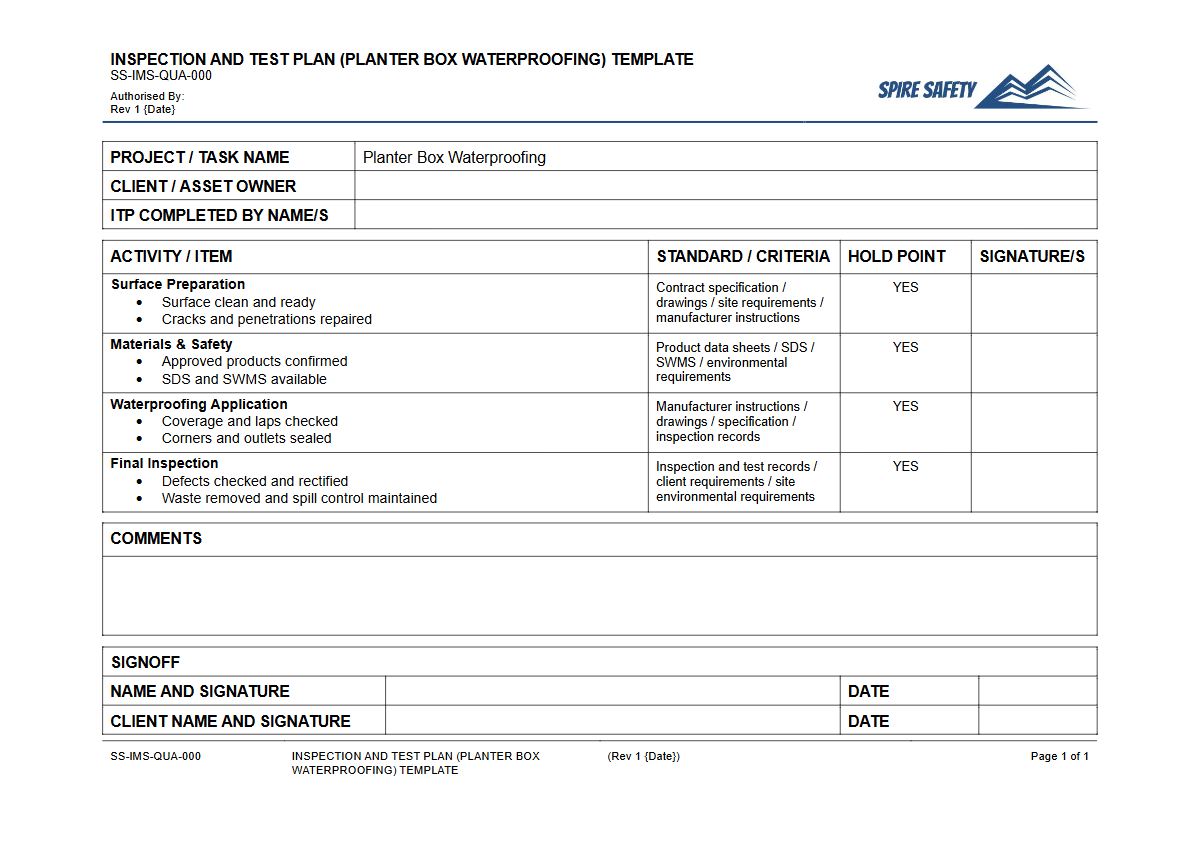
Download our free Inspection & Test Plan (Planter Box Waterproofing) Template. This DOCX & PDF resource helps ensure quality at every stage. Get started.
Free Inspection & Test Plan (Planter Box Waterproofing) Template
DOCX • 134 KB + PDF
Updated Oct 2026
No signup required
Purpose of the Free Inspection & Test Plan (Planter Box Waterproofing) Template
This Free Inspection & Test Plan (Planter Box Waterproofing) Template provides a structured framework for ensuring waterproofing works on planter boxes are completed to the required quality standards and project specifications. An ITP is a critical quality assurance document used to define the sequence of inspections, tests, and verifications needed at each stage of the construction process.
Its primary purpose is to prevent defects, which are notoriously difficult and expensive to rectify once a planter is filled and landscaped.
By methodically outlining hold points, witness points, and surveillance checks, the ITP helps project teams verify that all activities—from substrate preparation to final flood testing—comply with the manufacturer's requirements and Australian Standards. Implementing a formal ITP demonstrates a commitment to quality control and can be a core component of your broader WHS management systems.
Video walkthrough
How to use the Free Inspection & Test Plan (Planter Box Waterproofing) Template
This template serves as a comprehensive starting point, designed for customisation to fit your specific project needs. After downloading the DOCX file, you should adapt it by incorporating details from your project's architectural plans, the waterproofing membrane manufacturer's technical data sheets, and relevant building codes.
The process involves:
- Reviewing Project Documents: Thoroughly examine all specifications, drawings, and product guidelines.
- Customising Activities: Populate the ITP with the specific tasks, checks, and tests for your project. This includes substrate moisture testing, primer application checks, membrane thickness verification, and detailing around penetrations.
- Assigning Responsibilities: Clearly define who is responsible for performing, witnessing, and approving each check (e.g., Waterproofing Contractor, Site Supervisor, Principal Contractor, Consultant).
- Defining Acceptance Criteria: Specify the standards or measurements that must be met for each task to be considered complete and compliant.
Proper use of this document helps create an auditable record of quality control activities, which is invaluable for handover and for any future WHS compliance auditing.
A Note on Customisation
This Inspection & Test Plan is a template and must be customised to your specific project, materials, site conditions, and legal requirements. We are not liable for any issues arising from the use of this un-customised template.
It is the user's responsibility to ensure the final document is fit for purpose.
When to use it
An ITP for planter box waterproofing should be developed and approved before any physical work commences. It should be introduced during pre-construction meetings with all relevant parties, including the builder, waterproofing contractor, and project manager, to ensure everyone understands the quality expectations and verification processes.
The ITP is a live document used throughout the waterproofing installation. It is referenced daily by site supervisors to manage progress and is formally signed off at each hold point, providing a progressive record of compliance.
If your organisation needs assistance integrating such processes into your projects, consider engaging expert WHS consulting services.
Who should use it
This template is designed for a range of construction and project management professionals involved in ensuring the quality and durability of building works. Key users include:
- Project Managers: To oversee quality control and ensure project milestones are met without defects.
- Site Supervisors & Foremen: For day-to-day management and verification of waterproofing works on site.
- Quality Assurance / Quality Control (QA/QC) Managers: To implement and monitor the project's quality management plan.
- Waterproofing Contractors: To demonstrate that their work meets the required standards and to manage their own internal quality processes.
- Builders and Principal Contractors: To fulfil their responsibility for the overall quality of the construction project.
For organisations seeking formal certification, integrating ITPs into daily operations is a key step towards achieving standards like ISO 9001 or aligning with the principles of ISO 45001 consulting for safety management. You can find more tools to support your safety and quality programs in our free WHS resources library.
Common mistakes
Common mistakes to avoid
- Failing to adequately prepare the substrate (e.g., not cleaning, drying, or patching it correctly).
- Applying the membrane in unsuitable weather conditions (e.g., too hot, cold, or during rain).
- Skipping the flood test or conducting it for an insufficient duration (typically 24-48 hours).
- Damaging the newly applied membrane during backfilling or installation of protection boards.
Legal references
Legal considerations
The following legal requirements may be relevant to this type of work.
- Work Health and Safety Act (Harmonised) — Provides the primary duties for protecting workers and other people from work health and safety risks.
- Work Health and Safety Regulations (Harmonised) — Sets out requirements supporting the management of workplace hazards and risks.
The following codes may be relevant to this type of work.
- Managing WHS Risks Code of Practice — Provides practical guidance on identifying hazards, assessing risks and applying effective controls.
- Work Health and Safety Consultation, Cooperation and Coordination Code of Practice — Provides practical guidance on consulting workers and coordinating with other duty holders.
- Managing the Work Environment and Facilities Code of Practice — Provides practical guidance on safe work environments, workplace facilities and related controls.
Did you know
Cost of Failure
Waterproofing defects are one of the most common and costly building issues in Australia, often accounting for a significant portion of post-construction defect claims. A robust ITP is a key preventative measure.
FAQ
Frequently asked questions
01What is an Inspection and Test Plan (ITP) for waterproofing?
02Are 'hold points' and 'witness points' the same in an ITP?
03Does this template cover specific waterproofing membrane products?
04Who is responsible for signing off on the ITP?
Share this resource
Free Inspection & Test Plan (Planter Box Waterproofing) Template
Browse Categories
How To Use It
- 1Download and open in Word or PDF.
- 2Replace the placeholders with your business details.
- 3Get it reviewed by a WHS specialist before rollout.
Need it customised?
Our WHS consultants can adapt this template to your site, run a gap analysis, or audit what you already have in place.
Book a Free Consultation WHS consulting servicesor call 1300 156 382
Related templates
- Free Inspection & Test Plan (Plasterboard Lining) Template
- Free Inspection & Test Plan (Plastering Rendering) Template
- Free Inspection & Test Plan (Plumbing Drainage) Template
- Free Inspection & Test Plan (Plumbing Rough-In (First Fix)) Template
- Free Inspection & Test Plan (Plumbing Second Fix Fit off) Template
- Free Inspection & Test Plan (Polished Concrete Floor) Template