
Free Inspection & Test Plan (Pavement Road Base) Template
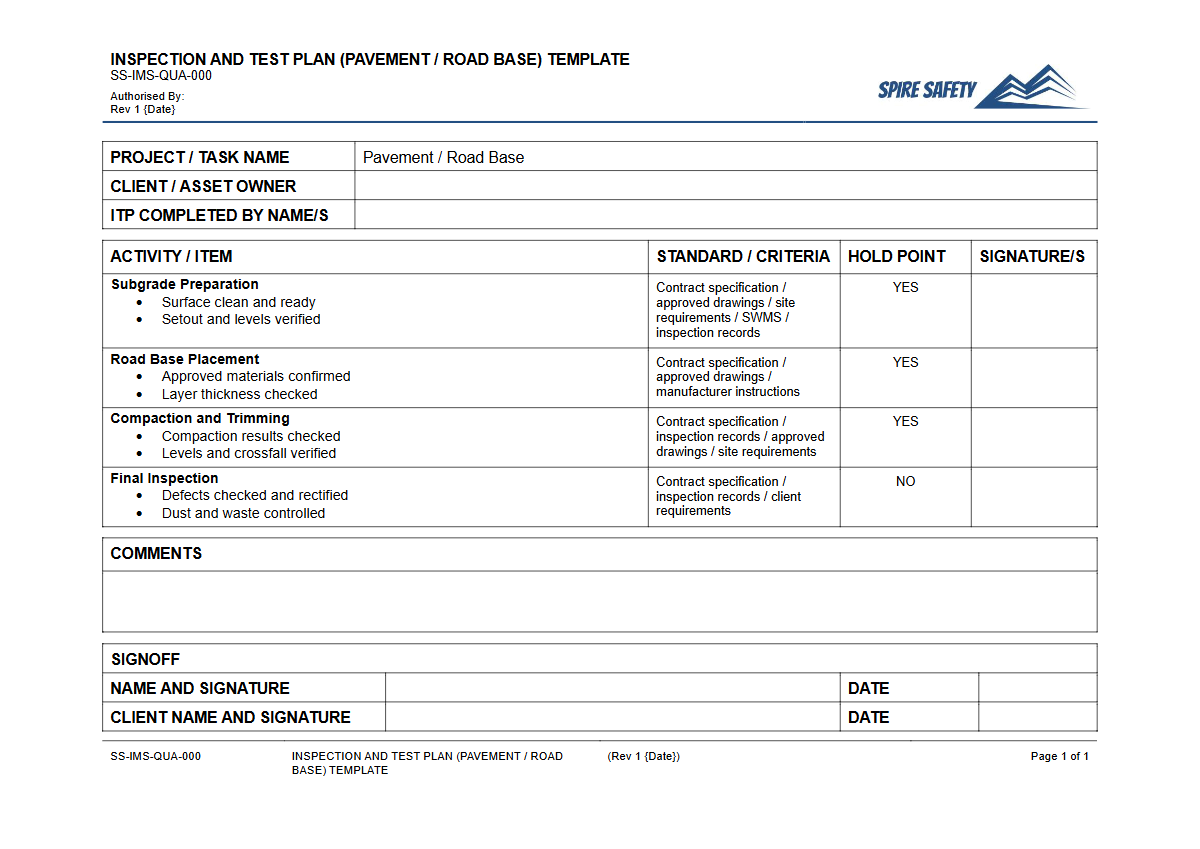
Download our free Inspection & Test Plan (Pavement Road Base) template. This structured DOCX and PDF helps ensure quality control for road base works.
Free Inspection & Test Plan (Pavement Road Base) Template
DOCX • 139 KB + PDF
Updated Oct 2026
No signup required
Purpose of the Free Inspection & Test Plan (Pavement Road Base) Template
An Inspection & Test Plan (ITP) for pavement road base is a critical quality management tool. Its primary purpose is to define the sequence of inspections and tests required to ensure the final product complies with the design and specification.
It acts as a roadmap for your quality control team, outlining every key verification step from subgrade preparation to final trimming. Using a structured ITP helps prevent costly rework, manages project risk, and provides auditable evidence of quality compliance. It also integrates with site safety protocols, which can be managed using our free Road Construction SWMS (Safe Work Method Statement) Template.
Video walkthrough
How to use the Free Inspection & Test Plan (Pavement Road Base) Template
This template is provided in both DOCX and PDF formats for easy customisation. It organises inspection activities by stage, detailing the characteristic to be checked, the acceptance criteria (often referencing a specific clause in a standard or specification), the type of inspection (e.g., Hold Point, Witness Point, Surveillance), and the records to be maintained.
You should review each line item and adjust it to match your project's unique requirements, including client specs, engineering drawings, and local council standards.
Important: This is a template, not a completed procedure. We have created it as a structured starting point, but you must customise it to suit your specific site, materials, plant, and project specifications.
Effectively implemented, these documents form a key part of how you can integrate into your WHS management systems and quality frameworks.
When to use an Inspection & Test Plan
This Inspection & Test Plan should be prepared before any road base construction work begins and implemented throughout the entire process. It is a live document used by site personnel daily. Key stages for its application include:
- Pre-commencement: Verifying material certificates and stockpile compliance from the source. This is crucial for managing hazards at the quarry source.
- Subgrade Preparation: Checking compaction, levels, and stability of the ground beneath the road base.
- Pavement Placement: Monitoring layer thickness, moisture content, and spreading techniques.
- Compaction: Testing for density using methods like a nuclear densometer to ensure it meets the specified requirements.
- Final Trim: Verifying the final surface levels and shape before sealing or asphalting.
Who should use this document
This ITP is essential for a range of personnel involved in civil construction and infrastructure projects. Key users include:
- Project Managers: For overall quality and project schedule oversight.
- Site Engineers & Supervisors: For day-to-day execution and verification of works on site.
- Quality Assurance (QA) Managers: To ensure processes are followed and documented correctly.
- Foremen: To guide their crews on the specific quality requirements at each stage.
- Third-party auditors: As a primary document during internal or external WHS compliance auditing processes.
By providing a clear framework for all parties, the ITP ensures everyone understands their role in delivering a quality product. This clarity helps in achieving project goals and can be a significant factor when aiming for continuous improvement or achieving ISO 45001 certification.
This Inspection & Test Plan is just one of many tools designed to improve workplace safety and compliance. For more templates and guides, explore our full free WHS resources library.
Common mistakes
Common mistakes to avoid
- Skipping witness points to save time, leading to non-conformances and rework.
- Using uncalibrated testing equipment (e.g., nuclear densometers), resulting in inaccurate readings.
- Failing to get formal sign-off on hold points, which can cause contractual disputes.
- Not adapting the generic ITP template to specific site conditions or client requirements.
Legal references
Legal considerations
The following legal requirements may be relevant to this type of work.
- Work Health and Safety Act (Harmonised) — Provides the primary duties for protecting workers and other people from work health and safety risks.
- Work Health and Safety Regulations (Harmonised) — Sets out requirements supporting the management of workplace hazards and risks.
The following codes may be relevant to this type of work.
- Managing WHS Risks Code of Practice — Provides practical guidance on identifying hazards, assessing risks and applying effective controls.
- Work Health and Safety Consultation, Cooperation and Coordination Code of Practice — Provides practical guidance on consulting workers and coordinating with other duty holders.
- Managing the Work Environment and Facilities Code of Practice — Provides practical guidance on safe work environments, workplace facilities and related controls.
Did you know
Compaction is Key
A poorly compacted road base can reduce a pavement's lifespan by over 50%. Proper testing and verification, as outlined in an ITP, are critical to long-term performance.
Material Source Matters
The properties of road base materials can vary significantly between quarries. An ITP ensures that all delivered material is tested and meets the strict specifications required for the project.
FAQ
Frequently asked questions
01What is an Inspection and Test Plan (ITP)?
02What is a 'hold point' in an ITP?
03Is this pavement road base ITP template suitable for all projects?
04How does an ITP relate to a Safe Work Method Statement (SWMS)?
Share this resource
Free Inspection & Test Plan (Pavement Road Base) Template
Browse Categories
How To Use It
- 1Download and open in Word or PDF.
- 2Replace the placeholders with your business details.
- 3Get it reviewed by a WHS specialist before rollout.
Need it customised?
Our WHS consultants can adapt this template to your site, run a gap analysis, or audit what you already have in place.
Book a Free Consultation WHS consulting servicesor call 1300 156 382
Related templates
- Free Inspection & Test Plan (Piling and Pier Installation) Template
- Free Inspection & Test Plan (Pipeline Installation) Template
- Free Inspection & Test Plan (Planter Box Waterproofing) Template
- Free Inspection & Test Plan (Plasterboard Lining) Template
- Free Inspection & Test Plan (Plastering Rendering) Template
- Free Inspection & Test Plan (Plumbing Drainage) Template