
Free Inspection & Test Plan (Piling and Pier Installation) Template
Ensure quality and safety in your piling and pier installation projects. Our free Inspection & Test Plan template provides a structured starting point.
Free Inspection & Test Plan (Piling and Pier Installation) Template
DOCX • 137 KB + PDF
Updated Oct 2026
No signup required
Purpose of the Free Inspection & Test Plan (Piling and Pier Installation) Template
Piling and pier installation are high-risk construction activities that form the critical foundation of a structure. Any errors in design, materials, or execution can have severe consequences for structural integrity and safety.
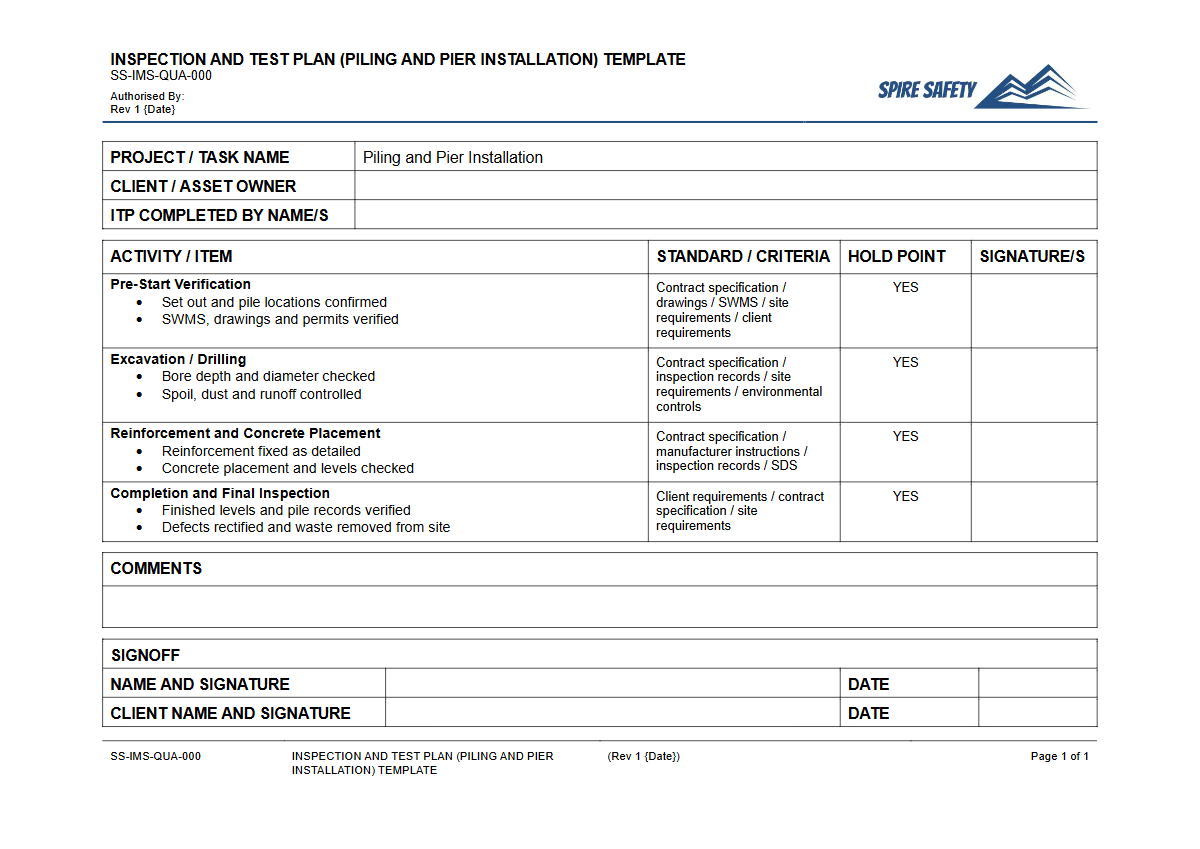
This Free Inspection & Test Plan (Piling and Pier Installation) Template provides a structured framework for documenting and verifying every crucial stage of the process, from initial set-out to final testing. Using an ITP is a fundamental practice for quality assurance, helping to ensure that all work complies with engineering specifications, geotechnical reports, and Australian Standards.
An ITP formalises the quality control process by defining the specific checks, tests, and verifications required. It outlines key hold points (work cannot proceed without sign-off), witness points (inspections that must be witnessed by specific personnel), and surveillance points (routine checks).
This systematic approach is essential for managing complex projects and serves as a key piece of evidence in your project's quality and safety records. Properly managing these steps is a core part of your duty of care, similar to how operators must develop Principal Mining Hazard Management Plans for other high-risk ground-based work.
Video walkthrough
How to use the Free Inspection & Test Plan (Piling and Pier Installation) Template
This template is provided in both DOCX and PDF formats to serve as a comprehensive starting point. To use it effectively, you must adapt it to the unique requirements of your specific project.
This involves a detailed review of the project's structural and geotechnical engineering drawings and specifications. The plan should be integrated into your overall project management documentation and used as a live document on-site by engineers, supervisors, and quality personnel.
IMPORTANT: This is a template only. We are not your safety advisors.
You must customise this document to the specific equipment, processes, personnel, and risks of your workplace and projects. It should be reviewed and approved by a competent person, such as a chartered professional engineer, before use.
Customisation Steps:
- Project Details: Fill in all project-specific information, including project name, location, and relevant drawing and specification numbers.
- Define Activities: List all sequential activities involved in the piling process, such as rig set-up, pile location survey, drilling or driving, steel reinforcement placement, concrete or grout pouring, and pile trimming.
- Set Inspection Points: For each activity, determine the type of verification required (Hold, Witness, Surveillance) and the acceptance criteria based on project specifications and relevant Australian Standards (e.g., AS 2159).
- Assign Responsibilities: Clearly nominate the roles responsible for carrying out and signing off on each inspection and test (e.g., Site Engineer, Geotechnical Engineer, Superintendent, Third-Party Inspector).
- Records: Specify the record or document that will be generated for each check, such as a daily pile record, concrete batch ticket, or non-destructive testing report.
An effective ITP doesn't exist in isolation; it is a critical tool within broader WHS management systems that govern project quality and safety from start to finish. This ensures that procedures are not just documented, but consistently implemented and reviewed.
When to use an Inspection & Test Plan
An Inspection & Test Plan for piling and pier installation should be developed during the project planning phase, well before any physical work commences on site. It should be reviewed and agreed upon by all key stakeholders, including the principal contractor, subcontractors, and the client's engineering representatives.
The ITP is then used daily throughout the construction phase to guide and record quality control activities. It becomes part of the final handover documentation, providing a complete record of quality verification for the building's foundation.
The plan also covers ancillary but critical checks, such as verifying plant and equipment are safe for use. Regular equipment inspections are a key part of site safety, not unlike the process detailed in our Free WHS Inspection (Vehicle Workshop) Template, but adapted for heavy construction machinery like piling rigs and concrete pumps.
Who should use this ITP Template
This template is designed for use by a range of professionals involved in the management and execution of civil and structural construction projects. Key users include:
- Project Managers and Construction Managers: For overall project quality oversight and to ensure contractual requirements are met.
- Site Engineers and Geotechnical Engineers: For executing and documenting on-the-ground inspections and tests according to design specifications.
- Quality Assurance / Quality Control (QA/QC) Managers and Inspectors: As their primary tool for implementing the project's quality management plan.
- WHS Advisors and Safety Officers: To ensure that safety-critical steps, such as rig stability checks and excavation safety, are formally integrated into the workflow.
- Principal Contractors and Subcontractors: To clarify quality expectations and responsibilities for foundation works.
Ultimately, the ITP serves as the backbone for quality on site. Its diligent use and maintenance are often a key focus during third-party evaluations, making robust documentation essential for demonstrating compliance and best practice during WHS compliance auditing.
For more tools to help formalise your safety processes, browse our complete free WHS resources library, which includes a wide range of checklists, plans, and templates for the construction industry.
Common mistakes
Common mistakes to avoid
- Failing to define clear, measurable acceptance criteria for each inspection point.
- Using a generic ITP without customising it for project-specific geotechnical reports and structural designs.
- Inadequate record-keeping, leading to gaps in quality assurance documentation and traceability.
- Not clearly assigning responsibility for each inspection, witness, and hold point.
Legal references
Legal considerations
The following legal requirements may be relevant to this type of work.
- Work Health and Safety Act (Harmonised) — Provides the primary duties for protecting workers and other people from work health and safety risks.
- Work Health and Safety Regulations (Harmonised) — Sets out requirements supporting the management of workplace hazards and risks.
The following codes may be relevant to this type of work.
- Managing WHS Risks Code of Practice — Provides practical guidance on identifying hazards, assessing risks and applying effective controls.
- Work Health and Safety Consultation, Cooperation and Coordination Code of Practice — Provides practical guidance on consulting workers and coordinating with other duty holders.
- Managing the Work Environment and Facilities Code of Practice — Provides practical guidance on safe work environments, workplace facilities and related controls.
Did you know
Geotechnical Surprises
A significant percentage of construction project variations and disputes are linked to unforeseen ground conditions. A thorough ITP helps manage and document how these conditions are handled during piling, providing crucial evidence of proper process.
Pile Integrity Testing
Non-destructive testing methods like Pile Integrity Testing (PIT) or Crosshole Sonic Logging (CSL) can assess the structural integrity of a pile after installation, verifying the quality of work documented in the ITP.
FAQ
Frequently asked questions
01What is the difference between a hold point and a witness point in an ITP?
02Does this ITP template cover all types of piling?
03Who is responsible for signing off on an Inspection and Test Plan for piling?
04How often should a piling ITP be reviewed?
Share this resource
Free Inspection & Test Plan (Piling and Pier Installation) Template
Browse Categories
How To Use It
- 1Download and open in Word or PDF.
- 2Replace the placeholders with your business details.
- 3Get it reviewed by a WHS specialist before rollout.
Need it customised?
Our WHS consultants can adapt this template to your site, run a gap analysis, or audit what you already have in place.
Book a Free Consultation WHS consulting servicesor call 1300 156 382
Related templates
- Free Inspection & Test Plan (Pipeline Installation) Template
- Free Inspection & Test Plan (Planter Box Waterproofing) Template
- Free Inspection & Test Plan (Plasterboard Lining) Template
- Free Inspection & Test Plan (Plastering Rendering) Template
- Free Inspection & Test Plan (Plumbing Drainage) Template
- Free Inspection & Test Plan (Plumbing Rough-In (First Fix)) Template