
Free WHS Inspection (Resource Recovery) Template
Download our free WHS Inspection (Resource Recovery) Template.
Free WHS Inspection (Resource Recovery) Template
DOCX • 127 KB + PDF
Updated Oct 2026
No signup required
Purpose of the Free WHS Inspection (Resource Recovery) Template
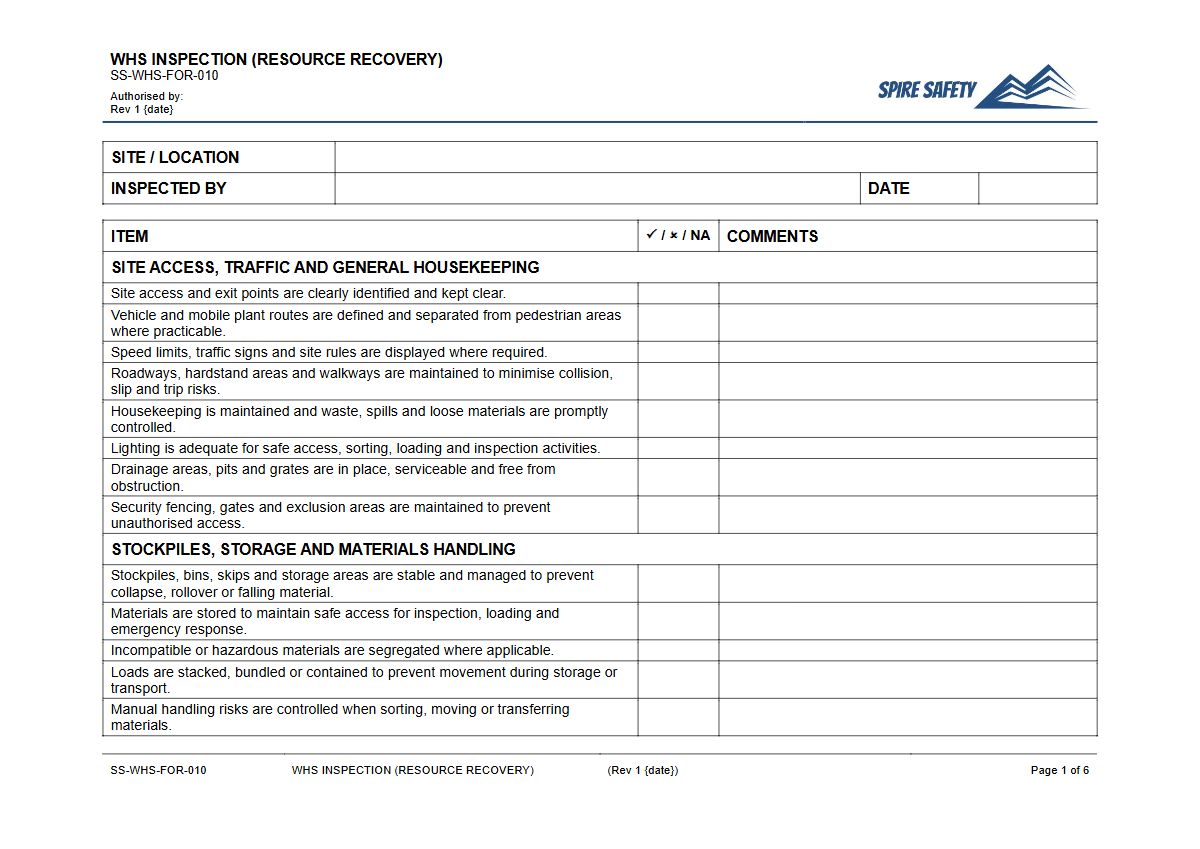
Resource recovery and recycling facilities present a unique and complex range of work health and safety risks. This Free WHS Inspection (Resource Recovery) Template provides a structured starting point for systematically identifying and managing hazards in your workplace.
Regular inspections are a fundamental component of any effective safety management system, helping your organisation proactively address issues before they lead to incidents. Using this template helps to formalise the process, ensuring that key areas—from tipping floors and sorting lines to balers and storage areas—are regularly assessed.
The goal is to create a documented record of your safety diligence, demonstrate commitment to WHS obligations, and foster a safer working environment for everyone on site. Integrating these checks is a practical step towards building robust WHS management systems that protect your workers and your business.
The template guides you to look for common hazards such as unguarded machinery, traffic management failures, fire risks, and poor housekeeping.
Video walkthrough
How to use the Free WHS Inspection (Resource Recovery) Template
This template is designed for ease of use. First, download the document in your preferred format (DOCX or PDF).
The DOCX version is fully editable, allowing for extensive customisation. The primary task is to adapt the checklist to the specific circumstances of your facility.
Walk through your site and add, remove, or modify checklist items to reflect the actual plant, equipment, materials, and work processes you manage. This might include adding checkpoints for specific types of conveyors, shredders, or mobile plant used in your operations.
Important: It is vital to customise this template for your specific site layout, machinery, and procedures. We have provided a comprehensive starting point aligned with Australian WHS principles, but you must adapt it to reflect the unique hazards and control measures of your workplace.
If you require assistance with this process, consider engaging specialist WHS consulting services.
When to use it
The frequency of inspections should be determined by risk. High-risk areas, such as vehicle interaction zones, tipping floors, and areas with moving plant, should be inspected more frequently—perhaps daily or weekly.
Lower-risk areas, like administrative offices, might only require monthly inspections. This template should also be used after an incident or near miss, when new machinery or processes are introduced, or when changes are made to the workplace layout.
Regular, scheduled inspections ensure that safety controls remain effective and that new hazards are identified promptly.
For specific pieces of machinery, a daily check is often required before use. While this general template is useful for area inspections, you might complement it with a more specific document like our free pre-start checklist for an electric hoist for workshop lifting equipment.
Who should use it
Workplace inspections should be conducted by competent personnel who are familiar with the work area and its associated hazards. This typically includes site supervisors, team leaders, managers, and elected Health and Safety Representatives (HSRs).
Involving workers who operate in the area being inspected is also highly beneficial, as they have direct, hands-on knowledge of the risks. Whoever performs the inspection must be trained to recognise hazards and understand the control measures that should be in place.
The completed reports should be reviewed by management to ensure corrective actions are assigned and completed.
While regular inspections are a key operational task, they are distinct from higher-level reviews. A person conducting an inspection is looking for non-conformances in the physical environment, which differs from the process of formal WHS compliance auditing that assesses the entire safety system itself.
Effective site traffic management is also critical and can be supported by specific tools, such as our free pre-start checklist for a boom gate, to ensure vehicle entry points are safe. You can find more targeted safety documents when you explore our free WHS resources library.
Common mistakes
Common mistakes to avoid
- Using the template 'as-is' without customising it for the specific site, plant, and processes.
- Failing to properly train inspectors on hazard identification and risk control measures.
- Not creating and tracking corrective actions to fix the hazards identified during the inspection.
- Treating the inspection as a paperwork exercise rather than a genuine opportunity to find and fix safety issues.
Legal references
Legal considerations
The following legal requirements may be relevant to this type of work.
- Work Health and Safety Act (Harmonised) — Provides the primary duties for protecting workers and other people from work health and safety risks.
- Work Health and Safety Regulations (Harmonised) — Sets out requirements supporting the management of workplace hazards and risks.
The following codes may be relevant to this type of work.
- Managing WHS Risks Code of Practice — Provides practical guidance on identifying hazards, assessing risks and applying effective controls.
- Work Health and Safety Consultation, Cooperation and Coordination Code of Practice — Provides practical guidance on consulting workers and coordinating with other duty holders.
- Managing the Work Environment and Facilities Code of Practice — Provides practical guidance on safe work environments, workplace facilities and related controls.
Did you know
A High-Risk Industry
The waste and recycling industry has one of the highest rates of serious injuries of any sector in Australia. The most common causes of fatalities and serious injuries are vehicle incidents and being hit by moving or falling objects.
FAQ
Frequently asked questions
01What is the difference between a WHS inspection and an audit?
02How often should I inspect a recycling plant?
03Can this template be used for mobile plant like forklifts or loaders?
04Does using this template guarantee legal compliance?
Share this resource
Free WHS Inspection (Resource Recovery) Template
Browse Categories
How To Use It
- 1Download and open in Word or PDF.
- 2Replace the placeholders with your business details.
- 3Get it reviewed by a WHS specialist before rollout.
Need it customised?
Our WHS consultants can adapt this template to your site, run a gap analysis, or audit what you already have in place.
Book a Free Consultation WHS consulting servicesor call 1300 156 382