
Free WHS Inspection (RSL Club) Template
Download our free WHS Inspection Template for RSL Clubs. A structured starting point to identify and control hazards in your venue. Get your free template now.
Free WHS Inspection (RSL Club) Template
DOCX • 128 KB + PDF
Updated Oct 2026
No signup required
Purpose of the Free WHS Inspection (RSL Club) Template
RSL clubs are dynamic environments with a unique mix of hospitality, gaming, and entertainment activities. Managing work health and safety requires a systematic approach to identifying hazards across diverse areas, from the bar and kitchen to the gaming floor and patron areas.
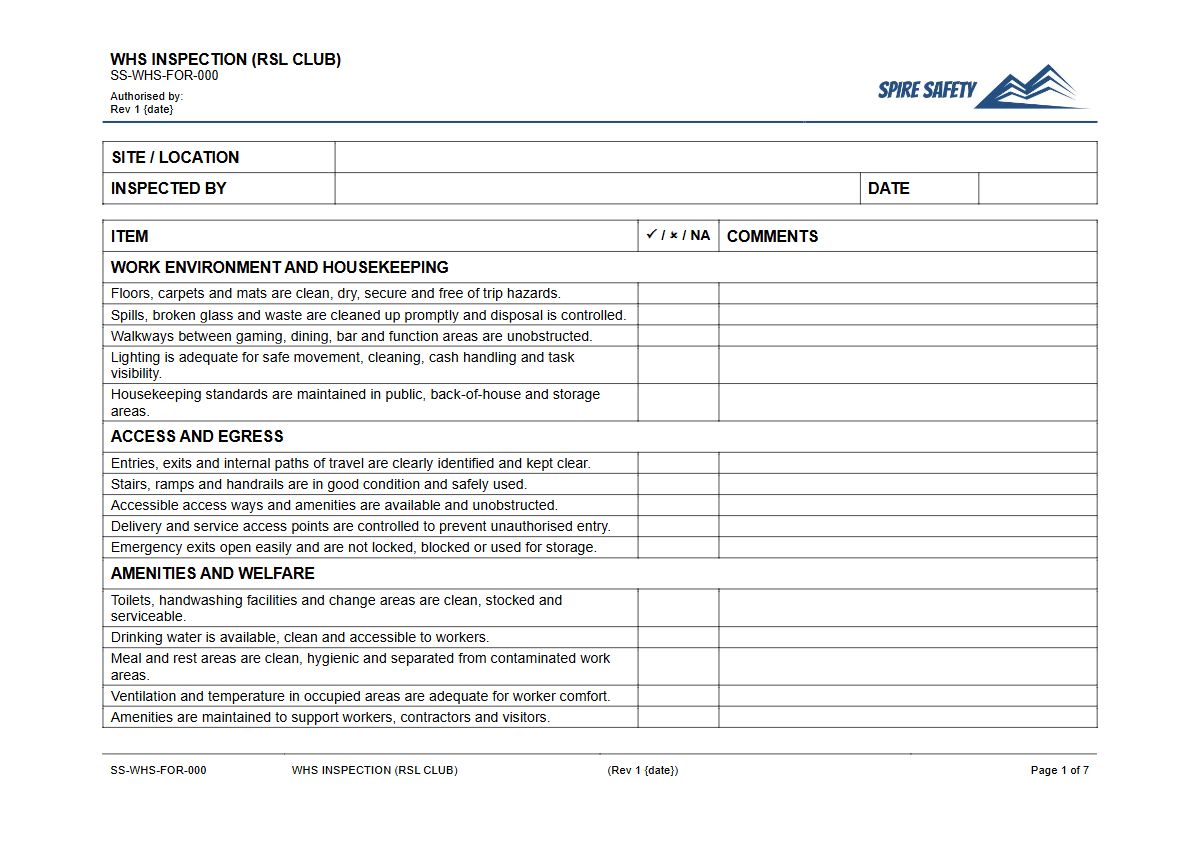
This free WHS Inspection (RSL Club) Template provides a structured starting point for your organisation to formalise this process. Regular, documented inspections are a key component of effective risk management, helping to prevent incidents before they occur and demonstrating your commitment to the safety of staff, members, and guests.
Using a standardised template helps ensure that inspections are consistent and thorough. It prompts the inspector to look at common and critical hazards specific to a club environment, such as slip and trip hazards from spills, electrical safety for gaming machines and AV equipment, manual handling risks in cellars, and hygiene standards in food preparation areas.
This document is designed to be a practical tool, aligned with Australian WHS principles, to help you build a safer workplace.
Video walkthrough
How to use the Free WHS Inspection (RSL Club) Template
This template is a comprehensive starting point, not a final document. To use it effectively, you must first download the DOCX file and adapt it to the specific layout, equipment, and operations of your club.
Walk through your venue and add or remove sections to ensure the checklist accurately reflects your workplace. Consider specific areas like the bistro, gaming lounge, function rooms, cellar, car park, and outdoor spaces.
You should also create specific checks for key pieces of equipment, which may require their own detailed checklists; for example, you can use a dedicated Free Pre-Start Checklist (Freezer) Template for your commercial walk-in units.
Once customised, the inspection should be conducted by a competent person, such as a manager, supervisor, or WHS representative. During the inspection, they should physically walk through each area, observing conditions and work practices.
For each item on the checklist, they record whether it is compliant, non-compliant, or not applicable. If a hazard is identified, they must detail the issue, assess the risk level, and propose a corrective action with a responsible person and a due date.
This process ensures that findings are not just noted but actioned, which is critical for closing the loop on safety management.
Important: We have created this template as a foundational guide. You must customise it to address the unique hazards and operational specifics of your RSL club.
It is your responsibility to ensure the final document is comprehensive and suitable for your site's specific risks and legal obligations.
When to use it
The frequency of WHS inspections depends on the level of risk and the dynamic nature of your club's operations. A general workplace inspection using this template is typically conducted on a weekly or monthly basis.
More frequent checks may be necessary for high-risk areas like the kitchen or cellar. It’s beneficial to schedule these inspections at different times of the day and on different days of the week to get a complete picture of your club's operational safety, capturing both peak and off-peak conditions.
These planned inspections form a crucial part of your overall safety framework, complementing daily pre-start checks and ad-hoc hazard reporting.
Inspections should be integrated into your overall WHS management systems, not treated as a standalone task. The findings and data gathered from these inspections provide valuable insights for your WHS committee meetings, management reviews, and continuous improvement planning.
Use the trends identified over time to inform training needs, review safe work procedures, or justify capital expenditure on safer equipment.
Who should use it
A range of personnel within an RSL club can and should use this template. Club managers, duty managers, and supervisors are primarily responsible for ensuring safety in their areas of control and are well-placed to conduct these inspections.
WHS Representatives and members of the WHS Committee should also be involved, as it is a core part of their role to monitor and improve workplace safety. Involving different people can also bring fresh eyes to the process, helping to spot hazards that may have become normalised over time.
Regardless of who conducts the inspection, they must be provided with adequate training to understand the hazards they are looking for and how to use the template correctly. It's not just about ticking boxes; it's about making informed judgements.
The results and corrective actions should be reviewed by senior management to ensure appropriate resources are allocated and that identified issues are resolved effectively. For a higher level of assurance, you might also engage external experts for periodic WHS compliance auditing to verify the effectiveness of your internal processes.
The template can also serve as a training tool for new managers or supervisors, helping them understand the key WHS considerations within the club. To further enhance your safety documentation, explore other relevant checklists in our free WHS resources library that might apply to specific equipment or tasks in your venue, such as a free blender pre-start checklist for your bar or kitchen, or a boom gate pre-start for your car park.
Common mistakes
Common mistakes to avoid
- Using a generic checklist without customising it for the club's specific layout and equipment.
- Failing to assign responsible persons and due dates for corrective actions.
- Not involving a range of workers and managers in the inspection process.
- Completing the inspection as a paper-based exercise without genuine observation and follow-up.
Legal references
Legal considerations
The following legal requirements may be relevant to this type of work.
- Work Health and Safety Act (Harmonised) — Provides the primary duties for protecting workers and other people from work health and safety risks.
- Work Health and Safety Regulations (Harmonised) — Sets out requirements supporting the management of workplace hazards and risks.
The following codes may be relevant to this type of work.
- Managing WHS Risks Code of Practice — Provides practical guidance on identifying hazards, assessing risks and applying effective controls.
- Work Health and Safety Consultation, Cooperation and Coordination Code of Practice — Provides practical guidance on consulting workers and coordinating with other duty holders.
- Managing the Work Environment and Facilities Code of Practice — Provides practical guidance on safe work environments, workplace facilities and related controls.
Did you know
Hospitality Hazards
Slips, trips and falls are the most common cause of injury in the hospitality industry, accounting for a significant percentage of all workers' compensation claims in the sector.
FAQ
Frequently asked questions
01What specific hazards should an RSL club inspection cover?
02How often should we conduct a WHS inspection in our club?
03Is this template enough for our club to be WHS-aligned?
04Who is responsible for actioning items found during an inspection?
Share this resource
Free WHS Inspection (RSL Club) Template
Browse Categories
How To Use It
- 1Download and open in Word or PDF.
- 2Replace the placeholders with your business details.
- 3Get it reviewed by a WHS specialist before rollout.
Need it customised?
Our WHS consultants can adapt this template to your site, run a gap analysis, or audit what you already have in place.
Book a Free Consultation WHS consulting servicesor call 1300 156 382