
Free WHS Inspection (Saw Mill) Template
Formalise safety checks in your timber processing facility with our Free WHS Inspection (Saw Mill) Template. A structured starting point for WHS. Download now.
Free WHS Inspection (Saw Mill) Template
DOCX • 129 KB + PDF
Updated Oct 2026
No signup required
Purpose of the Free WHS Inspection (Saw Mill) Template
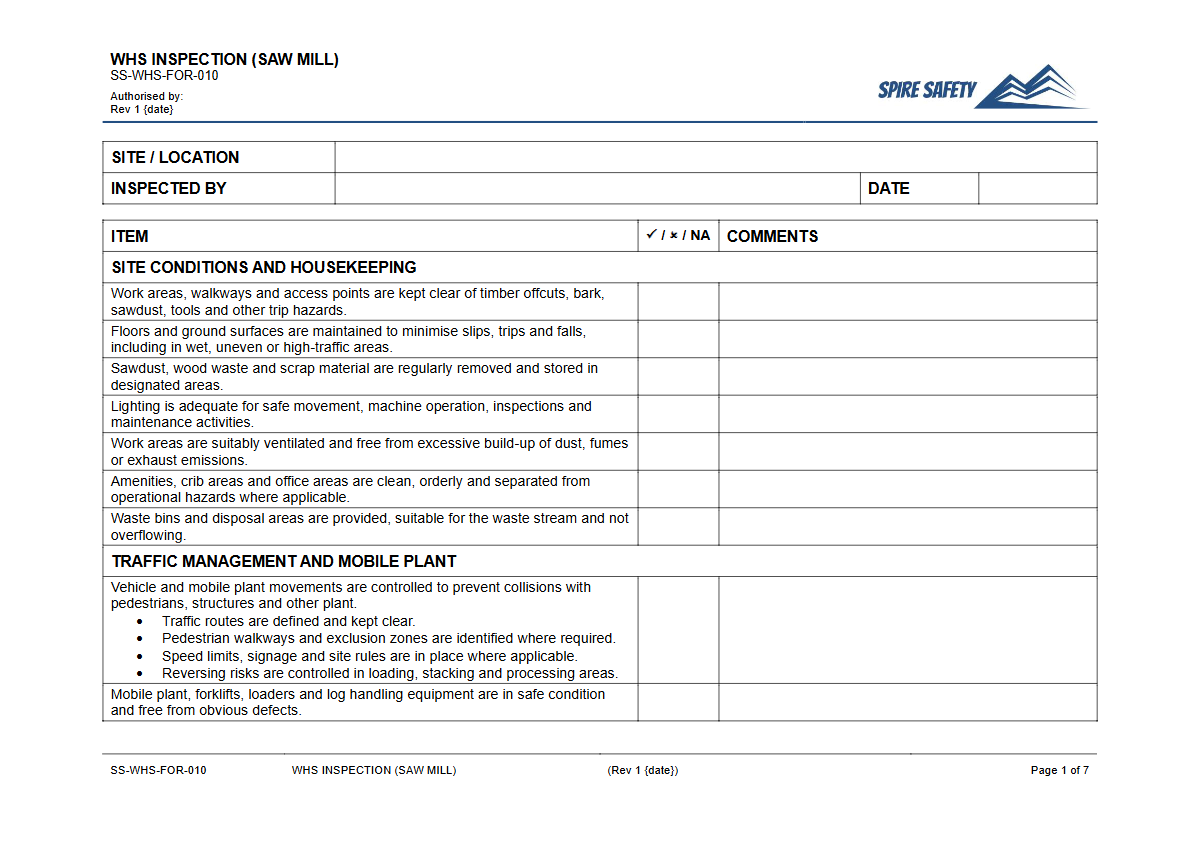
Saw mills are high-risk environments with significant hazards ranging from heavy machinery and high noise levels to airborne wood dust and complex traffic movements. This Free WHS Inspection (Saw Mill) Template provides a structured starting point for systematically identifying and assessing these risks within your facility.
Using a formal checklist helps ensure that inspections are thorough, consistent, and documented, forming a critical part of your overall safety management process. It is designed to prompt a review of key areas, including equipment guarding, emergency procedures, housekeeping, and personal protective equipment (PPE) usage, helping you proactively manage your WHS obligations.
Video walkthrough
How to use the Free WHS Inspection (Saw Mill) Template
This template is available for download in both DOCX for easy editing and PDF for straightforward printing. To get the most value from this resource, it must be adapted to the unique layout, machinery, and operational procedures of your specific saw mill.
A generic checklist cannot cover every potential hazard in every workplace.
Important Note: This document provides a general framework. You must customise it to address the specific equipment, processes, and risks present in your workplace. Spire Safety is not liable for any incidents arising from the use of this template.
Integrating regular, documented checks like this into your daily operations is a cornerstone of effective WHS management systems, helping to build a proactive safety culture and a robust compliance framework.
Key Areas Covered in the Inspection
While you will need to add site-specific items, the template provides prompts for inspecting several critical areas common to most saw mill operations:
- General Site and Traffic Management: This includes assessing walkways, signage, lighting, and the safe movement of vehicles like forklifts and log trucks. Proper controls over site entry and exit points are also essential, which can be managed using tools like our free pre-start checklist for boom gates.
- Log Yard and Debarking: Focuses on the stability of log stacks, safe operation of loading equipment, and control of exclusion zones around machinery.
- Sawing and Processing Areas: This is a critical section covering machine guarding, emergency stops, condition of blades, and operator competency. For specific lifting plant, checks should be even more detailed, similar to the process outlined in our Free Pre-Start Checklist (Electric Hoist) Template.
- Environmental Hazards: Includes checks on the effectiveness of dust extraction systems, noise level monitoring, and the provision and use of appropriate PPE. Managing airborne contaminants is a shared challenge in processing facilities, much like the focus of a feed mill pre-start checklist.
- Finishing, Packing, and Dispatch: Covers manual handling risks, strapping or wrapping equipment, and safe loading procedures.
- Amenities and First Aid: Ensures that welfare facilities are clean, accessible, and that first aid kits are fully stocked and accessible.
When to use it
Formal workplace inspections should be conducted at regular, scheduled intervals, such as weekly or monthly, depending on the risk level of the area. The frequency should be determined by a risk assessment.
Additionally, an inspection should be carried out after any significant incident, when new machinery or processes are introduced, or when concerns are raised by workers. The records from these inspections provide valuable data for continuous improvement and are often reviewed during formal WHS compliance auditing to verify that safety processes are being followed.
Who should use it
Workplace inspections should be conducted by competent personnel who understand the hazards of a saw mill environment. This typically includes supervisors, Health and Safety Representatives (HSRs), and managers.
Involving workers who operate the machinery or work in the areas being inspected is also highly beneficial, as they bring valuable firsthand knowledge of the risks. For complex environments or to establish a new inspection program, engaging external expertise through WHS consulting can provide valuable guidance and ensure your processes are robust and effective.
The person conducting the inspection must have the authority to implement or recommend corrective actions to address any identified hazards.
By formalising your safety checks with a dedicated template, you move from reactive problem-solving to proactive risk management. Explore our complete free WHS resources library for more tools to support your safety goals.
Common mistakes
Common mistakes to avoid
- Failing to customise the template for the specific machinery and layout of the site.
- Conducting 'pencil-whip' inspections without physically verifying the safety controls.
- Not assigning clear responsibility and deadlines for corrective actions.
- Failing to follow up to ensure identified hazards have been effectively controlled.
Legal references
Legal considerations
The following legal requirements may be relevant to this type of work.
- Work Health and Safety Act (Harmonised) — Provides the primary duties for protecting workers and other people from work health and safety risks.
- Work Health and Safety Regulations (Harmonised) — Sets out requirements supporting the management of workplace hazards and risks.
The following codes may be relevant to this type of work.
- Managing WHS Risks Code of Practice — Provides practical guidance on identifying hazards, assessing risks and applying effective controls.
- Work Health and Safety Consultation, Cooperation and Coordination Code of Practice — Provides practical guidance on consulting workers and coordinating with other duty holders.
- Managing the Work Environment and Facilities Code of Practice — Provides practical guidance on safe work environments, workplace facilities and related controls.
Did you know
Wood Dust Hazard
Inhaling airborne wood dust is a significant health risk in saw mills, potentially causing respiratory diseases, dermatitis, and cancer. Effective dust extraction and respiratory protection are critical controls.
Noise-Induced Hearing Loss
The timber processing industry has one of the highest rates of work-related noise-induced hearing loss. Noise levels in saw mills can easily exceed the exposure standard, making hearing protection and noise control measures mandatory.
FAQ
Frequently asked questions
01What's the difference between a pre-start check and a workplace inspection?
02How often should a saw mill be formally inspected?
03Who is responsible for acting on hazards found during a saw mill inspection?
04Can this template be used for other timber processing facilities?
Share this resource
Free WHS Inspection (Saw Mill) Template
Browse Categories
How To Use It
- 1Download and open in Word or PDF.
- 2Replace the placeholders with your business details.
- 3Get it reviewed by a WHS specialist before rollout.
Need it customised?
Our WHS consultants can adapt this template to your site, run a gap analysis, or audit what you already have in place.
Book a Free Consultation WHS consulting servicesor call 1300 156 382