
Free WHS Inspection (School Workshop) Template
Download our Free WHS Inspection (School Workshop) Template to proactively manage hazards in educational settings.
Free WHS Inspection (School Workshop) Template
DOCX • 128 KB + PDF
Updated Oct 2026
No signup required
Purpose of the Free WHS Inspection (School Workshop) Template
School workshops, including design, technology, woodwork, metalwork, and art classrooms, contain machinery and materials that pose significant WHS risks. A systematic inspection process is crucial for protecting both students and staff.
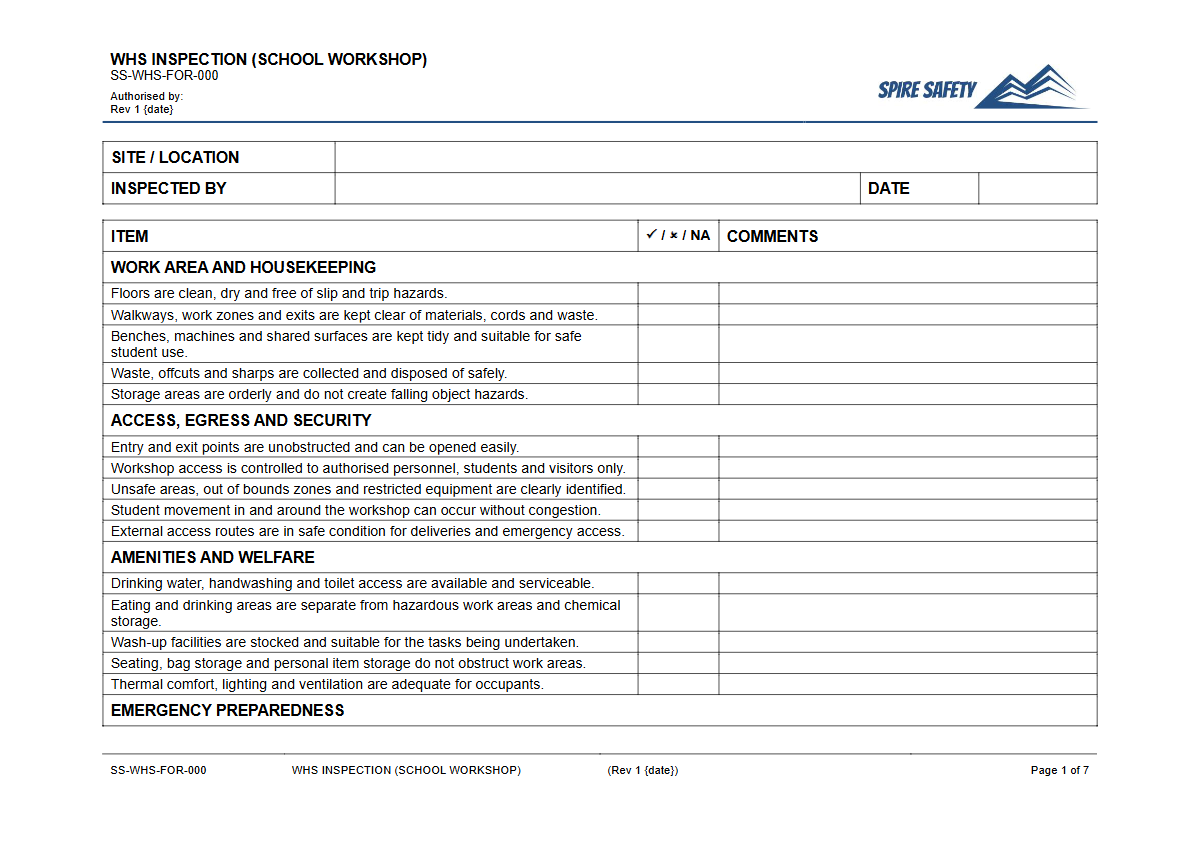
This Free WHS Inspection (School Workshop) Template provides a structured starting point for identifying hazards specific to these environments, such as unguarded machinery, inadequate ventilation, hazardous substance storage, and electrical faults. Regular use of this template helps a Person Conducting a Business or Undertaking (PCBU), such as the school administration, meet their primary duty of care.
By formalising your safety checks, you create a documented record of your risk management activities. This proactive approach helps prevent incidents before they occur and fosters a stronger safety culture within the school community.
Integrating these checks is a key part of developing effective WHS management systems that protect everyone on site.
Video walkthrough
How to use the Free WHS Inspection (School Workshop) Template
This document is designed as a foundational guide. To make it effective, you must adapt it to the unique context of your school's facilities.
Start by downloading the DOCX version and walking through the workshop space. Add, remove, or modify checklist items to reflect the specific plant, equipment, and processes used.
For example, you may need to add checks for pottery kilns, 3D printers, laser cutters, or fume cupboards that are unique to your curriculum.
Important: This is a template, not a finished document. We cannot guarantee it covers every potential hazard in your specific workplace.
You must customise it with site-specific information, taking into account your unique machinery, tasks, and environment to ensure all relevant risks are assessed. You might find that specific high-risk items, like lifting machinery, require their own daily checks using a resource like our Free Pre-Start Checklist (Electric Hoist) Template.
When to use it
Regularity is key to an effective inspection program. School workshops should be formally inspected on a scheduled basis to ensure ongoing safety.
A good practice is to conduct a thorough inspection at the beginning of each school term, before the space becomes busy with student activity. Additional inspections should be triggered by certain events, such as the introduction of new machinery, a change in workshop layout, or following any near miss or incident.
These documented checks provide valuable data for safety committee meetings and continuous improvement.
For organisations seeking a deeper level of assurance, these routine inspections can be supplemented with periodic, independent reviews. A formal WHS compliance auditing process can provide an external perspective on the effectiveness of your overall safety systems.
Who should use it
The inspection should be carried out by a person with the knowledge and experience to identify hazards in a workshop environment. This is typically the Technology Head Teacher, workshop technician, or a designated WHS representative.
It is beneficial to involve different staff members in rotation to bring a fresh set of eyes to the process. For example, a teacher from the Home Economics department might notice different hazards than the woodwork teacher, so consulting across departments can strengthen the process, especially where equipment like that covered in a Free Pre-Start Checklist (Blender) Template is used.
While students should not be responsible for the formal inspection, involving senior students under direct supervision can be an excellent educational tool. It helps them develop hazard identification skills and reinforces the importance of safe work behaviour.
The final sign-off and responsibility for actioning any findings, however, must remain with a competent staff member. For more templates and safety resources, you can explore our complete free WHS resources library.
Common mistakes
Common mistakes to avoid
- Failing to check ventilation and dust extraction systems, a critical control for wood dust and fumes.
- Overlooking the condition of electrical leads, power boards, and the accessibility of emergency stops.
- Not documenting corrective actions taken to fix identified hazards, creating a gap in the safety record.
- Using the template as a 'tick-and-flick' exercise without genuinely looking for potential risks.
Legal references
Legal considerations
The following legal requirements may be relevant to this type of work.
- Work Health and Safety Act (Harmonised) — Provides the primary duties for protecting workers and other people from work health and safety risks.
- Work Health and Safety Regulations (Harmonised) — Sets out requirements supporting the management of workplace hazards and risks.
The following codes may be relevant to this type of work.
- Managing WHS Risks Code of Practice — Provides practical guidance on identifying hazards, assessing risks and applying effective controls.
- Work Health and Safety Consultation, Cooperation and Coordination Code of Practice — Provides practical guidance on consulting workers and coordinating with other duty holders.
- Managing the Work Environment and Facilities Code of Practice — Provides practical guidance on safe work environments, workplace facilities and related controls.
Did you know
Consultation is a Legal Duty
Under Australian WHS law, schools must consult with their workers (teachers, technicians) and, where reasonably practicable, students on matters affecting their health and safety. Inspections are a great opportunity for this.
The Hierarchy of Controls
When a hazard is identified, the most effective control is to eliminate it completely. The least effective control is relying on personal protective equipment (PPE), which should only be used as a last resort.
FAQ
Frequently asked questions
01What's the difference between an inspection and a risk assessment?
02How often should a school workshop be inspected?
03Do I need a separate checklist for each machine?
04Can students be involved in safety inspections?
Share this resource
Free WHS Inspection (School Workshop) Template
Browse Categories
How To Use It
- 1Download and open in Word or PDF.
- 2Replace the placeholders with your business details.
- 3Get it reviewed by a WHS specialist before rollout.
Need it customised?
Our WHS consultants can adapt this template to your site, run a gap analysis, or audit what you already have in place.
Book a Free Consultation WHS consulting servicesor call 1300 156 382