
Free WHS Inspection (Sewage Plant) Template
Download our free WHS Inspection (Sewage Plant) Template. This DOCX and PDF helps identify hazards in wastewater facilities.
Free WHS Inspection (Sewage Plant) Template
DOCX • 128 KB + PDF
Updated Oct 2026
No signup required
Purpose of the Free WHS Inspection (Sewage Plant) Template
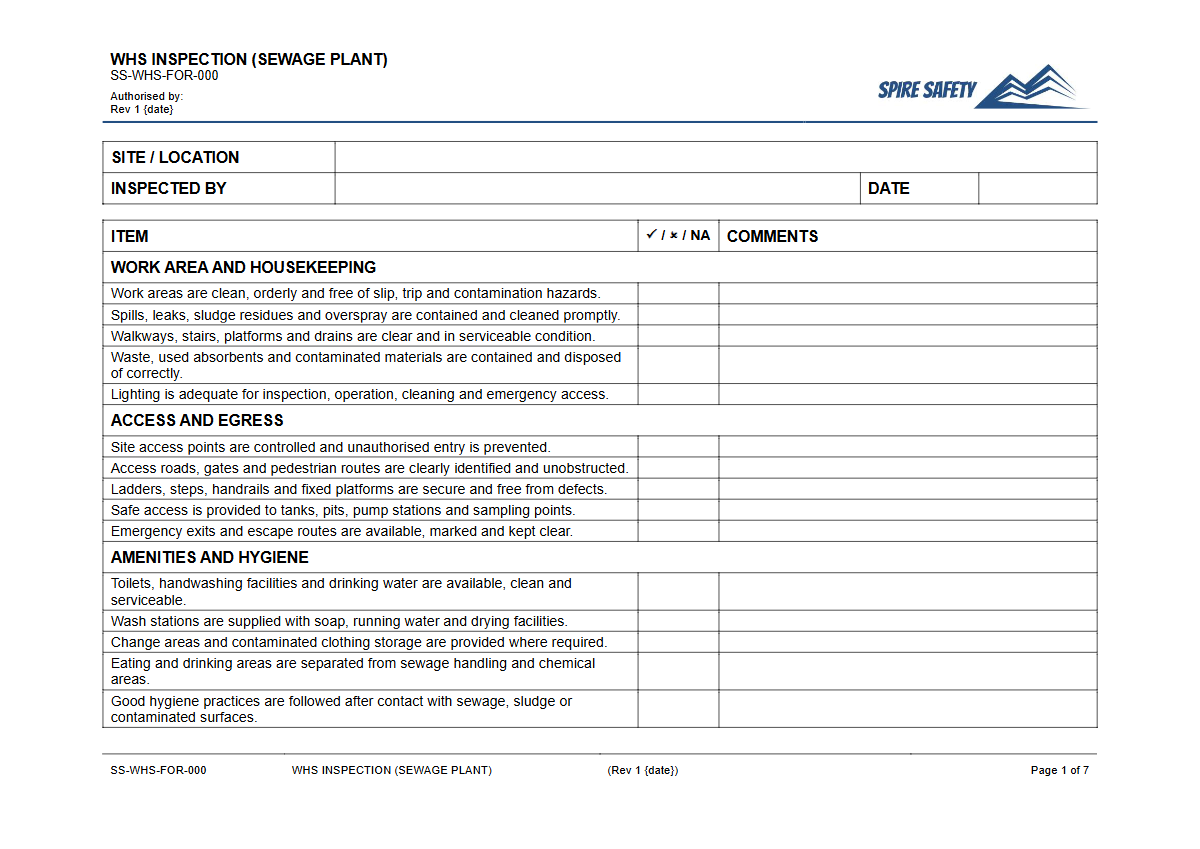
Wastewater and sewage treatment plants are high-risk environments with unique and significant WHS challenges. To help manage these complexities, our Free WHS Inspection (Sewage Plant) Template provides a structured starting point for your safety procedures.
This downloadable document guides you through a systematic check of your facility, helping to identify hazards and document necessary control measures to protect your workers. The primary purpose of this inspection template is to provide a formal, repeatable process for identifying health and safety hazards within a sewage treatment facility.
These environments present a complex mix of risks, including biological hazards from pathogens, chemical exposures, hazardous atmospheres in confined spaces, and physical dangers from machinery and potential for drowning. Using a standardised checklist helps ensure that key risk areas are not overlooked.
A documented inspection creates a valuable record for your safety management system, demonstrating due diligence and providing data for risk analysis. It helps in systematically reviewing control measures for effectiveness and identifying areas for improvement. Regular inspections are a key part of proactive safety management and are a vital input for broader processes like WHS compliance auditing.
Key hazards covered include access and egress, guarding on machinery, chemical storage and handling, ventilation, and the state of walkways and platforms. It also prompts checks on critical safety systems like emergency showers, eyewash stations, and rescue equipment. This includes assessing risks from tasks such as maintenance at heights, which may require a separate elevated work platform risk assessment.
Video walkthrough
How to use the Free WHS Inspection (Sewage Plant) Template
This template is available for download in both DOCX and PDF formats. The DOCX file is fully editable, allowing you to tailor the checklist to the specific layout, equipment, and processes of your facility.
You can add, remove, or modify checklist items to ensure they are relevant to your operational risks.
Important: This document is a general template designed as a starting point. We have based it on recognised Australian WHS principles, but it is not a complete, out-of-the-box solution.
You must customise this template to address the specific hazards and legal requirements applicable to your site and operations. We recommend consulting with your team and WHS professionals during this customisation process.
To use the template effectively, the designated inspector should walk through the site, systematically checking each item on the list. For any non-conformances or hazards identified, they should note the issue, assess the risk level, and specify the corrective action required, along with a person responsible and a due date. In environments like sewage plants, spills and leaks are a constant concern, and staff should be prepared with a clear response plan, as covered in our Spill Prevention and Response Toolbox Talk template.
When to conduct a Sewage Plant Inspection
The frequency of inspections should be determined by a risk assessment. For a high-risk environment like a sewage plant, a combination of checks is often appropriate.
We recommend conducting comprehensive site inspections at regular intervals, such as weekly or monthly. This should be supplemented by more frequent pre-start checks on critical plant and equipment.
This template is also valuable for use before commissioning new equipment, after significant maintenance or modifications to the plant, or following a safety incident or near-miss to identify contributing factors. Integrating these scheduled inspections into your overarching WHS management systems ensures they are completed consistently and that findings are tracked through to completion.
For organisations aiming for higher levels of safety assurance, these documented inspections also serve as important evidence for management system certification. If your business is pursuing or maintaining certification, our consultants can assist with ISO 45001 consulting to align your processes with international best practice.
Who should conduct the Inspection
This inspection should be carried out by a person or team with the competence to recognise the specific hazards of a wastewater treatment environment. This typically includes roles such as WHS Managers, Safety Advisors, Site Supervisors, or experienced Plant Operators who have received appropriate training.
Involving workers who operate in the areas being inspected is highly beneficial. Their direct experience provides valuable insights into day-to-day hazards and the practicality of existing control measures.
For a comprehensive overview of safety documentation, browse our entire free WHS resources library to find other useful templates.
Common mistakes
Common mistakes to avoid
- Assuming the atmosphere in a confined space is safe without testing.
- Using incorrect or poorly maintained Personal Protective Equipment (PPE).
- Failing to document and follow up on corrective actions identified during the inspection.
- Neglecting worker training on the specific biological and chemical hazards present.
Legal references
Legal considerations
The following legal requirements may be relevant to this type of work.
- Work Health and Safety Act (Harmonised) — Provides the primary duties for protecting workers and other people from work health and safety risks.
- Work Health and Safety Regulations (Harmonised) — Sets out requirements supporting the management of workplace hazards and risks.
The following codes may be relevant to this type of work.
- Managing WHS Risks Code of Practice — Provides practical guidance on identifying hazards, assessing risks and applying effective controls.
- Work Health and Safety Consultation, Cooperation and Coordination Code of Practice — Provides practical guidance on consulting workers and coordinating with other duty holders.
- Managing the Work Environment and Facilities Code of Practice — Provides practical guidance on safe work environments, workplace facilities and related controls.
Did you know
Confined Space Dangers
Confined spaces in sewage systems can contain hazardous atmospheres that are immediately dangerous to life or health. Gases like hydrogen sulphide and methane can displace oxygen or be flammable and toxic, often without any warning smell.
Biological Hazards
Wastewater contains numerous microorganisms, including bacteria, viruses, and parasites that can cause serious illness. Effective hygiene practices and Personal Protective Equipment (PPE) are critical for worker protection.
FAQ
Frequently asked questions
01What are the biggest hazards in a sewage treatment plant?
02How often should sewage plant inspections be conducted?
03Is this template compliant with Australian WHS laws?
04Who is qualified to conduct a sewage plant WHS inspection?
Share this resource
Free WHS Inspection (Sewage Plant) Template
Browse Categories
How To Use It
- 1Download and open in Word or PDF.
- 2Replace the placeholders with your business details.
- 3Get it reviewed by a WHS specialist before rollout.
Need it customised?
Our WHS consultants can adapt this template to your site, run a gap analysis, or audit what you already have in place.
Book a Free Consultation WHS consulting servicesor call 1300 156 382