
Free WHS Inspection (Sewer Depot) Template
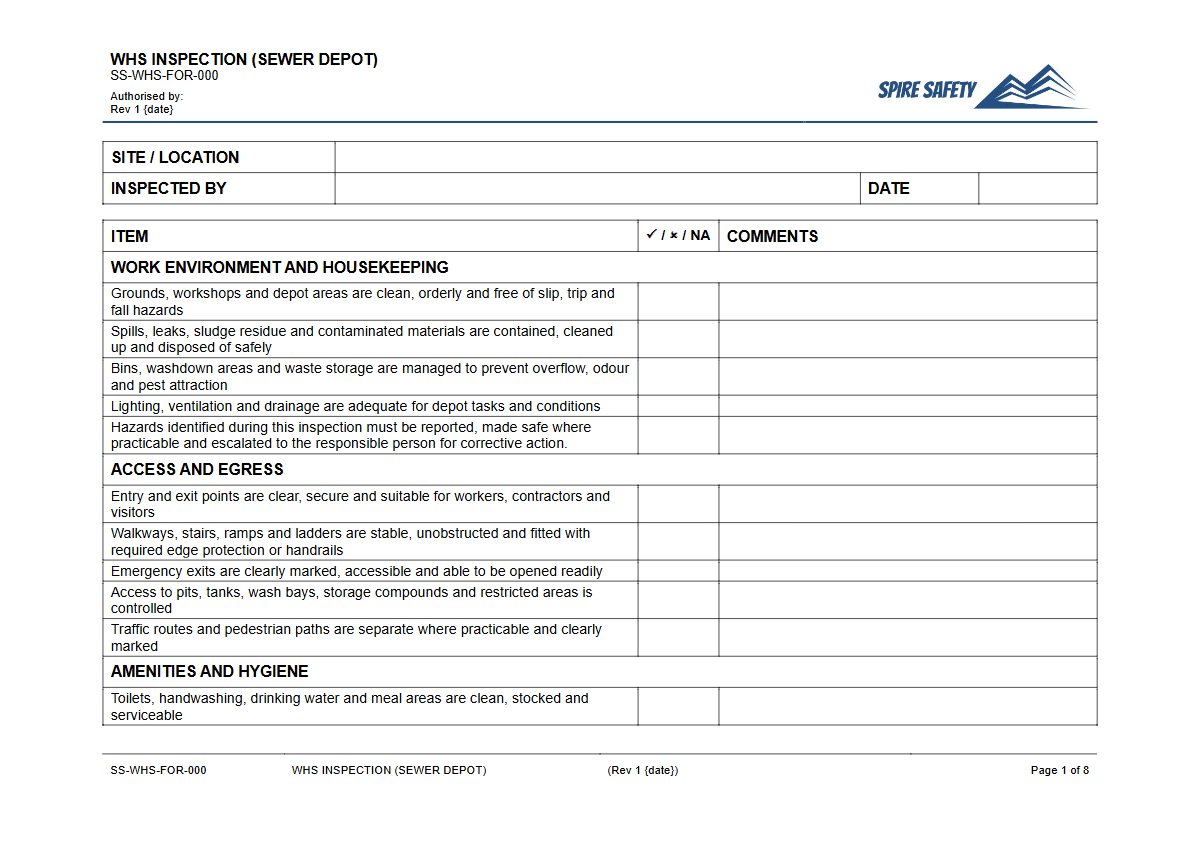
Download our free WHS Inspection (Sewer Depot) Template. This structured DOCX & PDF helps you formalise safety checks for sewer depot hazards.
Free WHS Inspection (Sewer Depot) Template
DOCX • 129 KB + PDF
Updated Oct 2026
No signup required
Purpose of the Free WHS Inspection (Sewer Depot) Template
Managing the health and safety of a sewer depot involves navigating a unique and complex set of risks. This Free WHS Inspection (Sewer Depot) Template provides a structured starting point for systematically identifying and controlling hazards specific to this environment.
Regular, documented inspections are a cornerstone of proactive safety management, helping your organisation meet its duty of care and prevent incidents before they occur. Using a dedicated template ensures that critical checks for hazards like confined spaces, biological agents, hazardous chemicals, and vehicle movements are not overlooked.
A thorough inspection process demonstrates a commitment to safety and provides valuable data for risk assessments and continuous improvement. It formalises the process of checking controls, equipment, and work areas, creating a verifiable record of your safety activities. Integrating these regular checks is a fundamental part of building and maintaining a robust WHS management system.
Video walkthrough
How to use the Free WHS Inspection (Sewer Depot) Template
This template is designed to be a practical tool for your workplace safety team. It covers common areas and hazards found in a typical sewer depot, from site security and traffic management to chemical storage and emergency equipment.
To get started, simply download the document in your preferred format (DOCX for easy editing or PDF for straightforward printing).
The inspection process should involve:
- Customisation: Adapt the checklist to your specific site. Add, remove, or modify sections to reflect the unique plant, equipment, and processes at your depot.
- Scheduling: Establish a regular schedule for inspections (e.g., monthly or quarterly).
- Assignment: Assign the inspection to a competent person, such as a site supervisor, manager, or Health and Safety Representative (HSR).
- Execution: Conduct a physical walk-through of the depot, completing each item on the checklist. Document all observations, both positive and negative.
- Actioning: For any non-conformances or hazards identified, record a clear corrective action, assign it to a specific person, and set a due date for completion.
- Review: Follow up on all corrective actions to ensure they have been effectively implemented. Review completed inspection reports to identify trends or recurring issues.
Important: This is a template document designed as a starting point. We strongly recommend you customise it to reflect the specific hazards, layout, equipment, and procedures present at your sewer depot.
Generic checklists can lead to critical risks being missed.
When to use it
Workplace inspections are not a one-off task. This inspection template should be used as part of a regular, ongoing safety program. Recommended times for use include:
- Scheduled Intervals: Conduct routine inspections on a monthly or quarterly basis to proactively monitor conditions and compliance.
- After an Incident: Use the template to conduct a thorough site review following an accident, near miss, or reported hazard to identify contributing factors.
- Following Changes: Perform an inspection whenever new plant, substances, or work processes are introduced to the depot.
- Before High-Risk Work: Use relevant sections to check an area before specific high-risk activities, like confined space entry or major chemical handling, commence.
The findings from these regular inspections can provide crucial evidence and focus areas for more in-depth WHS compliance auditing activities, helping to paint a complete picture of your safety performance.
Who should use it
This template is intended for use by personnel with responsibility for workplace health and safety at a sewer depot. This includes:
- Site Managers and Supervisors
- WHS Managers and Advisors
- Health and Safety Representatives (HSRs)
- Team Leaders and Forepersons
The person conducting the inspection must be competent to do so. This means they should have the knowledge and experience to identify the specific hazards associated with sewer depot operations, understand the control measures that should be in place, and feel confident in recommending corrective actions.
If your team lacks this specific expertise, consider engaging professional WHS consulting to assist with customising the template and training your staff.
While this template focuses on the depot as a whole, remember that individual pieces of equipment require their own checks. For site access points, a boom gate pre-start checklist ensures entryways are functioning safely.
Similarly, for specific machinery used in maintenance and operations, pre-start checks are essential. For example, if hoists are used for lifting equipment, a specific electric hoist pre-start checklist should be completed before each use.
This resource is just one of many tools available to help you build a safer workplace. You can explore our complete free WHS resources library for more templates, checklists, and guides to support your safety management efforts.
Common mistakes
Common mistakes to avoid
- Using a generic checklist that misses sewer-specific hazards like confined spaces or biological agents.
- Failing to assign clear responsibility and deadlines for corrective actions found during the inspection.
- Treating the inspection as a paperwork exercise instead of a proactive tool for hazard identification.
- Not providing adequate training on depot-specific hazards to the person conducting the inspection.
Legal references
Legal considerations
The following legal requirements may be relevant to this type of work.
- Work Health and Safety Act (Harmonised) — Provides the primary duties for protecting workers and other people from work health and safety risks.
- Work Health and Safety Regulations (Harmonised) — Sets out requirements supporting the management of workplace hazards and risks.
The following codes may be relevant to this type of work.
- Managing WHS Risks Code of Practice — Provides practical guidance on identifying hazards, assessing risks and applying effective controls.
- Work Health and Safety Consultation, Cooperation and Coordination Code of Practice — Provides practical guidance on consulting workers and coordinating with other duty holders.
- Managing the Work Environment and Facilities Code of Practice — Provides practical guidance on safe work environments, workplace facilities and related controls.
Did you know
The 'Rotten Egg' Gas
Hydrogen sulfide (H2S), common in sewers, is highly toxic. At high concentrations, it quickly deadens a person's sense of smell, meaning you can no longer rely on your nose to detect its dangerous presence.
Confined Space Dangers
According to Safe Work Australia, a significant number of confined space fatalities are would-be rescuers. These individuals often enter the space to help a collapsed colleague without the proper training, equipment, or safety procedures.
FAQ
Frequently asked questions
01What is the difference between a workplace inspection and a WHS audit?
02What are the biggest WHS risks in a sewer depot?
03How often should we inspect our sewer depot?
04Can I use this template for a water or electricity depot?
Share this resource
Free WHS Inspection (Sewer Depot) Template
Browse Categories
How To Use It
- 1Download and open in Word or PDF.
- 2Replace the placeholders with your business details.
- 3Get it reviewed by a WHS specialist before rollout.
Need it customised?
Our WHS consultants can adapt this template to your site, run a gap analysis, or audit what you already have in place.
Book a Free Consultation WHS consulting servicesor call 1300 156 382