
Free WHS Inspection (Sports Centre) Template
Proactively manage safety in your facility with our Free WHS Inspection (Sports Centre) Template. A structured starting point for gyms and sports halls.
Free WHS Inspection (Sports Centre) Template
DOCX • 128 KB + PDF
Updated Oct 2026
No signup required
Purpose of the Free WHS Inspection (Sports Centre) Template
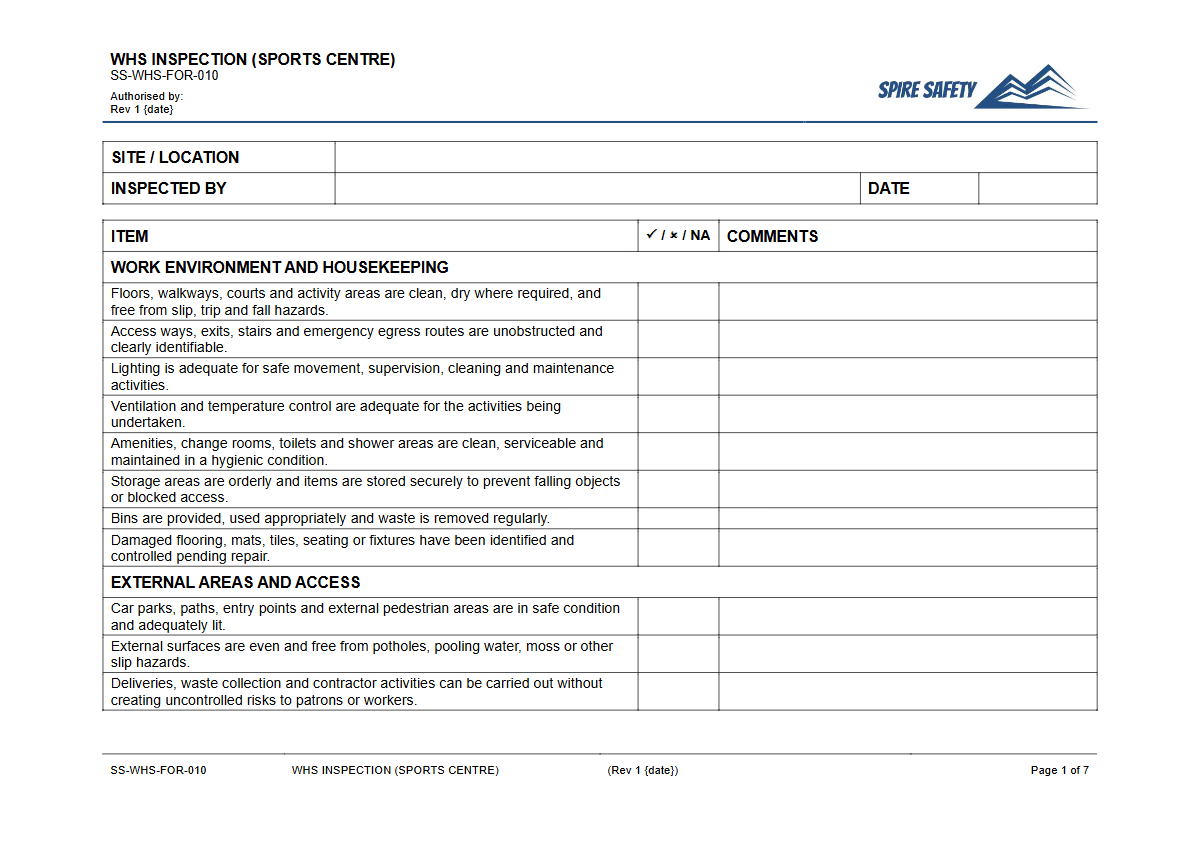
Operating a sports centre involves managing a dynamic environment with a diverse range of hazards. This Free WHS Inspection (Sports Centre) Template provides a structured starting point for systematically identifying and controlling risks across your facility.
Regular inspections are a fundamental part of a proactive approach to work health and safety, helping to prevent incidents before they occur. The template is designed to guide you through checking key areas, from public spaces and amenities to specific sports equipment and plant.
Using a formal checklist helps ensure consistency and accountability in your safety processes. It prompts checks for common hazards like slip, trip, and fall risks, faulty equipment, inadequate lighting, and blocked emergency exits.
For specific equipment within your facility, such as treadmills, you may need more detailed checks, which can be supported by our free Pre-Start Checklist for Gym Treadmills. Documenting these inspections creates a valuable record of due diligence, demonstrating your organisation’s commitment to providing a safe environment for staff and patrons.
Video walkthrough
How to use the Free WHS Inspection (Sports Centre) Template
This resource is available for download as a DOCX file for easy editing or a PDF for straightforward printing. To get the most value from this template, you should adapt it to the specific layout, equipment, and activities of your sports centre.
A generic checklist cannot cover every unique hazard in a workplace.
Important: We strongly advise that you customise this template to reflect the unique risks of your site. This may involve adding, removing, or modifying sections to align with your specific environment, including courts, pools, change rooms, and spectator areas.
A well-customised inspection checklist is a critical tool within broader WHS management systems, ensuring your safety procedures are relevant and effective.
What this Inspection template covers
This template is organised into logical sections to streamline your walkthrough inspection. It includes prompts for checking:
- General Areas & Amenities: Floors, walkways, lighting, signage, and cleanliness in reception areas, corridors, and change rooms.
- Sports & Activity Areas: Condition of courts, fields, and specialised surfaces. Checks for fixed equipment like basketball hoops or goalposts.
- Gym & Fitness Equipment: General visual inspection of fitness machines, free weights, and functional training gear for visible defects or damage.
- First Aid & Emergency Systems: Availability and condition of first aid kits, defibrillators (AEDs), fire extinguishers, and emergency exit paths.
- Outdoor & External Areas: Car parks, pathways, landscaping, and building exterior. Entrances and exits, including automated barriers, can be managed with a dedicated checklist like our free Pre-Start Checklist (Boom Gate) Template.
When to use it
The frequency of inspections should be determined by a risk assessment. High-traffic areas or high-risk equipment may require daily checks, while other parts of the facility might be inspected weekly or monthly.
It is good practice to conduct a brief inspection before opening each day to ensure the facility is safe for the first patrons. More thorough inspections should be scheduled regularly.
You should also conduct inspections after major events, maintenance work, or any incident to ensure the area is safe for normal use. For groundskeeping equipment, a separate inspection regime should be in place, which can be formalised using tools like our free Pre-Start Checklist (Aerator) Template.
Who should use it
Workplace inspections can be carried out by various personnel. This template is suitable for:
- Centre Managers and Facility Managers
- Duty Managers or Team Leaders
- WHS Representatives or Committee Members
- Supervisors responsible for specific areas (e.g., Gym Floor Supervisor, Aquatics Manager)
It is essential that anyone performing an inspection is trained to recognise the hazards they are looking for. The completed inspection forms should be reviewed by a manager who can authorise and track any required corrective actions. A systematic approach to inspections, corrective actions, and reviews is a key activity verified during a formal WHS compliance audit. For more guides and checklists, you can browse our complete free WHS resources library.
Common mistakes
Common mistakes to avoid
- Failing to customise the template for the specific facility and its unique hazards.
- Not training inspectors on how to properly identify and document hazards.
- Neglecting to follow up on identified issues and track corrective actions to completion.
- Treating the inspection as a 'tick-and-flick' exercise without genuine observation.
Legal references
Legal considerations
The following legal requirements may be relevant to this type of work.
- Work Health and Safety Act (Harmonised) — Provides the primary duties for protecting workers and other people from work health and safety risks.
- Work Health and Safety Regulations (Harmonised) — Sets out requirements supporting the management of workplace hazards and risks.
The following codes may be relevant to this type of work.
- Managing WHS Risks Code of Practice — Provides practical guidance on identifying hazards, assessing risks and applying effective controls.
- Work Health and Safety Consultation, Cooperation and Coordination Code of Practice — Provides practical guidance on consulting workers and coordinating with other duty holders.
- Managing the Work Environment and Facilities Code of Practice — Provides practical guidance on safe work environments, workplace facilities and related controls.
Did you know
Slips, Trips, and Falls
Slips, trips, and falls are a leading cause of injury in public venues. In Australia, they account for a significant portion of all serious workers' compensation claims and public liability incidents.
FAQ
Frequently asked questions
01What's the difference between a workplace inspection and a risk assessment?
02How often should a sports centre conduct WHS inspections?
03Can this inspection template be used for swimming pool areas?
04Who is legally responsible for safety in a sports centre?
Share this resource
Free WHS Inspection (Sports Centre) Template
Browse Categories
How To Use It
- 1Download and open in Word or PDF.
- 2Replace the placeholders with your business details.
- 3Get it reviewed by a WHS specialist before rollout.
Need it customised?
Our WHS consultants can adapt this template to your site, run a gap analysis, or audit what you already have in place.
Book a Free Consultation WHS consulting servicesor call 1300 156 382