
Free WHS Inspection (Stadium) Template
Download our Free WHS Inspection (Stadium) Template to formalise safety checks for your venue. Aligned with Australian WHS practices. Download your DOCX today.
Free WHS Inspection (Stadium) Template
DOCX • 129 KB + PDF
Updated Oct 2026
No signup required
Purpose of the Free WHS Inspection (Stadium) Template
Managing a stadium involves overseeing a complex and dynamic environment with significant work health and safety obligations. This Free WHS Inspection (Stadium) Template provides a structured starting point for systematically identifying and controlling hazards across your venue.
Stadiums present unique risks, from managing large crowds and public access areas to ensuring the structural integrity of grandstands, lighting towers, and broadcast facilities. Using a dedicated inspection checklist helps formalise your safety processes, ensuring nothing is overlooked.
A thorough inspection covers everything from patron facilities and emergency egress paths to event-specific infrastructure. This template is designed to prompt a comprehensive review of key safety elements, helping you meet your duty of care to workers, contractors, volunteers, and the public.
By documenting regular checks, you create a clear record of your organisation's commitment to proactive risk management. For specific equipment within the venue, such as automated entry points, using a targeted checklist like our Free Pre-Start Checklist (Boom Gate) Template can supplement your broader stadium inspection.
What this Inspection Template Covers
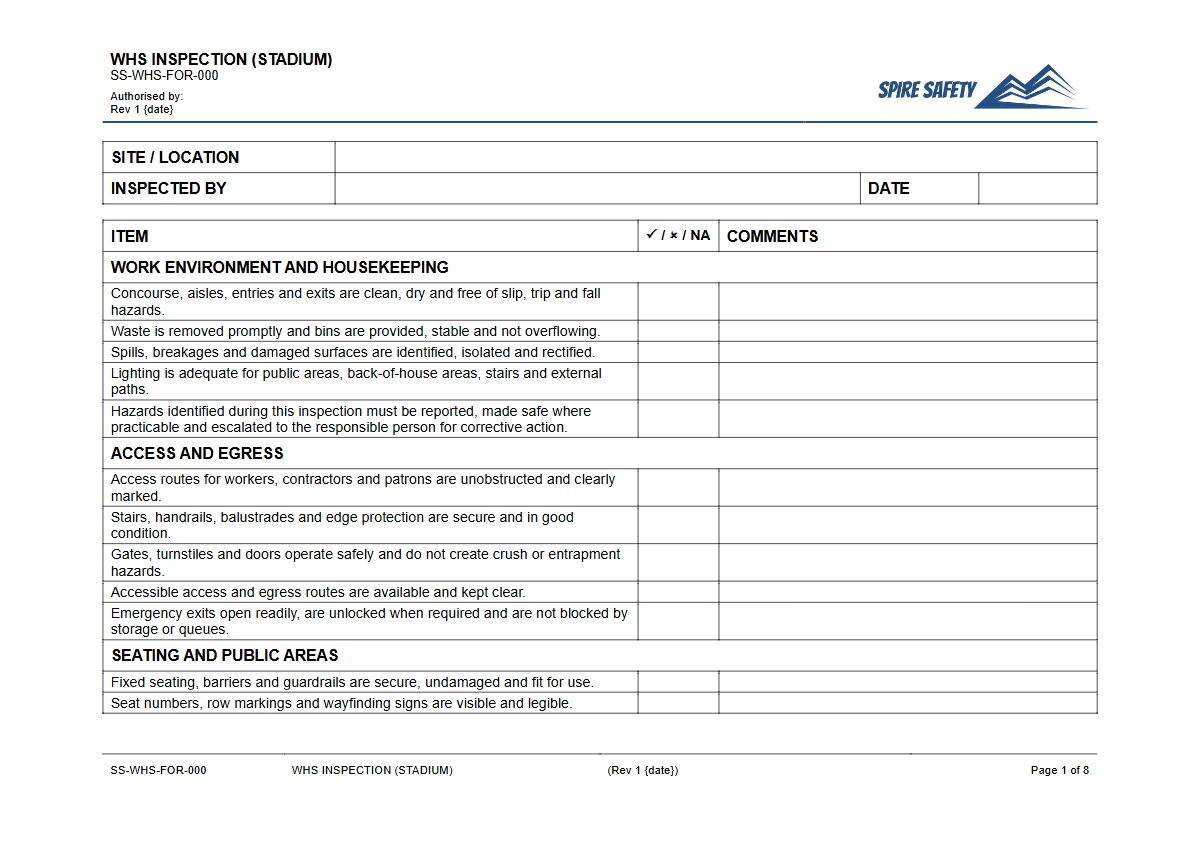
This template is structured to guide your inspection across key zones and operational areas of a typical stadium, including:
- Public Areas: Seating, aisles, stairs, handrails, and viewing platforms.
- Amenities: Toilets, food and beverage outlets, and first aid rooms.
- Entry and Egress: Turnstiles, gates, emergency exits, and evacuation routes.
- Back of House: Plant rooms, storage areas, loading docks, and staff facilities.
- Field of Play: Playing surface condition, goalposts, and perimeter fencing.
- Temporary Structures: Staging, marquees, and temporary seating for events.
Video walkthrough
How to use the Free WHS Inspection (Stadium) Template
This document is provided in DOCX format for easy customisation. To effectively implement it, start by walking through your venue and adapting the checklist items to match your specific layout, equipment, and operations.
Add or remove sections to ensure the inspection is relevant and comprehensive for your site. Consider the different types of events you host and whether specific checks are needed for concerts versus sporting matches.
It’s vital to remember that this is a template, not a finished document. We have designed it as a starting point, and you must customise it to reflect the specific hazards, equipment, and layout of your unique stadium environment.
Integrating customised templates like this one is a foundational activity when developing robust WHS management systems that are truly effective for your organisation.
When to conduct a Stadium Inspection
The frequency of inspections depends on the area and associated risk level. Some checks should be part of a daily routine, while others can be conducted weekly, monthly, or on an event-driven basis.
- Pre-Event Inspections: Conducted in the hours leading up to gates opening to ensure the venue is safe for incoming patrons and staff.
- Post-Event Inspections: Carried out after an event to identify damage, excessive waste, or other hazards that need immediate attention.
- Routine Inspections: Regular (daily, weekly, or monthly) checks of the entire venue to monitor general condition and identify maintenance needs. For groundskeeping machinery, a separate daily check using a tool like our Free Pre-Start Checklist (Lawn Tractor) Template is advisable.
- Post-Incident Inspections: Performed after any reported incident or near miss to identify causal factors and prevent recurrence.
Who should use this Inspection Template
This template is designed for individuals with responsibility for venue safety and operations. This typically includes:
- Venue Managers
- Operations Managers
- Health and Safety Officers or Managers
- Facilities and Maintenance Supervisors
- Event Managers
Completed inspection forms provide crucial evidence of due diligence and an auditable trail of hazard identification and corrective actions. These records are invaluable during safety reviews and can be examined as part of a formal WHS compliance audit to verify that your safety procedures are being consistently followed. For specialised equipment used in event setup, such as lifting gear for sound and lighting rigs, it's also important to use specific checklists, which might be based on principles from resources like our Free Pre-Start Checklist (Electric Hoist) Template. For more templates and checklists, feel free to browse our complete free WHS resources library.
Common mistakes
Common mistakes to avoid
- Using a generic checklist without customising it for the specific venue and event type.
- Focusing only on public areas and neglecting back-of-house zones like plant rooms, kitchens, and loading docks.
- Failing to document corrective actions taken to address identified hazards, creating a gap in safety records.
- Inadequate training for staff responsible for conducting inspections, leading to inconsistent or incomplete checks.
Legal references
Legal considerations
The following legal requirements may be relevant to this type of work.
- Work Health and Safety Act (Harmonised) — Provides the primary duties for protecting workers and other people from work health and safety risks.
- Work Health and Safety Regulations (Harmonised) — Sets out requirements supporting the management of workplace hazards and risks.
The following codes may be relevant to this type of work.
- Managing WHS Risks Code of Practice — Provides practical guidance on identifying hazards, assessing risks and applying effective controls.
- Work Health and Safety Consultation, Cooperation and Coordination Code of Practice — Provides practical guidance on consulting workers and coordinating with other duty holders.
- Managing the Work Environment and Facilities Code of Practice — Provides practical guidance on safe work environments, workplace facilities and related controls.
Did you know
Duty of Care
Under Australian WHS law, a person conducting a business or undertaking (PCBU) that manages a venue like a stadium has a primary duty of care not only to its workers but also to every other person at the workplace, including patrons and visitors.
FAQ
Frequently asked questions
01What are the most critical areas to inspect in a stadium before an event?
02How often should a full stadium WHS inspection be conducted?
03Can this template be used for smaller arenas or outdoor venues?
04What is the difference between a pre-event check and a routine inspection?
Share this resource
Free WHS Inspection (Stadium) Template
Browse Categories
How To Use It
- 1Download and open in Word or PDF.
- 2Replace the placeholders with your business details.
- 3Get it reviewed by a WHS specialist before rollout.
Need it customised?
Our WHS consultants can adapt this template to your site, run a gap analysis, or audit what you already have in place.
Book a Free Consultation WHS consulting servicesor call 1300 156 382