
Free WHS Inspection (TAFE Workshop) Template
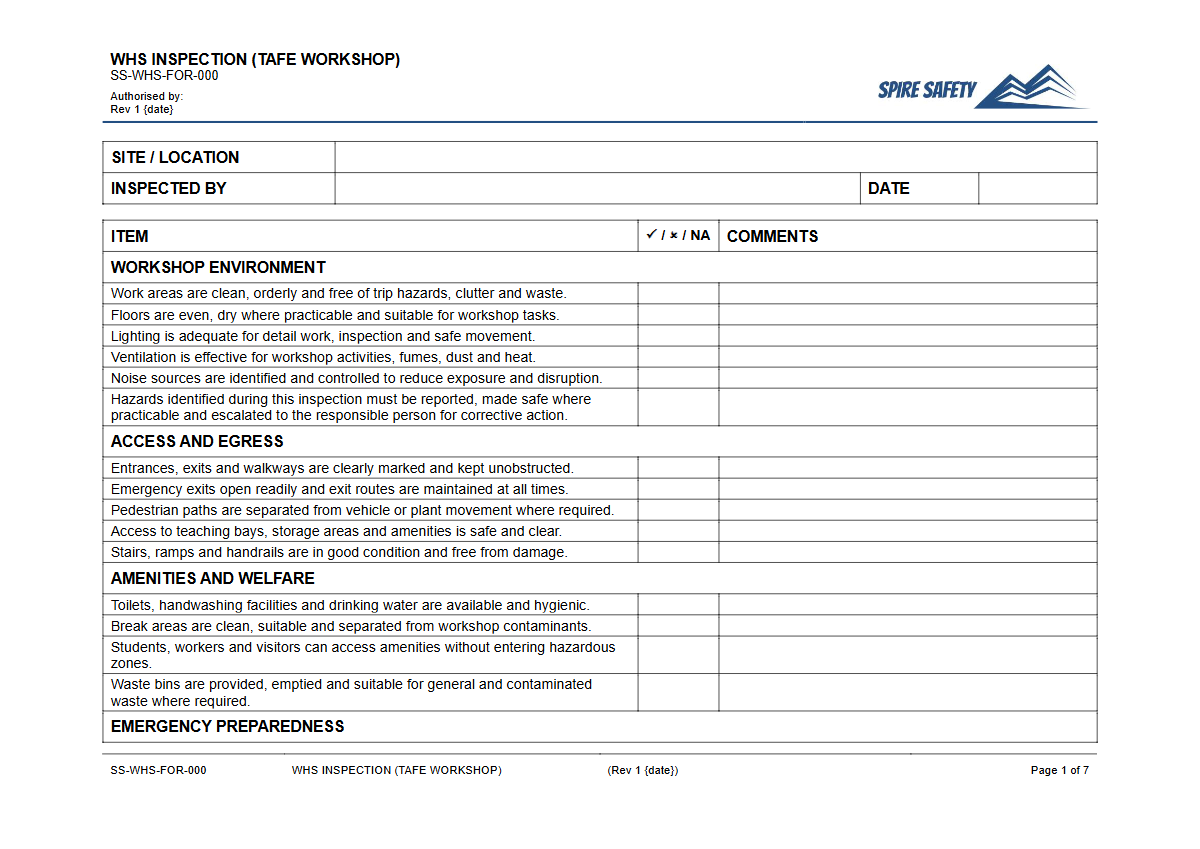
Download our Free WHS Inspection (TAFE Workshop) Template. A structured starting point for formalising safety checks in vocational education settings.
Free WHS Inspection (TAFE Workshop) Template
DOCX • 128 KB + PDF
Updated Oct 2026
No signup required
Purpose of the Free WHS Inspection (TAFE Workshop) Template
TAFE and RTO workshops are dynamic environments filled with machinery, tools, and substances that present unique work health and safety risks. This Free WHS Inspection (TAFE Workshop) Template provides a structured starting point for systematically identifying and assessing hazards specific to vocational training settings.
Regular, documented inspections are a cornerstone of effective safety management, helping your organisation meet its duty of care to both staff and students.
Using this template helps formalise the process of checking for common workshop hazards, such as inadequate machine guarding, poor housekeeping, electrical faults, incorrect storage of hazardous chemicals, and trip hazards. By proactively identifying these issues, you can implement control measures before an incident occurs.
Integrating these inspections is a critical part of developing robust WHS management systems that protect everyone on site.
Video walkthrough
How to use the Free WHS Inspection (TAFE Workshop) Template
To get the most value from this Inspection template, it must be adapted to the specific context of your workshop. A metalwork facility will have different risks to a commercial cookery kitchen or a hairdressing salon.
Download the DOCX file and customise it to reflect the unique equipment, processes, and layout of your training environment.
We strongly recommend you conduct this customisation process in consultation with the people who use the space every day—the teachers, technicians, and even senior students. Their practical knowledge is invaluable for identifying real-world hazards.
Once finalised, ensure all personnel responsible for conducting the inspections are trained on how to use the document correctly and understand the criteria for each checkpoint. For very specific plant, a general inspection can be supported by a more granular check, such as our Free Pre-Start Checklist (Electric Hoist) Template.
When to use it
Formal workshop inspections should be conducted on a regular, scheduled basis. The appropriate frequency—whether weekly, monthly, or per term—will depend on the level of risk and the intensity of use.
A high-traffic workshop with heavy machinery may require more frequent inspections than a lower-risk environment.
Beyond routine scheduling, this inspection should also be used in specific situations:
- Following any workplace incident, accident, or near miss.
- When new machinery, equipment, or hazardous substances are introduced.
- When work processes or the layout of the workshop are significantly changed.
- Before the commencement of a new school term or a large intake of new students.
Regular inspections form part of the evidence demonstrating proactive safety management, which can be invaluable during a formal WHS compliance audit.
Who should use it
This template is designed for use by individuals with responsibility for safety in a vocational education setting. This typically includes:
- Workshop Supervisors or Managers
- WHS/OHS Advisors and Officers
- Health and Safety Representatives (HSRs)
- Department Heads or Faculty Managers
While one person may lead the inspection, it is best practice to involve a small team, including an HSR and a staff member who works in the area. This collaborative approach improves the quality of the inspection and promotes a positive safety culture.
The findings and any required corrective actions should be formally reported to management for review, sign-off, and resource allocation. If your organisation needs assistance defining these roles and responsibilities, engaging external WHS consulting can provide clarity and direction.
For organisations offering courses in horticulture or groundskeeping, a general workshop inspection can be supplemented with equipment-specific checks. For example, our Free Pre-Start Checklist (Lawn Tractor) Template can be used to formalise daily safety verifications for mobile plant.
This template is just one of many documents available to help you build out your safety systems. You can explore our complete free WHS resources library for more checklists, procedures, and forms to support your safety goals.
Common mistakes
Common mistakes to avoid
- Using a generic checklist without customising it for the workshop's specific tools, equipment, and tasks.
- Failing to assign clear responsibility and realistic deadlines for completing corrective actions.
- Conducting the inspection without consulting the staff and HSRs who use the workshop daily.
- Not following up to verify that identified hazards have been effectively controlled.
Legal references
Legal considerations
The following legal requirements may be relevant to this type of work.
- Work Health and Safety Act (Harmonised) — Provides the primary duties for protecting workers and other people from work health and safety risks.
- Work Health and Safety Regulations (Harmonised) — Sets out requirements supporting the management of workplace hazards and risks.
The following codes may be relevant to this type of work.
- Managing WHS Risks Code of Practice — Provides practical guidance on identifying hazards, assessing risks and applying effective controls.
- Work Health and Safety Consultation, Cooperation and Coordination Code of Practice — Provides practical guidance on consulting workers and coordinating with other duty holders.
- Managing the Work Environment and Facilities Code of Practice — Provides practical guidance on safe work environments, workplace facilities and related controls.
Did you know
Duty of Care to Students
Under Australian WHS law, educational institutions like TAFEs have a primary duty of care for the health and safety of their students, who are considered 'other persons' at the workplace.
A Leading Cause of Injury
According to Safe Work Australia, incidents involving machinery and equipment are consistently a leading cause of serious injury claims across the Australian workforce, highlighting the importance of workshop safety.
FAQ
Frequently asked questions
01What is the difference between a workshop inspection and a pre-start check?
02How often should a TAFE workshop be formally inspected?
03Who is responsible for fixing hazards found during an inspection?
04Can students be involved in WHS inspections?
Share this resource
Free WHS Inspection (TAFE Workshop) Template
Browse Categories
How To Use It
- 1Download and open in Word or PDF.
- 2Replace the placeholders with your business details.
- 3Get it reviewed by a WHS specialist before rollout.
Need it customised?
Our WHS consultants can adapt this template to your site, run a gap analysis, or audit what you already have in place.
Book a Free Consultation WHS consulting servicesor call 1300 156 382