
Free WHS Inspection (Textile Factory) Template
Download our Free WHS Inspection (Textile Factory) Template to streamline safety checks.
Free WHS Inspection (Textile Factory) Template
DOCX • 128 KB + PDF
Updated Oct 2026
No signup required
Purpose of the Free WHS Inspection (Textile Factory) Template
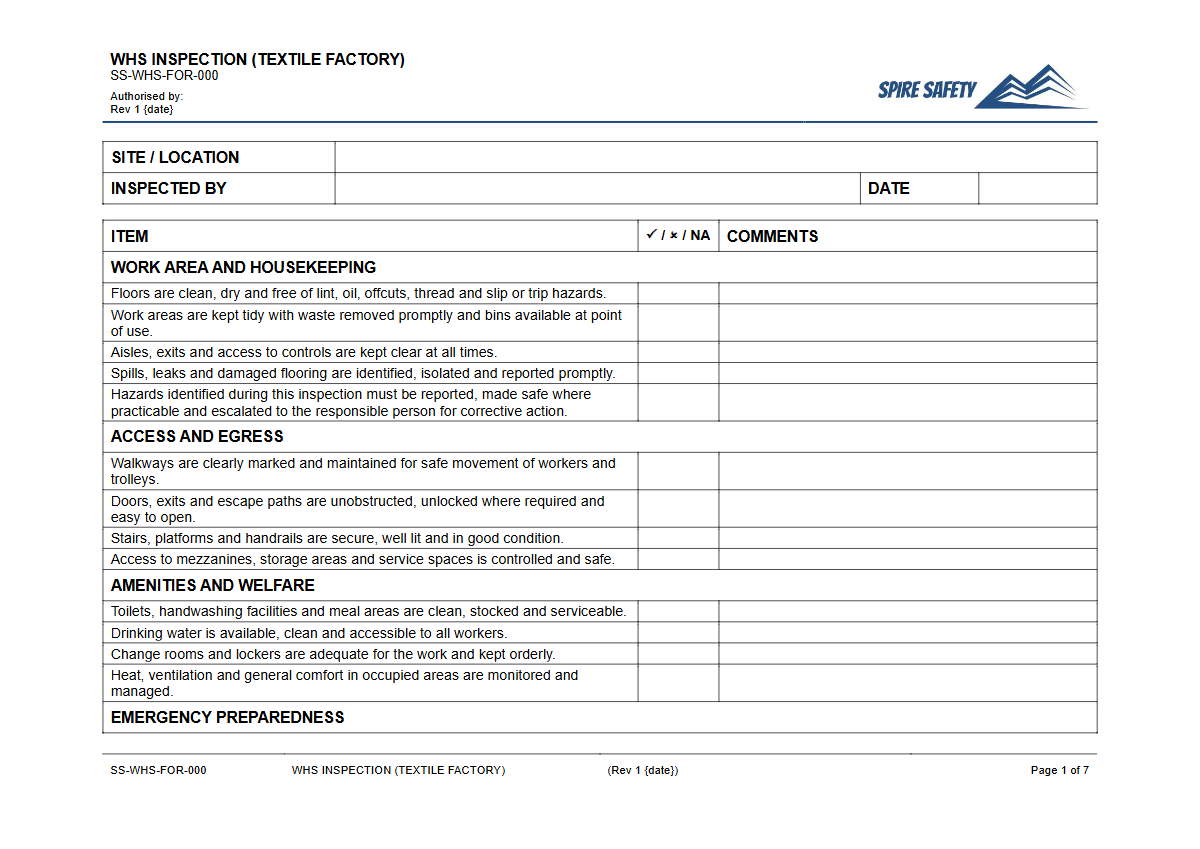
This Free WHS Inspection (Textile Factory) Template provides a structured starting point for systematically identifying and managing health and safety hazards in a textile manufacturing environment. Australian textile factories present a unique combination of risks, from fast-moving machinery and hazardous chemicals to airborne dust and high noise levels.
Using a formal checklist helps ensure that inspections are thorough, consistent, and documented, forming a crucial part of your overall safety management approach.
The template is designed to prompt a comprehensive review of key risk areas, including machine guarding on looms and cutting equipment, chemical storage for dyes and solvents, ventilation for dust control, and ergonomic risks from repetitive tasks. By formalising this process, you create a reliable record of your safety diligence and a clear action plan for hazard control. This proactive approach helps in preventing incidents and forms a fundamental component of effective WHS management systems.
Video walkthrough
How to use the Free WHS Inspection (Textile Factory) Template
Begin by downloading the template in your preferred format (DOCX for easy customisation or PDF for straightforward printing). Before use, it is crucial to adapt the document to the specific context of your facility.
The checklist covers common hazards found in the textile industry, but every workplace is different.
Important: It is crucial to customise this template for your specific workplace. We've provided a comprehensive starting point, but you must add, remove, or modify sections to reflect the unique machinery (e.g., specific models of sewing machines, dyeing vats, automated cutters), processes, chemicals, and layout of your facility.
Always consult with your workers and Health and Safety Representatives (HSRs) when tailoring the checklist.
Work through each section methodically, observing the conditions and practices in each area. For each item, record your findings and note any non-compliance or areas for improvement.
Where a hazard is identified, a corrective action should be assigned to a specific person with a clear deadline. For machinery-specific checks, such as those for lifting heavy fabric rolls, you can integrate detailed checks from other resources like our Free Pre-Start Checklist (Electric Hoist) Template.
When to use this Inspection Template
Workplace inspections should be conducted at regular, planned intervals to proactively identify developing hazards. The frequency will depend on the level of risk associated with different areas and activities.
A common schedule is monthly or quarterly for a full site inspection. However, more frequent inspections may be needed for high-risk areas, such as chemical storage or sections with high-speed machinery.
This comprehensive inspection should also be triggered by specific events, such as after a workplace incident or near miss, when new equipment or substances are introduced, or when there are changes to work processes or legislation. It serves a different purpose than daily equipment checks.
While a resource like a Free Pre-Start Checklist (Feed Mixer) Template is for operators to use before every shift on a single piece of plant, this broader inspection evaluates the entire work environment and its interacting systems.
Who should use this Inspection Template
This template is designed for use by personnel with responsibility for workplace health and safety. This typically includes WHS Managers, Site Supervisors, and business owners (or their delegates).
To ensure a comprehensive and practical inspection, it is best practice to involve the people who perform the work day-to-day. Health and Safety Representatives (HSRs) and experienced workers have invaluable firsthand knowledge of the risks and the effectiveness of current controls.
Completing the checklist creates a formal record that can be used for management review, safety committee meetings, and to demonstrate due diligence. The documented findings provide a clear, evidence-based foundation for making safety improvements and allocating resources.
These records are also essential if you undergo a third-party audit. Having a history of structured, completed inspections is a key indicator of a mature safety culture during a WHS compliance auditing process.
By implementing a regular inspection schedule using this template, you build a stronger, safer workplace. For more tools to support your safety program, explore our complete free WHS resources library.
Common mistakes
Common mistakes to avoid
- Failing to ensure machine guarding is in place and effective on all moving parts.
- Neglecting to check the adequacy of ventilation systems for controlling airborne dust and chemical vapours.
- Overlooking ergonomic risks associated with lifting heavy fabric rolls or performing repetitive tasks.
- Not verifying that Safety Data Sheets (SDS) are readily available for all chemicals and that workers are trained to understand them.
Legal references
Legal considerations
The following legal requirements may be relevant to this type of work.
- Work Health and Safety Act (Harmonised) — Provides the primary duties for protecting workers and other people from work health and safety risks.
- Work Health and Safety Regulations (Harmonised) — Sets out requirements supporting the management of workplace hazards and risks.
The following codes may be relevant to this type of work.
- Managing WHS Risks Code of Practice — Provides practical guidance on identifying hazards, assessing risks and applying effective controls.
- Work Health and Safety Consultation, Cooperation and Coordination Code of Practice — Provides practical guidance on consulting workers and coordinating with other duty holders.
- Managing the Work Environment and Facilities Code of Practice — Provides practical guidance on safe work environments, workplace facilities and related controls.
Did you know
Brown Lung Disease
Byssinosis, or 'brown lung disease', is a serious respiratory condition historically linked to inhaling dust from raw cotton, flax, or hemp processing in textile mills before modern ventilation standards were enforced.
Deafening Looms
Traditional weaving looms can operate at over 100 decibels, well above the 85 dBA exposure standard where hearing protection becomes mandatory. Noise-induced hearing loss is a significant and irreversible risk in the industry.
FAQ
Frequently asked questions
01What are the biggest WHS hazards in a textile factory?
02How often should I inspect textile manufacturing equipment?
03Can this template be used for a formal WHS audit?
04What is the difference between a pre-start check and a workplace inspection?
Share this resource
Free WHS Inspection (Textile Factory) Template
Browse Categories
How To Use It
- 1Download and open in Word or PDF.
- 2Replace the placeholders with your business details.
- 3Get it reviewed by a WHS specialist before rollout.
Need it customised?
Our WHS consultants can adapt this template to your site, run a gap analysis, or audit what you already have in place.
Book a Free Consultation WHS consulting servicesor call 1300 156 382