
Free WHS Inspection (Transfer Station) Template
Download our Free WHS Inspection (Transfer Station) Template to identify hazards and control risks in your facility. A structured starting point. Get it now.
Free WHS Inspection (Transfer Station) Template
DOCX • 128 KB + PDF
Updated Oct 2026
No signup required
Purpose of the Free WHS Inspection (Transfer Station) Template
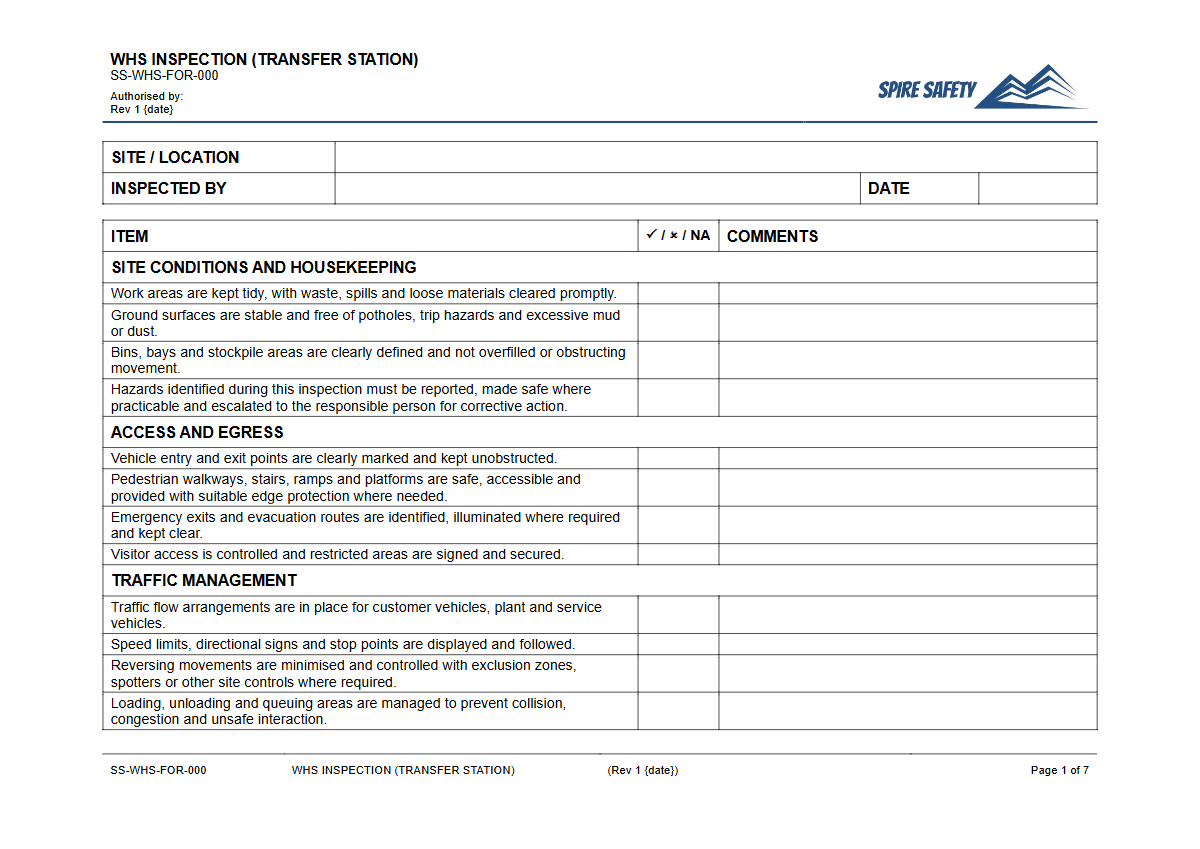
Operating a waste transfer station involves significant work health and safety risks, from moving vehicles and heavy machinery to hazardous materials and manual handling. This Free WHS Inspection (Transfer Station) Template provides a structured starting point for systematically identifying and assessing these hazards in your workplace.
Regular inspections are a cornerstone of proactive safety management, helping your organisation to meet its duty of care and prevent incidents before they occur. The template is designed to guide a competent person through a thorough check of key operational areas, ensuring that controls are in place and remain effective.
Using a formal checklist helps to standardise the inspection process, create documented records for due diligence, and track corrective actions over time. This document is aligned with Australian WHS principles and encourages a comprehensive approach to safety, covering everything from traffic management and plant safety to housekeeping and emergency procedures.
It serves as a practical tool to support your overall safety framework and foster a safer working environment for everyone on site.
Video walkthrough
How to use the Free WHS Inspection (Transfer Station) Template
This resource is available for download as a DOCX file for easy editing, or as a PDF for immediate use. The primary goal is to adapt the template to your specific operational context.
Transfer stations vary widely in size, layout, the types of waste they handle, and the equipment they use. Therefore, a generic checklist is insufficient for ensuring safety.
Customisation is Essential
IMPORTANT: Every workplace is unique. We have designed this template as a comprehensive starting point, but you MUST customise it to reflect the specific hazards, equipment (e.g., balers, compactors, vehicles), procedures, and legal requirements of your transfer station.
Add, remove, or modify checklist items to ensure it is entirely relevant to your site. A customised inspection checklist is a critical component of effective WHS management systems.
Conducting the Inspection
Once customised, the inspection should be carried out by a person or team with the right knowledge and training. The process involves walking through the site, methodically checking each item, recording observations, and noting any non-conformances or areas for improvement.
Any identified issues should be documented clearly, with recommendations for corrective actions, assigned responsibilities, and deadlines for completion. Involving health and safety representatives (HSRs) and workers in the inspection process is highly encouraged, as they bring valuable frontline experience.
Key Areas to Inspect
A thorough transfer station inspection should cover multiple facets of the operation. While your customised checklist will be more detailed, key areas generally include:
- Traffic Management: Check for clear and visible signage, separation of vehicles and pedestrians, designated walkways, speed limits, and the functional state of any traffic control devices. For sites with automated barriers, a pre-start checklist for boom gates can supplement daily checks.
- Plant and Equipment: Inspect machinery such as compactors, balers, conveyors, and mobile plant (e.g., front-end loaders). Verify that guards are in place, emergency stops are functional and accessible, and maintenance is up to date. For lifting equipment, specific checks like those in our Free Pre-Start Checklist (Electric Hoist) Template are vital.
- Hazardous Materials: Ensure correct procedures are followed for identifying, segregating, and storing hazardous waste (e.g., chemicals, asbestos, batteries). Check that safety data sheets (SDS) are available and appropriate personal protective equipment (PPE) is being used.
- Housekeeping and Environment: Assess the general tidiness of the site. Look for slip, trip, and fall hazards, control of dust and odours, proper waste containment, and the structural integrity of floors, platforms, and railings.
- Emergency Preparedness: Verify that fire extinguishers, first aid kits, and emergency eyewash stations are accessible, inspected, and signed. Ensure emergency exits are clear and personnel are trained in emergency procedures.
When to use it
Formal workplace inspections should be conducted at regular, planned intervals to proactively manage risk. The frequency will depend on the level of risk, the type of activity, and your organisation's specific procedures.
A common schedule might include weekly or monthly general inspections. This template should also be used following an incident or near miss, when new machinery or processes are introduced, or when concerns are raised by workers.
These checks form an essential part of ongoing monitoring and can be a key input for more extensive WHS compliance auditing activities.
Who should use it
This inspection template is designed for use by individuals with responsibilities for workplace safety. This includes Site Supervisors, Operations Managers, WHS Managers, and Health and Safety Representatives (HSRs).
It can also be used by a dedicated inspection team. The individuals performing the inspection must be competent to do so—meaning they have the necessary knowledge, training, and experience to recognise hazards specific to a transfer station environment.
For complex issues, seeking advice from external safety professionals may be necessary. If you need expert guidance in establishing your inspection program, our WHS consulting team can provide tailored support.
This is just one of many tools available to help improve safety in your workplace. For more templates, checklists, and guides, explore our complete free WHS resources library.
Common mistakes
Common mistakes to avoid
- Using a generic checklist without customising it for the specific site, equipment, and materials.
- Failing to create and track corrective actions to resolve identified hazards.
- Only performing inspections reactively after an incident has already occurred.
- Assigning inspections to personnel who are not adequately trained or familiar with transfer station hazards.
Legal references
Legal considerations
The following legal requirements may be relevant to this type of work.
- Work Health and Safety Act (Harmonised) — Provides the primary duties for protecting workers and other people from work health and safety risks.
- Work Health and Safety Regulations (Harmonised) — Sets out requirements supporting the management of workplace hazards and risks.
The following codes may be relevant to this type of work.
- Managing WHS Risks Code of Practice — Provides practical guidance on identifying hazards, assessing risks and applying effective controls.
- Work Health and Safety Consultation, Cooperation and Coordination Code of Practice — Provides practical guidance on consulting workers and coordinating with other duty holders.
- Managing the Work Environment and Facilities Code of Practice — Provides practical guidance on safe work environments, workplace facilities and related controls.
Did you know
A High-Risk Industry
The Waste and Recycling industry in Australia is recognised as one of the highest-risk sectors, with a fatality rate significantly higher than the all-industry average, primarily due to incidents involving vehicles and machinery.
FAQ
Frequently asked questions
01What is a WHS inspection for a transfer station?
02How often should a transfer station be inspected?
03Who is responsible for safety at a waste transfer station?
04What are the main hazards at a waste transfer station?
Share this resource
Free WHS Inspection (Transfer Station) Template
Browse Categories
How To Use It
- 1Download and open in Word or PDF.
- 2Replace the placeholders with your business details.
- 3Get it reviewed by a WHS specialist before rollout.
Need it customised?
Our WHS consultants can adapt this template to your site, run a gap analysis, or audit what you already have in place.
Book a Free Consultation WHS consulting servicesor call 1300 156 382