
Free WHS Inspection (Tyre Workshop) Template
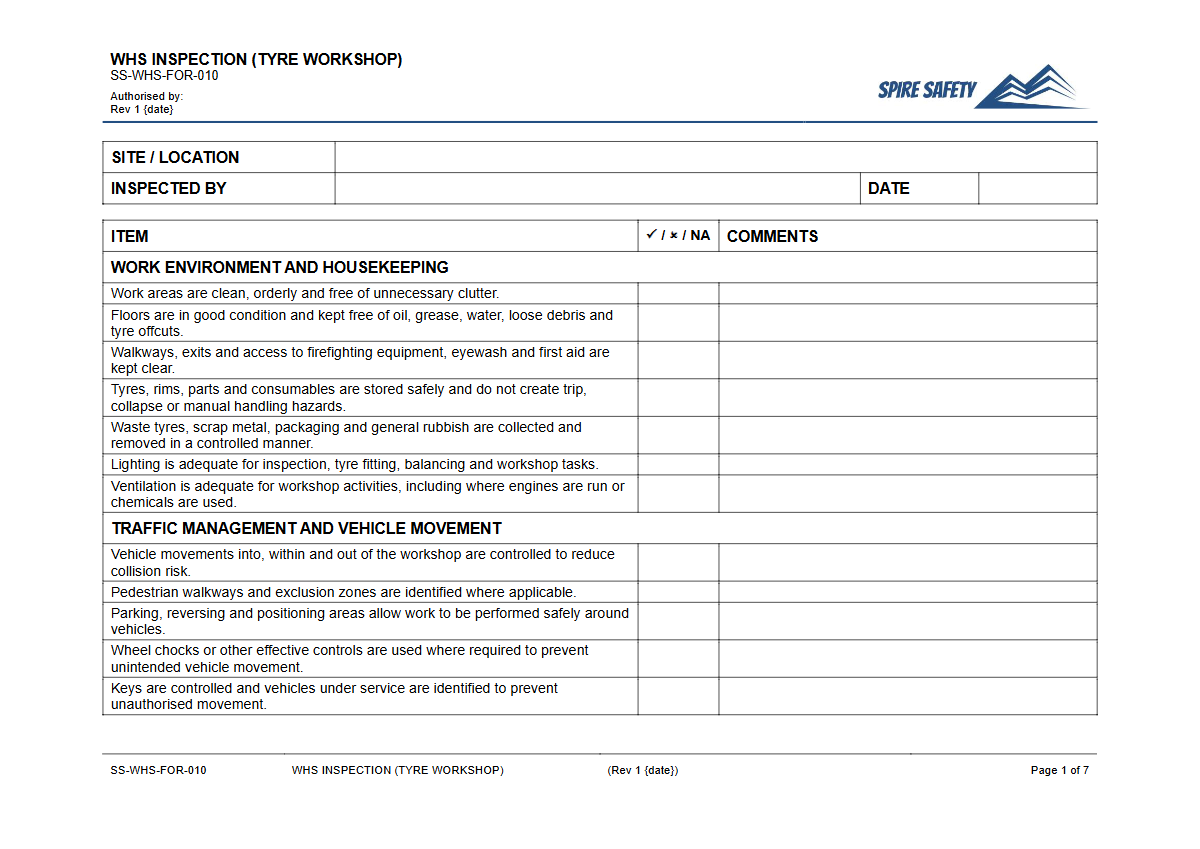
Download our Free WHS Inspection (Tyre Workshop) Template (DOCX & PDF). A structured starting point for identifying and managing WHS risks in your workshop.
Free WHS Inspection (Tyre Workshop) Template
DOCX • 128 KB + PDF
Updated Oct 2026
No signup required
Purpose of the Free WHS Inspection (Tyre Workshop) Template
Proactively managing health and safety in a tyre workshop is crucial for preventing injuries and ensuring operational continuity. Our Free WHS Inspection (Tyre Workshop) Template provides a structured starting point for identifying and controlling common hazards associated with tyre fitting and repair.
This downloadable DOCX and PDF resource is designed to help you formalise your safety processes, covering everything from equipment safety to general workshop conditions, aligning with Australian WHS principles.
A tyre workshop contains numerous hazards, including manual handling of heavy wheels, exposure to pressurised air systems, interaction with moving vehicles, and the use of machinery like tyre changers and wheel balancers. This Inspection template guides you through a systematic check of key areas to help you identify unsafe conditions or at-risk behaviours before they lead to an incident.
It covers critical items such as the condition of pneumatic hoses, the functionality of machine guarding, the safe storage of tools and materials, and the adequacy of housekeeping.
The template also prompts checks on general site safety, such as managing vehicle and pedestrian traffic, including checks on access control systems like those covered in our free Pre-Start Checklist (Boom Gate) Template.
Video walkthrough
How to use the Free WHS Inspection (Tyre Workshop) Template
Using this template effectively involves more than just filling it out. Follow these steps to integrate it properly into your safety practices:
- Download and Customise: Download the template in the format that works best for you. Crucially, this template is a starting point. We recommend you customise it thoroughly to reflect the specific equipment, layout, chemicals, and processes unique to your own workshop. Add or remove items to make it directly relevant to your operations.
- Integrate: Incorporate the inspection schedule and procedure into your overall safety processes. A robust inspection program is a key component of effective WHS management systems.
- Train Personnel: Ensure that the person or people conducting the inspection are competent. They must understand the hazards of the workshop and be trained on what to look for and how to document findings accurately.
- Schedule and Conduct: Implement a regular schedule for inspections. Once completed, the findings should be signed, dated, and filed for record-keeping purposes.
- Review and Action: The most important step is to act on the findings. Assign corrective actions for any identified hazards or non-conformances, set deadlines for completion, and track them through to resolution. Simply identifying a problem is not enough to discharge your duty of care.
When to conduct a Tyre Workshop Inspection
The frequency of your workshop inspections should be based on risk. A good starting point is to conduct a full workshop inspection on a monthly or quarterly basis.
This helps identify gradual degradation of equipment, poor housekeeping trends, or outdated procedures. Daily or pre-start checks should also be performed on critical pieces of equipment, such as tyre inflation cages and vehicle hoists.
Additionally, a full inspection is recommended after an incident or near miss, when introducing new equipment or processes, or if there has been a significant change in legislation or industry standards.
While the template covers general equipment, specific high-risk plant like lifting devices requires its own detailed check. You can use our free Pre-Start Checklist for Electric Hoists for this purpose.
Who should conduct the Inspection
A workplace inspection can be carried out by various personnel, depending on your business structure. This could include the Workshop Manager, a Supervisor, a Health and Safety Representative (HSR), or a competent worker who has received appropriate training.
It is beneficial to involve different people over time to bring fresh eyes to the process. The person conducting the inspection must be familiar with the work performed and empowered to report findings without fear of reprisal.
These routine inspections complement, but do not replace, the need for periodic, independent WHS compliance auditing to get an objective assessment of your safety performance.
Explore our full free WHS resources library for more templates, checklists, and guides to support your safety management system.
Common mistakes
Common mistakes to avoid
- Using a generic checklist without customising it for the specific equipment and layout of the workshop.
- Failing to follow up on corrective actions identified during the inspection.
- 'Pencil-whipping' the checklist without physically and thoroughly checking each item.
- Assigning inspections to untrained staff who may not recognise developing hazards.
Legal references
Legal considerations
The following legal requirements may be relevant to this type of work.
- Work Health and Safety Act (Harmonised) — Provides the primary duties for protecting workers and other people from work health and safety risks.
- Work Health and Safety Regulations (Harmonised) — Sets out requirements supporting the management of workplace hazards and risks.
The following codes may be relevant to this type of work.
- Managing WHS Risks Code of Practice — Provides practical guidance on identifying hazards, assessing risks and applying effective controls.
- Work Health and Safety Consultation, Cooperation and Coordination Code of Practice — Provides practical guidance on consulting workers and coordinating with other duty holders.
- Managing the Work Environment and Facilities Code of Practice — Provides practical guidance on safe work environments, workplace facilities and related controls.
Did you know
Tyre Inflation Risks
An unsecured 11R22.5 truck tyre inflated to 120 PSI contains approximately 35,000 foot-pounds of stored energy. If it were to rupture, the resulting explosion can be fatal, which is why safety cages are a critical control.
FAQ
Frequently asked questions
01What are the biggest WHS risks in a tyre workshop?
02How often should I inspect tyre fitting equipment?
03Is a generic workplace inspection checklist enough for a tyre workshop?
04Who is responsible for workplace safety in a tyre workshop?
Share this resource
Free WHS Inspection (Tyre Workshop) Template
Browse Categories
How To Use It
- 1Download and open in Word or PDF.
- 2Replace the placeholders with your business details.
- 3Get it reviewed by a WHS specialist before rollout.
Need it customised?
Our WHS consultants can adapt this template to your site, run a gap analysis, or audit what you already have in place.
Book a Free Consultation WHS consulting servicesor call 1300 156 382