
Free WHS Inspection (Warehouse) Template
Proactively manage safety in your warehouse with our Free WHS Inspection Template. A structured starting point to identify and control common hazards.
Free WHS Inspection (Warehouse) Template
DOCX • 127 KB + PDF
Updated Oct 2026
No signup required
Purpose of the Free WHS Inspection (Warehouse) Template
Warehouses are dynamic and often high-risk environments, containing hazards from moving plant and vehicles to manual tasks and storage systems. This Free WHS Inspection (Warehouse) Template provides a structured starting point for systematically identifying these hazards and ensuring control measures are in place and effective.
Regular, documented inspections are a fundamental part of a proactive safety culture, helping your organisation meet its duty of care and prevent incidents before they occur.
Using a standardised template helps ensure consistency and thoroughness in your inspection process. It prompts the inspector to check key areas such as pedestrian safety, pallet racking integrity, traffic management, and emergency equipment. The findings from these inspections are crucial for informing risk assessments and are a vital component of robust WHS management systems.
Video walkthrough
How to use the Free WHS Inspection (Warehouse) Template
This template is designed for ease of use. After downloading the DOCX file, you can add your company logo and details before printing or using it digitally.
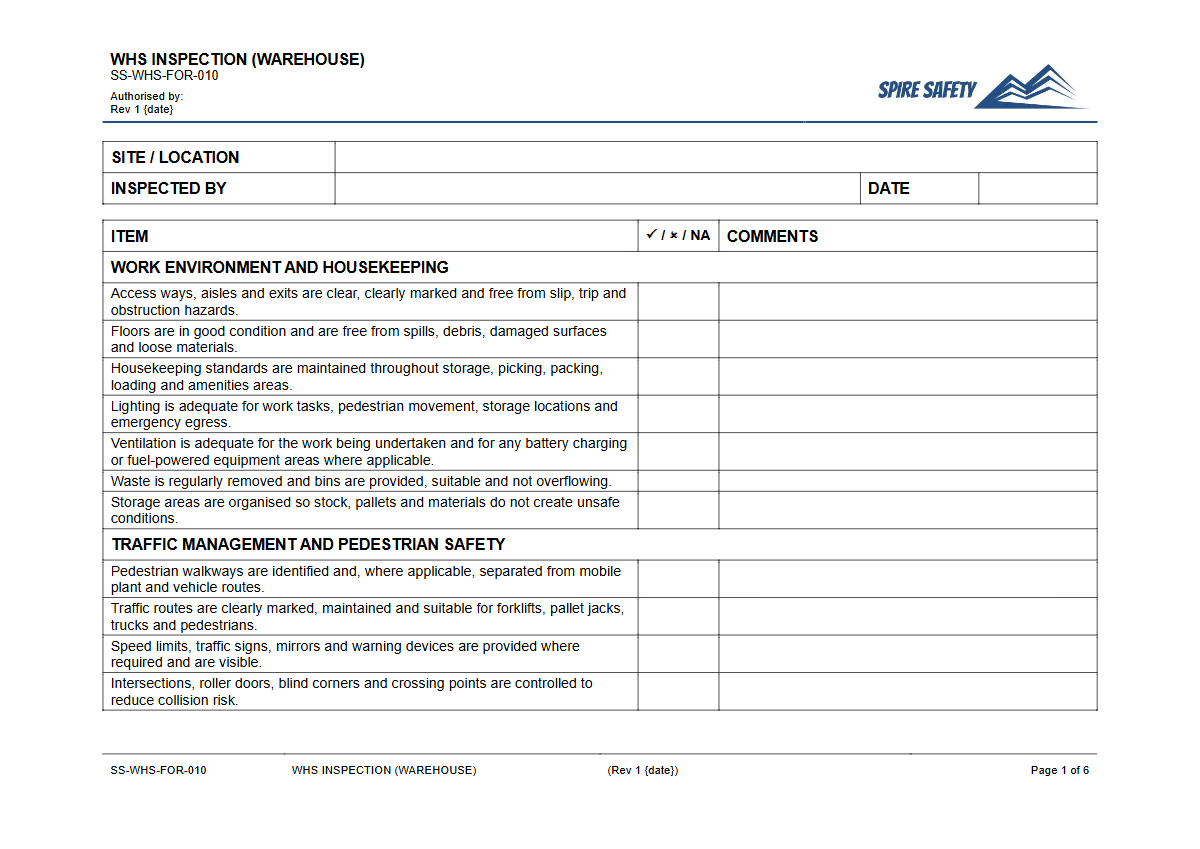
It guides the user through various sections of a typical warehouse, with checkboxes and space for comments to note observations, non-compliances, and required corrective actions. A corresponding PDF version is also available for straightforward printing and distribution.
Please note: This template provides a general framework and must be customised to your specific workplace. We recommend a person competent in WHS consulting reviews your final document to ensure it adequately covers all unique hazards and operational requirements of your site.
The goal is to create a checklist that is directly relevant to your layout, equipment, and processes.
What is covered in the Inspection?
The template is organised into logical sections to ensure comprehensive coverage of common warehouse risks, including:
- General Environment and Housekeeping
- Traffic Management (Vehicles and Pedestrians)
- Pallet Racking and Storage Systems
- Plant and Equipment
- Manual Tasks
- Hazardous Chemicals
- Emergency and First Aid Facilities
While this Inspection covers general plant and equipment, specific items may require their own daily checks. For example, many warehouses use lifting equipment which should be checked before each shift using a specific tool like our free pre-start checklist for an electric hoist.
When to use it
Formal warehouse inspections should be conducted at regular, scheduled intervals as determined by your risk assessment—for example, monthly or quarterly. The frequency may be increased for higher-risk areas.
In addition to scheduled inspections, this template should be used whenever there are significant changes in the workplace, such as the introduction of new racking systems, a change in layout, or the use of new types of mobile plant. It is also best practice to conduct an inspection after an incident or near miss to identify any contributing system failures.
These formal inspections complement, but do not replace, the need for daily pre-start checks on equipment. Checking key infrastructure like security barriers is also important; you can formalise this with our boom gate pre-start checklist.
Who should use it
This template is ideal for use by Warehouse Managers, Supervisors, Health and Safety Representatives (HSRs), and members of a Health and Safety Committee. The person or team conducting the inspection should be familiar with the warehouse's operations and have received training in hazard identification and risk management principles.
To ensure impartiality and fresh eyes, it can be beneficial to have a team of at least two people, including a manager from the area and an HSR or safety team member.
The completed inspection report, particularly the corrective actions, should be reviewed by management. Significant or recurring issues identified during the inspection may indicate a need for a more in-depth review or a formal WHS compliance audit to assess the effectiveness of your overall safety systems.
Specific areas within a warehouse, such as cold storage or freezer rooms, present unique risks like cold stress and ice build-up. These areas require dedicated attention during an inspection, which can be supplemented by specific equipment checks using a resource like our pre-start checklist for freezers.
By implementing a routine of documented inspections, your organisation creates a valuable record of its risk management activities. For more tools to support your safety program, feel free to browse our complete free WHS resources library for a wide range of checklists, templates, and procedures.
Common mistakes
Common mistakes to avoid
- Failing to customise the template for the specific site's hazards and layout.
- Only 'ticking and flicking' without properly investigating potential issues.
- Not assigning clear responsibility and deadlines for corrective actions found during the inspection.
- Poor record-keeping, making it difficult to track trends or prove due diligence.
Legal references
Legal considerations
The following legal requirements may be relevant to this type of work.
- Work Health and Safety Act (Harmonised) — Provides the primary duties for protecting workers and other people from work health and safety risks.
- Work Health and Safety Regulations (Harmonised) — Sets out requirements supporting the management of workplace hazards and risks.
The following codes may be relevant to this type of work.
- Managing WHS Risks Code of Practice — Provides practical guidance on identifying hazards, assessing risks and applying effective controls.
- Work Health and Safety Consultation, Cooperation and Coordination Code of Practice — Provides practical guidance on consulting workers and coordinating with other duty holders.
- Managing the Work Environment and Facilities Code of Practice — Provides practical guidance on safe work environments, workplace facilities and related controls.
Did you know
Forklift Dangers
According to Safe Work Australia, incidents involving forklifts are a leading cause of serious injury and death in Australian warehouses. Clear separation of pedestrian and vehicle traffic is a critical control measure.
Racking Collapse
Pallet racking that is overloaded, incorrectly installed, or damaged by impact poses a significant collapse risk. Regular inspection and maintenance of racking systems is a legal requirement in Australia.
FAQ
Frequently asked questions
01What is the difference between a warehouse inspection and a risk assessment?
02How often should warehouse safety inspections be conducted in Australia?
03What are the most common hazards in a warehouse?
04Who is responsible for actioning items from a warehouse inspection report?
Share this resource
Free WHS Inspection (Warehouse) Template
Browse Categories
How To Use It
- 1Download and open in Word or PDF.
- 2Replace the placeholders with your business details.
- 3Get it reviewed by a WHS specialist before rollout.
Need it customised?
Our WHS consultants can adapt this template to your site, run a gap analysis, or audit what you already have in place.
Book a Free Consultation WHS consulting servicesor call 1300 156 382