
Free WHS Inspection (Waste Facility) Template
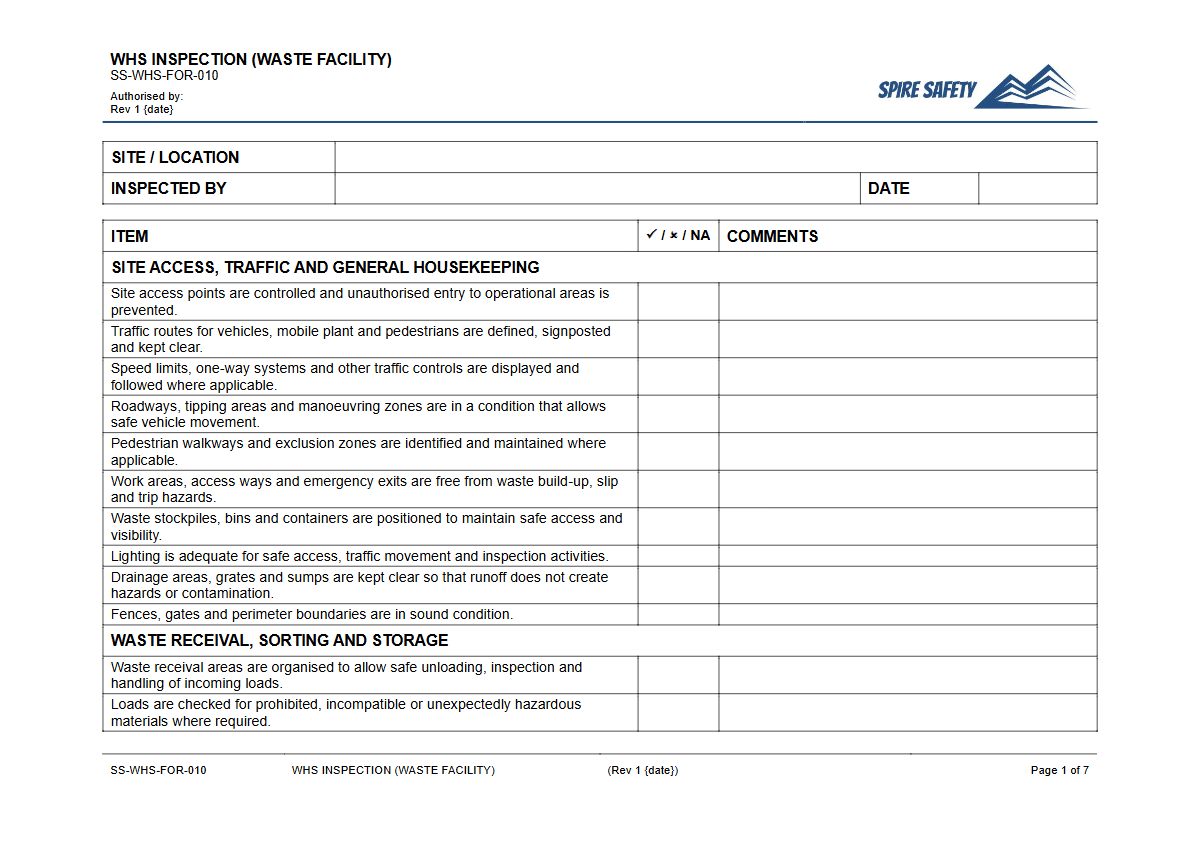
Manage safety in high-risk waste environments with our free WHS Inspection (Waste Facility) Template. A structured starting point to identify hazards.
Free WHS Inspection (Waste Facility) Template
DOCX • 128 KB + PDF
Updated Oct 2026
No signup required
Purpose of the Free WHS Inspection (Waste Facility) Template
Waste facilities are inherently high-risk workplaces, combining mobile plant, heavy vehicle traffic, hazardous substances, and potential biological hazards. A systematic approach to safety is essential.
Our free WHS Inspection (Waste Facility) Template provides a structured starting point for identifying and controlling these risks. Regular, documented inspections are a cornerstone of proactive safety management, helping your organisation meet its duty of care and maintain a safe working environment for all personnel and visitors.
This inspection template is designed to integrate into your existing safety framework. It helps formalise the process of hazard identification, risk assessment, and the implementation of control measures. By using a consistent template, you create a documented history of your site's condition, which is invaluable for tracking trends, demonstrating due diligence, and continuously improving your WHS management systems.
Video walkthrough
How to use the Free WHS Inspection (Waste Facility) Template
Download the template in your preferred format (DOCX for easy editing or PDF for straightforward printing). It's crucial to understand that this document is a template, not a finished product.
You must customise it to reflect the specific hazards, equipment, and operational procedures of your unique waste facility.
Important: We have created this template as a guide based on common industry practice. To make it useful for your business, you must review and customise it to address the specific equipment, processes, and risks in your workplace.
A generic checklist that doesn't reflect your reality offers limited protection.
Key Inspection Areas
Your customisation should focus on key risk areas common to waste facilities. The template prompts you to consider items such as traffic management, pedestrian safety, stockpile stability, fire prevention, and spill containment.
It also includes sections for assessing the condition of safety equipment, plant and machinery, and first aid facilities. For specific plant, you might use detailed pre-start checklists, such as our free Electric Hoist Pre-Start Checklist, to supplement your general inspection.
Don't overlook site maintenance and groundskeeping, which can present their own hazards. This includes managing vegetation, ensuring clear access routes, and maintaining fencing and security infrastructure.
For equipment used in these tasks, a specific checklist like our free Lawn Tractor Pre-Start Checklist can be beneficial.
When to use this Inspection Template
The frequency of inspections should be determined by a risk assessment. High-risk areas or activities may require daily or weekly checks, while a full-site inspection might be conducted monthly or quarterly.
This template is suitable for scheduled, routine safety tours conducted by supervisors or the health and safety committee. It can also be used for unscheduled inspections, such as those following a reported incident or near miss, or after significant changes to the workplace, like the introduction of new machinery or a change in layout.
For access control points, which see constant use, daily checks are often warranted. Using a dedicated checklist, such as our free Boom Gate Pre-Start Checklist, ensures these critical safety components are always functional.
Who should use this Inspection Template
This inspection template can be used by various personnel, including Site Supervisors, Department Managers, WHS Representatives, and members of the Health and Safety Committee. The key is that the person conducting the inspection must be competent to do so.
This means they should be familiar with the work area, understand the potential hazards, have knowledge of relevant WHS legislation and site procedures, and be trained in the inspection process itself.
For complex sites or as part of a formal audit program, you may consider engaging external expertise. A qualified safety professional can provide an independent perspective and help identify issues that may be missed by those familiar with the day-to-day operations.
Spire Safety offers professional WHS consulting services to assist with this process.
This resource is just one of many tools designed to support your safety efforts. For more templates, checklists, and guides, browse our complete free WHS resources library.
Common mistakes
Common mistakes to avoid
- Using a generic checklist without customising it for the specific site and its unique hazards.
- Failing to assign responsibility and deadlines for the corrective actions identified during the inspection.
- Not providing adequate training to the personnel tasked with conducting the inspections.
- Focusing only on physical hazards and overlooking risks like biological exposure, chemical safety, or psychosocial issues.
Legal references
Legal considerations
The following legal requirements may be relevant to this type of work.
- Work Health and Safety Act (Harmonised) — Provides the primary duties for protecting workers and other people from work health and safety risks.
- Work Health and Safety Regulations (Harmonised) — Sets out requirements supporting the management of workplace hazards and risks.
The following codes may be relevant to this type of work.
- Managing WHS Risks Code of Practice — Provides practical guidance on identifying hazards, assessing risks and applying effective controls.
- Work Health and Safety Consultation, Cooperation and Coordination Code of Practice — Provides practical guidance on consulting workers and coordinating with other duty holders.
- Managing the Work Environment and Facilities Code of Practice — Provides practical guidance on safe work environments, workplace facilities and related controls.
Did you know
A High-Risk Industry
According to Safe Work Australia, the waste collection industry has one of the highest rates of serious workers' compensation claims, highlighting the critical need for robust safety inspections and management.
FAQ
Frequently asked questions
01What are the most common hazards at a waste facility?
02How often should a waste facility be inspected for WHS issues?
03Who is responsible for conducting WHS inspections in a waste facility?
04Can I use this template for any type of waste facility?
Share this resource
Free WHS Inspection (Waste Facility) Template
Browse Categories
How To Use It
- 1Download and open in Word or PDF.
- 2Replace the placeholders with your business details.
- 3Get it reviewed by a WHS specialist before rollout.
Need it customised?
Our WHS consultants can adapt this template to your site, run a gap analysis, or audit what you already have in place.
Book a Free Consultation WHS consulting servicesor call 1300 156 382