
Free WHS Inspection (Welding Workshop) Template
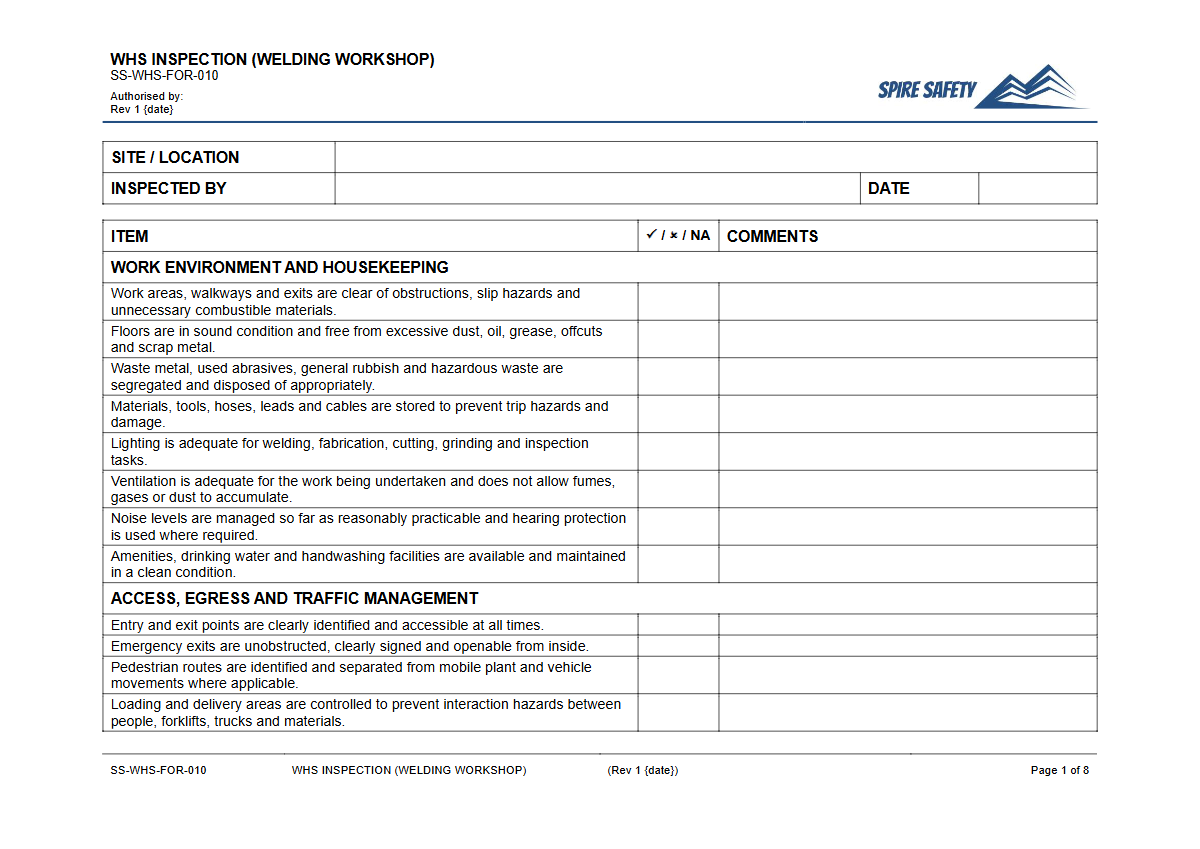
Download our Free WHS Inspection (Welding Workshop) Template to formalise safety checks in your fabrication environment. Aligned with Australian WHS practice.
Free WHS Inspection (Welding Workshop) Template
DOCX • 129 KB + PDF
Updated Oct 2026
No signup required
Purpose of the Free WHS Inspection (Welding Workshop) Template
Welding workshops present a unique combination of high-risk hazards, including ultraviolet radiation, toxic fumes, electrical dangers, and significant fire or explosion risks. This Free WHS Inspection (Welding Workshop) Template provides a structured starting point for systematically identifying, assessing, and controlling these hazards.
Regular, documented inspections are a cornerstone of proactive safety management, helping your organisation meet its duty of care and prevent incidents before they occur. This template helps formalise the process, ensuring key safety elements from equipment condition to emergency preparedness are not overlooked.
Using a standardised checklist ensures consistency and thoroughness, regardless of who performs the inspection. It creates a documented record of your safety diligence, which is crucial for demonstrating compliance and continuous improvement.
The template is designed to be integrated into a comprehensive WHS management system, providing valuable data for risk assessments and safety meetings.
Video walkthrough
How to use the Free WHS Inspection (Welding Workshop) Template
This document serves as a foundational guide for inspecting your welding and fabrication areas. It is delivered in both DOCX and PDF formats, allowing for easy customisation or immediate use.
Follow these steps to get the most out of your Inspection template:
- Download: Select the DOCX file for editing or the PDF for straightforward printing.
- Customise: Adapt the checklist to the specific context of your workshop. Add or remove items based on the types of welding performed (e.g., MIG, TIG, Stick, Plasma), the specific equipment in use, the layout of the workspace, and the materials being worked on.
- Conduct the Inspection: Walk through the workshop and systematically complete the checklist. For each item, note its condition, marking it as compliant, non-compliant, or not applicable. Add detailed comments and photographic evidence for any identified issues.
- Document and Act: Record any non-compliances or hazards. Assign corrective actions to responsible persons with clear deadlines. File the completed inspection report for your records.
- Review and Improve: Use the findings from your inspections to update your risk assessments, safe work procedures, and training programs.
Important: This is a template, not a finished document. To be effective, you must customise it to reflect the specific hazards and control measures relevant to your workplace.
We cannot guarantee it covers every possible risk for your unique operations.
When to use it
Regular inspections are key to maintaining a safe welding environment. The frequency of inspections should be determined by your own risk assessment, but a typical schedule might include:
- Routine Inspections: Conducted at regular intervals, such as monthly or quarterly, to monitor ongoing safety performance and equipment condition.
- After an Incident: A thorough inspection should be part of any incident investigation to identify causal factors and prevent recurrence.
- Legislative Changes: When WHS laws or codes of practice related to welding are updated.
- Introduction of New Equipment: Before commissioning any new welders, cutting tools, or ventilation systems.
- Changes in Workshop Layout or Process: If you reconfigure the workspace or introduce new welding techniques or materials.
These scheduled inspections supplement, but do not replace, daily pre-start checks on individual pieces of equipment. Some industrial sites also use specific checks for shared plant; for example, our free Pre-Start Checklist (Electric Hoist) Template can be adapted for workshops that use hoists for material handling.
Who should use it
This Inspection template is designed for use by personnel with responsibility for workplace safety. This can include:
- Workshop Supervisors or Foremen: Those with direct oversight of daily operations and the first line of responsibility for worker safety.
- WHS Managers and Safety Officers: Professionals responsible for developing and implementing the organisation's safety management system.
- Health and Safety Representatives (HSRs): Elected representatives who can use this tool to facilitate inspections and discussions with management.
- Business Owners (PCBUs): For smaller operations, the Person Conducting a Business or Undertaking (PCBU) may perform inspections to ensure they are meeting their primary duty of care.
For organisations seeking external verification of their safety practices, the data from these internal inspections provides valuable input for a formal WHS compliance audit. Consistent internal checks demonstrate a mature approach to safety management. Larger facilities may also need to consider site-wide controls, such as those covered in our free Pre-Start Checklist (Boom Gate) Template for vehicle access points. You can find more templates like this in our complete free WHS resources library.
Common mistakes
Common mistakes to avoid
- Using a generic checklist without customising it for site-specific equipment and processes.
- Overlooking the condition and suitability of fume extraction and ventilation systems.
- Failing to check the accessibility and serviceability of fire extinguishers and fire blankets.
- Ignoring the condition of Personal Protective Equipment (PPE), such as cracked helmet lenses or damaged gloves.
Legal references
Legal considerations
The following legal requirements may be relevant to this type of work.
- Work Health and Safety Act (Harmonised) — Provides the primary duties for protecting workers and other people from work health and safety risks.
- Work Health and Safety Regulations (Harmonised) — Sets out requirements supporting the management of workplace hazards and risks.
The following codes may be relevant to this type of work.
- Managing WHS Risks Code of Practice — Provides practical guidance on identifying hazards, assessing risks and applying effective controls.
- Work Health and Safety Consultation, Cooperation and Coordination Code of Practice — Provides practical guidance on consulting workers and coordinating with other duty holders.
- Managing the Work Environment and Facilities Code of Practice — Provides practical guidance on safe work environments, workplace facilities and related controls.
Did you know
Invisible Danger
Welding fumes are a complex mixture of metallic oxides, silicates, and fluorides. In 2017, the International Agency for Research on Cancer (IARC) reclassified welding fumes as 'carcinogenic to humans' (Group 1).
Arc Eye
Arc eye, or photokeratitis, is a painful eye condition caused by exposure to UV radiation from a welding arc. Symptoms can appear hours after exposure and are often described as feeling like sand in the eyes.
FAQ
Frequently asked questions
01What are the most common hazards in a welding workshop?
02How often should welding equipment be inspected?
03Who is qualified to conduct a welding workshop inspection?
04Does this template include hot work permits?
Share this resource
Free WHS Inspection (Welding Workshop) Template
Browse Categories
How To Use It
- 1Download and open in Word or PDF.
- 2Replace the placeholders with your business details.
- 3Get it reviewed by a WHS specialist before rollout.
Need it customised?
Our WHS consultants can adapt this template to your site, run a gap analysis, or audit what you already have in place.
Book a Free Consultation WHS consulting servicesor call 1300 156 382