
Free WHS Inspection (Workshop) Template
Download our Free WHS Inspection (Workshop) Template to proactively identify and manage hazards in your workshop.
Free WHS Inspection (Workshop) Template
DOCX • 127 KB + PDF
Updated Oct 2026
No signup required
Purpose of the Free WHS Inspection (Workshop) Template
Regularly inspecting your workshop is a fundamental part of maintaining a safe work environment. This Free WHS Inspection (Workshop) Template provides a structured starting point for systematically identifying hazards, assessing risks, and ensuring control measures are effective.
Using a formal checklist helps move beyond ad-hoc checks, creating a documented record of your safety diligence. Proactive inspections allow you to find and fix issues—from slip hazards and poor housekeeping to unguarded machinery and faulty electrical equipment—before they lead to an incident.
A consistent inspection process is a key component of any robust safety framework. It demonstrates a commitment to health and safety and provides valuable data for continuous improvement.
Integrating regular checks like these helps build and maintain effective WHS management systems, ensuring safety is an organised, ongoing activity rather than a reactive one.
Video walkthrough
How to use the Free WHS Inspection (Workshop) Template
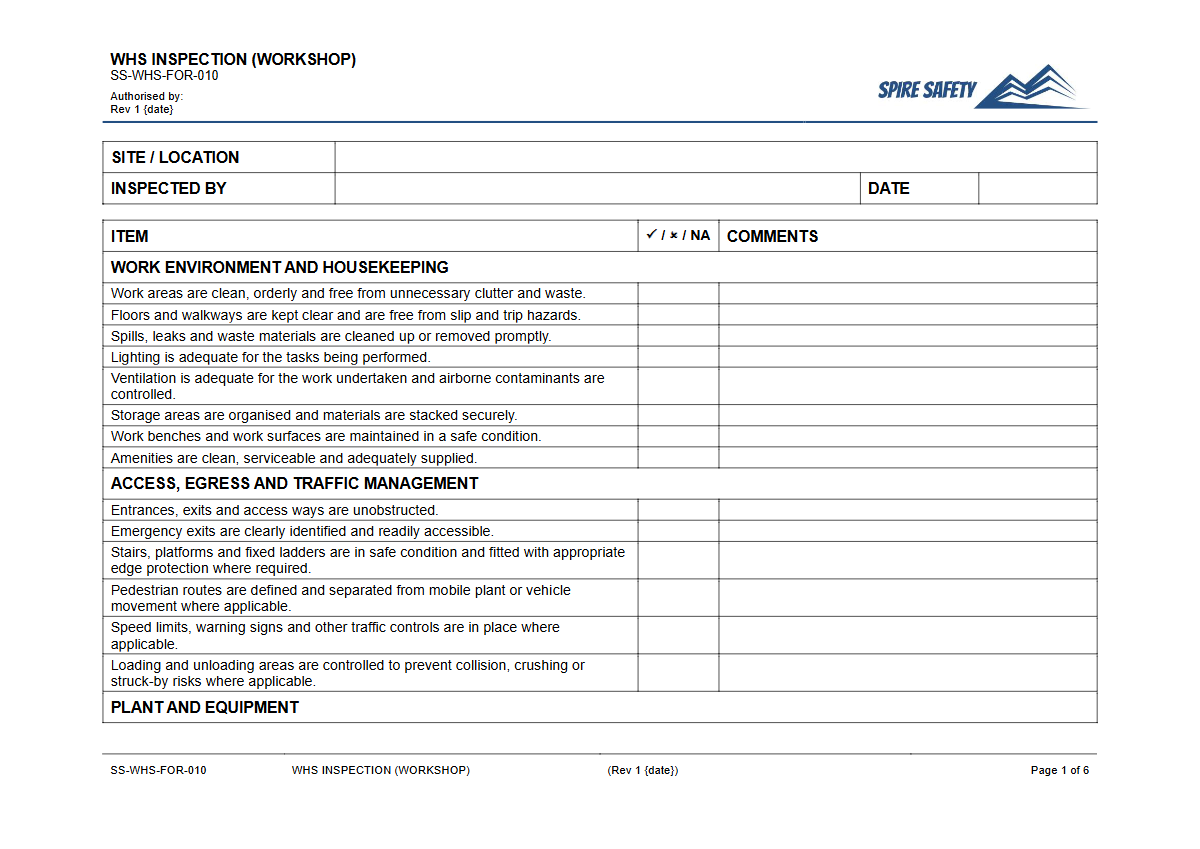
Our workshop inspection template is designed to be a comprehensive but adaptable tool. It covers common areas of concern in a typical workshop environment, including general housekeeping, fire safety, electrical safety, machinery and equipment, chemical storage, and personal protective equipment (PPE).
The document is formatted as a simple checklist, allowing the inspector to mark items as compliant, non-compliant, or not applicable, with space to add comments and required actions.
Important: This template is a starting point and must be customised to your specific workplace. Every workshop is different, with unique layouts, equipment, and processes.
We recommend you walk through your workshop and add, remove, or modify checklist items to reflect the actual hazards and control measures relevant to your operations. For example, some workshops may require dedicated checks for specific high-risk plant; for these, you may need a more detailed document like our Free Pre-Start Checklist (Electric Hoist) Template.
Customisation should also consider the type of work performed. A metal fabrication shop will have different priorities (e.g., welding fumes, hot work permits) than a grounds maintenance depot.
For a depot servicing vehicles like mowers, you might supplement your general workshop inspection with a specific equipment checklist, such as our Free Pre-Start Checklist (Lawn Tractor) Template, to cover vehicle-specific hazards.
When to use it
The frequency of workshop inspections depends on the level of risk and the nature of the work. For many workshops, conducting a thorough inspection on a monthly or quarterly basis is a reasonable schedule.
This should be supplemented by daily pre-start checks on high-risk equipment and general daily observations by supervisors and workers. Consider increasing the frequency if there are significant changes to the workplace, such as the introduction of new machinery, or following an incident or near-miss.
It's important to distinguish between these routine workplace inspections and formal safety audits. While this template is excellent for regular internal checks, a full audit is a more in-depth, systematic process often conducted by an independent party to verify overall compliance.
For businesses needing to confirm their systems align with legislation or standards like ISO 45001, engaging professional WHS compliance auditing services is recommended.
Who should use it
Workshop inspections can be carried out by various personnel. This could include the workshop manager, a supervisor, a Health and Safety Representative (HSR), or a member of the safety committee.
The person conducting the inspection should be familiar with the workshop's operations and have a good understanding of relevant WHS principles. Involving different people over time can bring fresh eyes to the process and help build a stronger safety culture across the organisation.
Ultimately, the Person Conducting a Business or Undertaking (PCBU) is responsible for ensuring these inspections occur and that any identified issues are rectified. For organisations that lack the internal expertise to develop and manage a comprehensive inspection program, seeking external guidance can be invaluable.
Our team provides practical WHS consulting to help businesses establish effective safety processes tailored to their specific needs.
This document is just one of many tools designed to help you manage workplace safety. For more checklists, templates, and guides covering a wide range of WHS topics, be sure to browse our complete free WHS resources library.
Common mistakes
Common mistakes to avoid
- Using the generic template without customising it for the specific workshop environment.
- Completing the checklist as a paper exercise without physically verifying each item.
- Failing to assign clear responsibility and deadlines for corrective actions.
- Not keeping completed inspection records as evidence of safety management activities.
Legal references
Legal considerations
The following legal requirements may be relevant to this type of work.
- Work Health and Safety Act (Harmonised) — Provides the primary duties for protecting workers and other people from work health and safety risks.
- Work Health and Safety Regulations (Harmonised) — Sets out requirements supporting the management of workplace hazards and risks.
The following codes may be relevant to this type of work.
- Managing WHS Risks Code of Practice — Provides practical guidance on identifying hazards, assessing risks and applying effective controls.
- Work Health and Safety Consultation, Cooperation and Coordination Code of Practice — Provides practical guidance on consulting workers and coordinating with other duty holders.
- Managing the Work Environment and Facilities Code of Practice — Provides practical guidance on safe work environments, workplace facilities and related controls.
Did you know
Slips, Trips, and Falls
Slips, trips, and falls are among the most common causes of injury in Australian workshops, often resulting from poor housekeeping such as cluttered walkways, spills, or improper cable management.
FAQ
Frequently asked questions
01What is the difference between a pre-start check and a workshop inspection?
02How often should a workshop WHS inspection be conducted?
03Who is responsible for fixing hazards found during an inspection?
04Can this inspection template be used for any type of workshop?
Share this resource
Free WHS Inspection (Workshop) Template
Browse Categories
How To Use It
- 1Download and open in Word or PDF.
- 2Replace the placeholders with your business details.
- 3Get it reviewed by a WHS specialist before rollout.
Need it customised?
Our WHS consultants can adapt this template to your site, run a gap analysis, or audit what you already have in place.
Book a Free Consultation WHS consulting servicesor call 1300 156 382