
Free WHS Inspection (University Lab) Template
Conduct thorough safety inspections in university laboratories with our free WHS Inspection (University Lab) Template. A structured starting point.
Free WHS Inspection (University Lab) Template
DOCX • 128 KB + PDF
Updated Oct 2026
No signup required
Purpose of the Free WHS Inspection (University Lab) Template
University laboratories present a unique and complex mix of hazards, from chemical and biological agents to high-powered equipment and radioactive materials. Proactively identifying and controlling these risks is a fundamental duty for any person conducting a business or undertaking (PCBU).
Our Free WHS Inspection (University Lab) Template provides a structured starting point for systematically reviewing your laboratory environment. This inspection checklist helps your organisation identify potential hazards, document unsafe conditions or behaviours, and assign corrective actions before an incident occurs.
Using a standardised template ensures consistency across different labs within a faculty or institution. It formalises the inspection process, turning it from an ad-hoc activity into a documented, repeatable element of your safety management program. The findings from these inspections provide valuable data for risk assessments, training needs analysis, and management reviews, forming a critical component of effective WHS management systems.
Video walkthrough
How to use the Free WHS Inspection (University Lab) Template
This resource is designed as a comprehensive starting point for your laboratory safety audits. It is available for download as both a DOCX file, for easy customisation, and a PDF for immediate use.
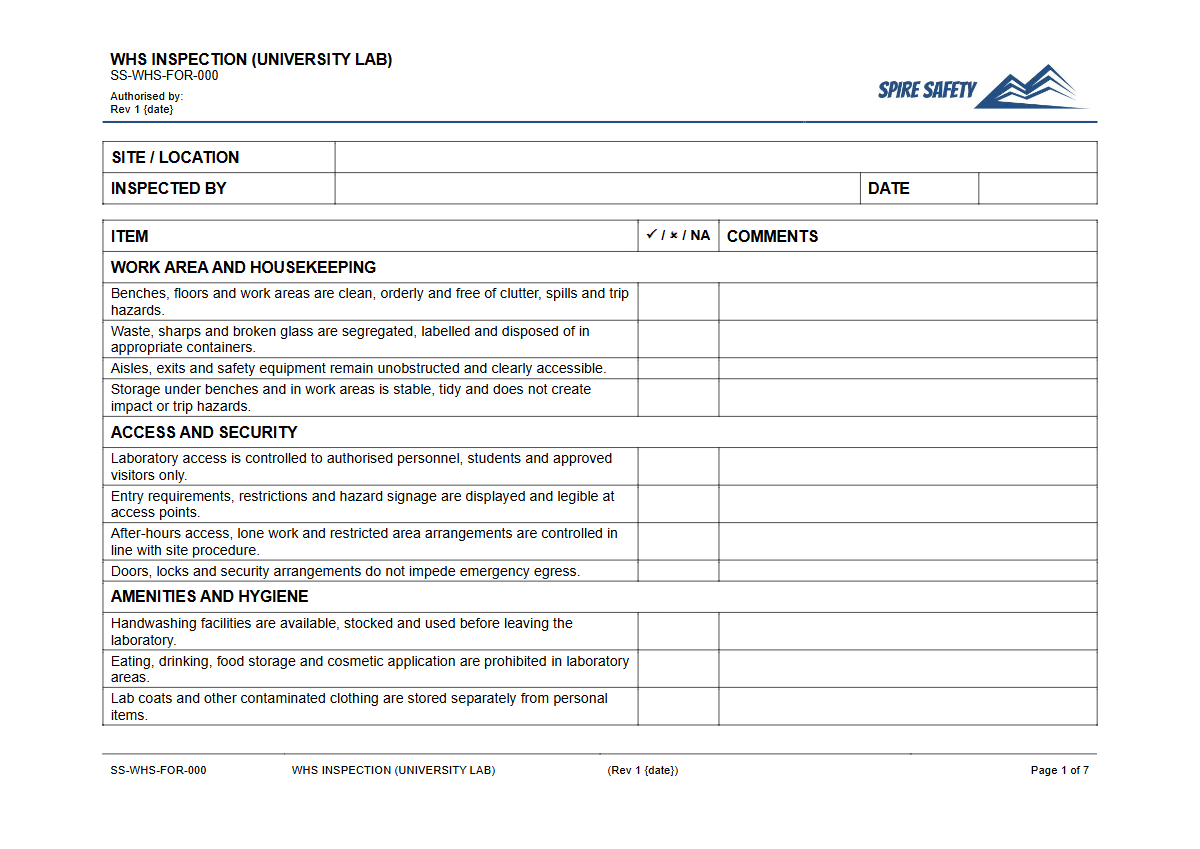
The template guides the inspector through key areas of a typical laboratory, prompting checks on facilities, equipment, procedures, and documentation. It includes columns for recording observations, assigning risk levels, recommending corrective actions, and tracking their completion status.
IMPORTANT: This document is a template only. We are not familiar with your specific laboratory environment, equipment, or procedures.
You MUST customise this template to align with the specific hazards and control measures relevant to your workplace. This may involve adding sections for specialised equipment, such as checking the maintenance logs for scientific freezers, for which you can adapt our freezer pre-start checklist, or removing sections that are not applicable.
Key Areas Covered in the Inspection Template
Our template is organised into logical sections to ensure a thorough review of your laboratory's WHS provisions. While it must be adapted to your specific context, the core categories include:
- General Environment & Housekeeping: Assesses trip hazards, cleanliness, lighting, and general organisation.
- Chemical Safety & Storage: Covers labelling, segregation of incompatible substances, Safety Data Sheet (SDS) availability, and condition of storage cabinets.
- Biological Hazard Controls: Focuses on containment procedures, biosafety cabinet certification, and decontamination protocols.
- Equipment & Machinery Safety: Checks for machine guarding, emergency stops, electrical safety testing, and correct use of specialised apparatus. Some labs may use processing equipment for sample preparation, making a tool like our blender pre-start checklist a useful supplementary document.
- Personal Protective Equipment (PPE): Verifies the availability, suitability, condition, and proper use of required PPE.
- Emergency Preparedness: Inspects the accessibility and condition of first aid kits, emergency eyewash stations, safety showers, and fire extinguishers.
- Waste Disposal: Reviews procedures for segregating and disposing of chemical, biological, sharps, and general waste.
- Documentation & Training Records: Confirms that risk assessments, standard operating procedures (SOPs), and training records are current and accessible.
When to use it
Regular, scheduled inspections are crucial for maintaining a safe laboratory environment. This template should be used at planned intervals, such as monthly or quarterly, depending on the risk level of the work being conducted.
Beyond routine checks, it is also valuable to conduct an inspection after a significant change occurs, such as the introduction of new hazardous substances, the installation of major equipment, following a near-miss or incident, or when a new research project commences. Regular inspections and independent verification are key components of a robust safety program, often assessed during a formal WHS compliance audit.
Who should use it
This inspection template is beneficial for a range of personnel responsible for safety in a university setting. Key users include:
- Laboratory Managers: For overseeing day-to-day safety and ensuring compliance within their specific area.
- WHS Officers and Coordinators: As part of their routine safety assurance activities and for providing support to different departments.
- Principal Investigators: To meet their responsibility for the safety of their research group and the work they conduct.
- Health and Safety Representatives (HSRs): To facilitate workplace inspections and represent the safety concerns of their work group.
- WHS Committee Members: To gain insight into the state of safety across different laboratories and inform university-wide safety initiatives.
Ultimately, a strong safety culture requires more than just checklists; it involves leadership commitment, worker participation, and integrated safety processes. If you need assistance developing these broader frameworks, our WHS consulting team can provide expert guidance. For more templates and tools to support your safety program, browse our complete free WHS resources library.
Common mistakes
Common mistakes to avoid
- Failing to customise the template for the specific hazards and equipment in your lab.
- Treating the inspection as a 'tick-and-flick' exercise without careful observation.
- Neglecting to assign clear responsibility and deadlines for corrective actions.
- Poor record-keeping, making it difficult to track trends or demonstrate due diligence.
Legal references
Legal considerations
The following legal requirements may be relevant to this type of work.
- Work Health and Safety Act (Harmonised) — Provides the primary duties for protecting workers and other people from work health and safety risks.
- Work Health and Safety Regulations (Harmonised) — Sets out requirements supporting the management of workplace hazards and risks.
The following codes may be relevant to this type of work.
- Managing WHS Risks Code of Practice — Provides practical guidance on identifying hazards, assessing risks and applying effective controls.
- Work Health and Safety Consultation, Cooperation and Coordination Code of Practice — Provides practical guidance on consulting workers and coordinating with other duty holders.
- Managing the Work Environment and Facilities Code of Practice — Provides practical guidance on safe work environments, workplace facilities and related controls.
Did you know
Safety in Laboratories
The Australian Standard AS/NZS 2243 series, 'Safety in laboratories', provides detailed guidance on everything from planning and construction to chemical handling, microbiology, and radiation safety, serving as a key technical reference for the sector.
Chemical Exposure
According to Safe Work Australia, exposure to chemicals is a leading cause of work-related diseases. Regular lab inspections are a critical control measure to ensure chemical storage, handling, and ventilation systems are functioning correctly to minimise exposure.
FAQ
Frequently asked questions
01What is the difference between a lab inspection and a risk assessment?
02How often should university laboratories be formally inspected?
03Who is responsible for correcting hazards found during a lab inspection?
04Can this template be used for commercial research labs as well?
Share this resource
Free WHS Inspection (University Lab) Template
Browse Categories
How To Use It
- 1Download and open in Word or PDF.
- 2Replace the placeholders with your business details.
- 3Get it reviewed by a WHS specialist before rollout.
Need it customised?
Our WHS consultants can adapt this template to your site, run a gap analysis, or audit what you already have in place.
Book a Free Consultation WHS consulting servicesor call 1300 156 382