
Free WHS Inspection (Timber Depot) Template
Download our free WHS Inspection Template for timber depots. A structured DOCX & PDF to help identify hazards and streamline safety checks. Get yours now.
Free WHS Inspection (Timber Depot) Template
DOCX • 129 KB + PDF
Updated Oct 2026
No signup required
Purpose of the Free WHS Inspection (Timber Depot) Template
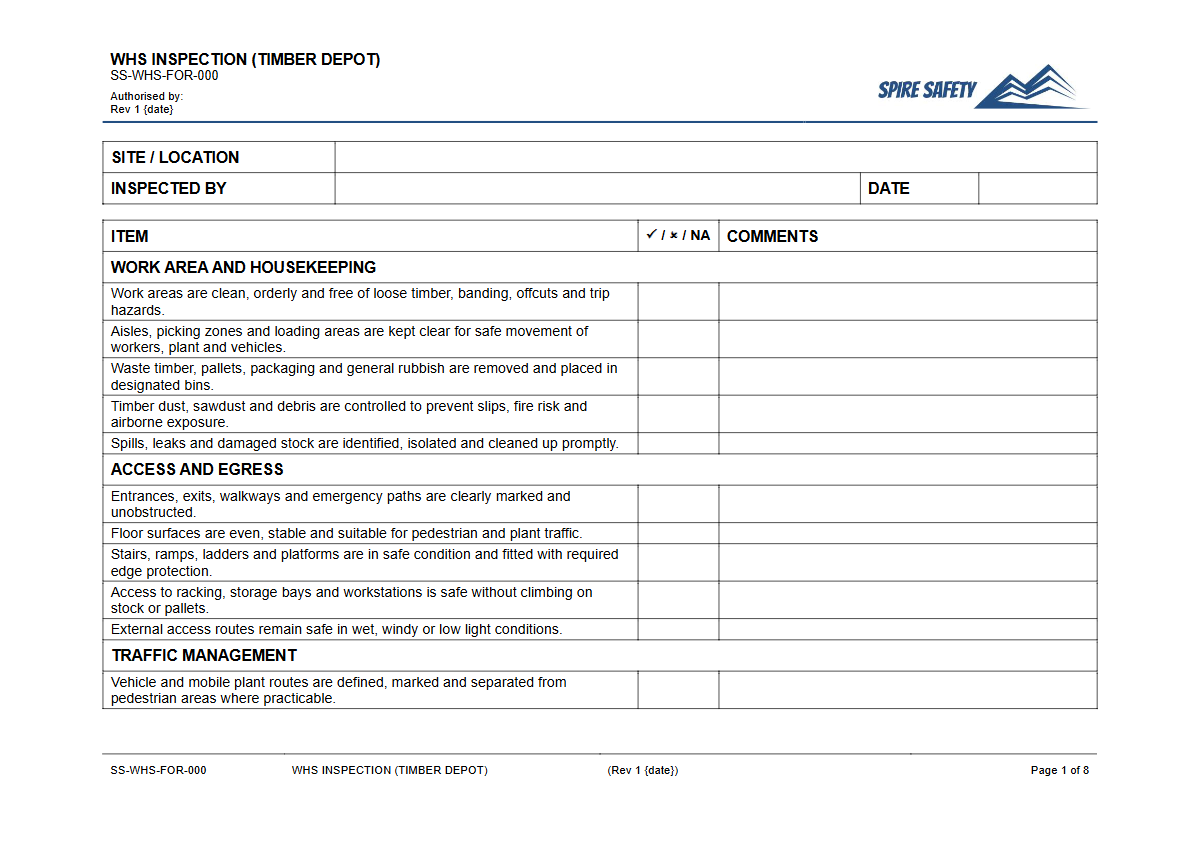
This Free WHS Inspection (Timber Depot) Template provides a structured starting point for systematically identifying and managing health and safety risks in a timber storage and processing environment. Timber depots present unique hazards, including moving vehicles and plant, hazardous manual tasks, wood dust exposure, noise, and risks associated with stacking and storing timber.
Using a formal checklist helps ensure that inspections are consistent, thorough, and documented, forming a crucial part of your overall safety management.
Regular, documented inspections are a key activity for any Person Conducting a Business or Undertaking (PCBU) in meeting their primary duty of care. This template is designed to align with Australian WHS principles, prompting checks on traffic management, machinery safety, storage methods, housekeeping, and emergency procedures.
Integrating these inspections into your broader WHS management systems helps create a proactive safety culture and a safer workplace for everyone.
Video walkthrough
How to use the Free WHS Inspection (Timber Depot) Template
To get the most value from this inspection template, begin by walking through your depot and customising the checklist items. Add, remove, or modify sections to reflect the specific machinery, storage systems (like racking or block stacking), and work processes at your site.
For example, you might add specific checks for docking saws, forklifts, or strapping equipment.
During the inspection, the designated inspector should systematically review each area and item, noting any non-conformances, potential hazards, or opportunities for improvement. Be detailed in your notes and take photos where appropriate.
After the inspection, document corrective actions for each identified issue, assign responsibility, and set a deadline for completion. Tracking these actions is just as important as finding the hazards.
This template can also be used as a foundation to develop more specific checklists for individual pieces of equipment. For example, your checks on lifting gear could be expanded using a dedicated resource like our Free Pre-Start Checklist (Electric Hoist) Template to ensure detailed daily verifications are also occurring.
A Note on Customisation
Important: This document is a template, not a finished safety document. It is critical that you customise it to reflect the specific layout, equipment, and processes of your timber depot.
We cannot guarantee it covers every unique hazard at your site. If you need assistance with customisation or identifying specific risks, consider engaging professional WHS consulting services.
When to use this Inspection Template
Workplace inspections should be conducted on a regular, scheduled basis. The frequency depends on the level of risk.
For a dynamic environment like a timber depot, a comprehensive inspection might be conducted monthly or quarterly. In addition to scheduled checks, this template should be used:
- After an incident, accident, or near miss to identify root causes.
- When new machinery, equipment, or work processes are introduced.
- Following changes to the layout of the depot.
- As part of a periodic review of your safety procedures.
These formal inspections complement, but do not replace, daily pre-start checks on mobile plant and equipment. For areas like site access, you might use a specific daily checklist such as our Free Pre-Start Checklist (Boom Gate) Template. Regular inspections are also a core component of preparation for any formal WHS compliance auditing.
Who should use this Template
This template is designed for use by a range of personnel responsible for workplace safety. This can include:
- Site Managers or Supervisors
- WHS Managers or Safety Officers
- Health and Safety Representatives (HSRs)
- Members of the Health and Safety Committee (HSC)
It's best practice for inspections to be conducted by competent persons who are familiar with the work area and have been trained in hazard identification. Involving workers who perform the tasks being inspected can provide valuable insights into how work is actually done, rather than just how it is documented.
This consultative approach is a fundamental principle of effective WHS management. If you're looking for more tools to support your safety program, you can browse our entire free WHS resources library.
Common mistakes
Common mistakes to avoid
- Failing to implement and maintain a traffic management plan to separate pedestrians from mobile plant.
- Underestimating the risk of combustible wood dust, leading to poor housekeeping and inadequate fire prevention.
- Providing insufficient training for workers on safe manual handling techniques for awkward or heavy loads.
- Neglecting regular inspection and maintenance of timber storage racks and systems, leading to collapse risks.
Legal references
Legal considerations
The following legal requirements may be relevant to this type of work.
- Work Health and Safety Act (Harmonised) — Provides the primary duties for protecting workers and other people from work health and safety risks.
- Work Health and Safety Regulations (Harmonised) — Sets out requirements supporting the management of workplace hazards and risks.
The following codes may be relevant to this type of work.
- Managing WHS Risks Code of Practice — Provides practical guidance on identifying hazards, assessing risks and applying effective controls.
- Work Health and Safety Consultation, Cooperation and Coordination Code of Practice — Provides practical guidance on consulting workers and coordinating with other duty holders.
- Managing the Work Environment and Facilities Code of Practice — Provides practical guidance on safe work environments, workplace facilities and related controls.
Did you know
Wood Dust Hazard
In Australia, certain hardwood and softwood dusts are classified as carcinogens. Long-term exposure without adequate controls like local exhaust ventilation can lead to serious respiratory diseases, including nasal cancer.
Mobile Plant Risks
Incidents involving vehicles, particularly forklifts, are a leading cause of serious injuries and fatalities in storage environments. Effective traffic management is one of the most critical safety controls in a timber depot.
FAQ
Frequently asked questions
01What are the main WHS risks in a timber depot?
02How often should a timber depot be formally inspected?
03Can I use this template for a small, family-owned timber yard?
04What's the difference between a workplace inspection and a pre-start check?
Share this resource
Free WHS Inspection (Timber Depot) Template
Browse Categories
How To Use It
- 1Download and open in Word or PDF.
- 2Replace the placeholders with your business details.
- 3Get it reviewed by a WHS specialist before rollout.
Need it customised?
Our WHS consultants can adapt this template to your site, run a gap analysis, or audit what you already have in place.
Book a Free Consultation WHS consulting servicesor call 1300 156 382