
Free WHS Inspection (Trade Centre) Template
Download our Free WHS Inspection (Trade Centre) Template (DOCX & PDF).
Free WHS Inspection (Trade Centre) Template
DOCX • 128 KB + PDF
Updated Oct 2026
No signup required
Purpose of the Free WHS Inspection (Trade Centre) Template
Maintaining a safe environment is crucial in any retail or wholesale trade centre. Our Free WHS Inspection (Trade Centre) Template provides a structured framework to help you proactively identify, assess, and control hazards specific to this setting.
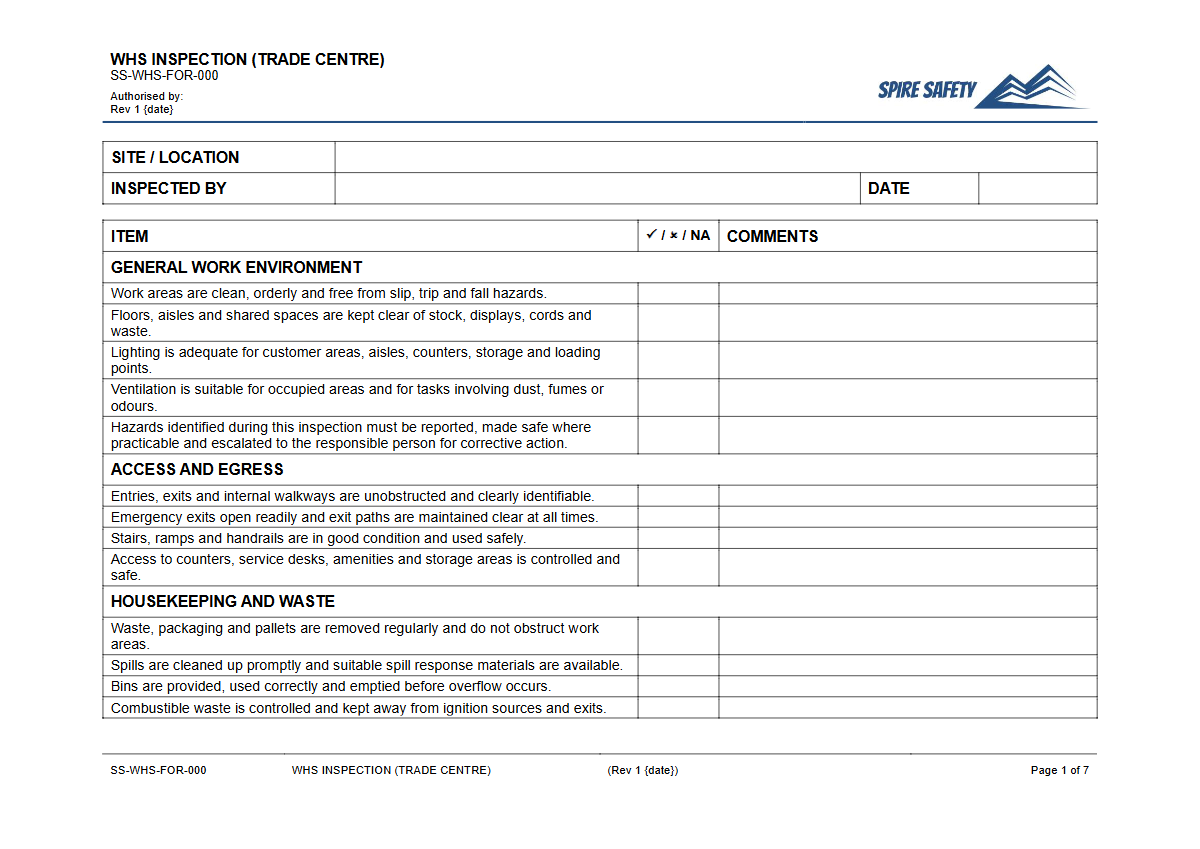
Regular inspections are a cornerstone of effective safety management, helping to prevent incidents before they occur. This template is designed as a practical tool to guide your inspections, covering common areas such as public access zones, storage and racking, loading docks, staff facilities, and emergency preparedness.
Using a systematic approach helps demonstrate due diligence and contributes to a positive safety culture.
This document serves as a starting point, intended to be integrated into your broader safety framework. A consistent inspection schedule is a key component of robust WHS management systems, providing valuable data for risk assessment and continuous improvement.
It creates a formal record of your safety efforts, which can be critical for demonstrating compliance and tracking the closure of identified issues.
Video walkthrough
How to use the Free WHS Inspection (Trade Centre) Template
This template is designed for ease of use and customisation. Once downloaded, you can adapt the checklist to perfectly match the unique layout, equipment, and operational risks of your specific trade centre.
It includes sections for general environment, traffic management, manual tasks, plant and equipment, and emergency procedures.
Follow these steps to get the most out of the inspection document:
- Customise: Add, remove, or modify checklist items to reflect your site. Consider specific hazards related to your products, customer demographics, and delivery processes.
- Schedule: Determine an appropriate frequency for inspections (e.g., weekly, fortnightly, monthly) and assign clear responsibility to a competent person, such as a manager or Health and Safety Representative (HSR).
- Conduct: Walk through the site and systematically complete the checklist, noting any non-conformances, hazards, or opportunities for improvement. Add photos and detailed comments where necessary.
- Action: For each issue identified, assign a corrective action, a person responsible, and a due date. Track these actions to ensure they are completed effectively.
- Review: Periodically review completed inspection reports to identify recurring issues or trends. This analysis can inform your risk register and safety training programs.
Important Note: This document is a template and not a complete safety solution. We have designed it to be a useful starting point, but you must customise it to suit the specific hazards and operational context of your workplace.
Its effectiveness depends on its correct implementation and integration into your overall safety management system.
When to use this Inspection Template
Regular, planned inspections are the primary use for this template. Establishing a routine helps ensure that safety standards are consistently maintained and that new hazards are identified promptly. Beyond routine checks, this inspection should also be conducted:
- Following an incident, accident, or near miss to identify contributing factors.
- After significant changes to the workplace layout, such as new racking or display installations.
- When new equipment or work processes are introduced.
- As part of management safety walks or HSR workplace reviews.
For a more in-depth review of your entire safety system against legal requirements, you might engage specialists for formal WHS compliance auditing, which provides a higher-level assessment than a physical workplace inspection.
Who should use this Template
This inspection template is a valuable tool for anyone with responsibility for workplace health and safety in a trade centre environment. This includes:
- Store and Centre Managers: Responsible for overall site safety and ensuring a safe environment for workers and the public.
- WHS Managers and Advisors: Tasked with implementing and monitoring safety procedures and systems.
- Supervisors and Team Leaders: Responsible for safety in their specific department or work area.
- Health and Safety Representatives (HSRs): Who represent their work group and have powers to conduct inspections.
For specialised machinery within the centre, this general inspection should be supplemented with equipment-specific checks, such as a pre-start checklist for an electric hoist in the warehouse. If your facility has a car park with automated entry, a specific boom gate pre-start checklist would also be appropriate. Similarly, equipment in staff areas, like a commercial freezer, requires its own checks, which can be managed with a freezer pre-start checklist. You can find more templates like these in our free WHS resources library.
Common mistakes
Common mistakes to avoid
- Using a generic template without customising it for the specific site layout and hazards.
- Failing to assign clear responsibility for corrective actions identified during the inspection.
- Only 'ticking the boxes' without properly observing the work environment and worker behaviour.
- Poor record-keeping, making it difficult to track trends or demonstrate due diligence.
Legal references
Legal considerations
The following legal requirements may be relevant to this type of work.
- Work Health and Safety Act (Harmonised) — Provides the primary duties for protecting workers and other people from work health and safety risks.
- Work Health and Safety Regulations (Harmonised) — Sets out requirements supporting the management of workplace hazards and risks.
The following codes may be relevant to this type of work.
- Managing WHS Risks Code of Practice — Provides practical guidance on identifying hazards, assessing risks and applying effective controls.
- Work Health and Safety Consultation, Cooperation and Coordination Code of Practice — Provides practical guidance on consulting workers and coordinating with other duty holders.
- Managing the Work Environment and Facilities Code of Practice — Provides practical guidance on safe work environments, workplace facilities and related controls.
Did you know
Consultation is Key
Under model WHS laws, PCBUs have a duty to consult with workers on health and safety matters, including when developing procedures like workplace inspections.
FAQ
Frequently asked questions
01Is this trade centre inspection checklist a legal requirement?
02How often should I inspect my trade centre?
03What's the difference between an inspection and an audit?
04Can I add our company logo to this template?
Share this resource
Free WHS Inspection (Trade Centre) Template
Browse Categories
How To Use It
- 1Download and open in Word or PDF.
- 2Replace the placeholders with your business details.
- 3Get it reviewed by a WHS specialist before rollout.
Need it customised?
Our WHS consultants can adapt this template to your site, run a gap analysis, or audit what you already have in place.
Book a Free Consultation WHS consulting servicesor call 1300 156 382