
Free WHS Inspection (Timber Yard) Template
Proactively manage safety in your timber yard with our free WHS Inspection Template. This DOCX & PDF checklist helps identify hazards. Download yours now.
Free WHS Inspection (Timber Yard) Template
DOCX • 128 KB + PDF
Updated Oct 2026
No signup required
Purpose of the Free WHS Inspection (Timber Yard) Template
A timber yard is a dynamic and high-risk work environment. To effectively manage safety, a systematic approach to identifying and controlling hazards is essential.
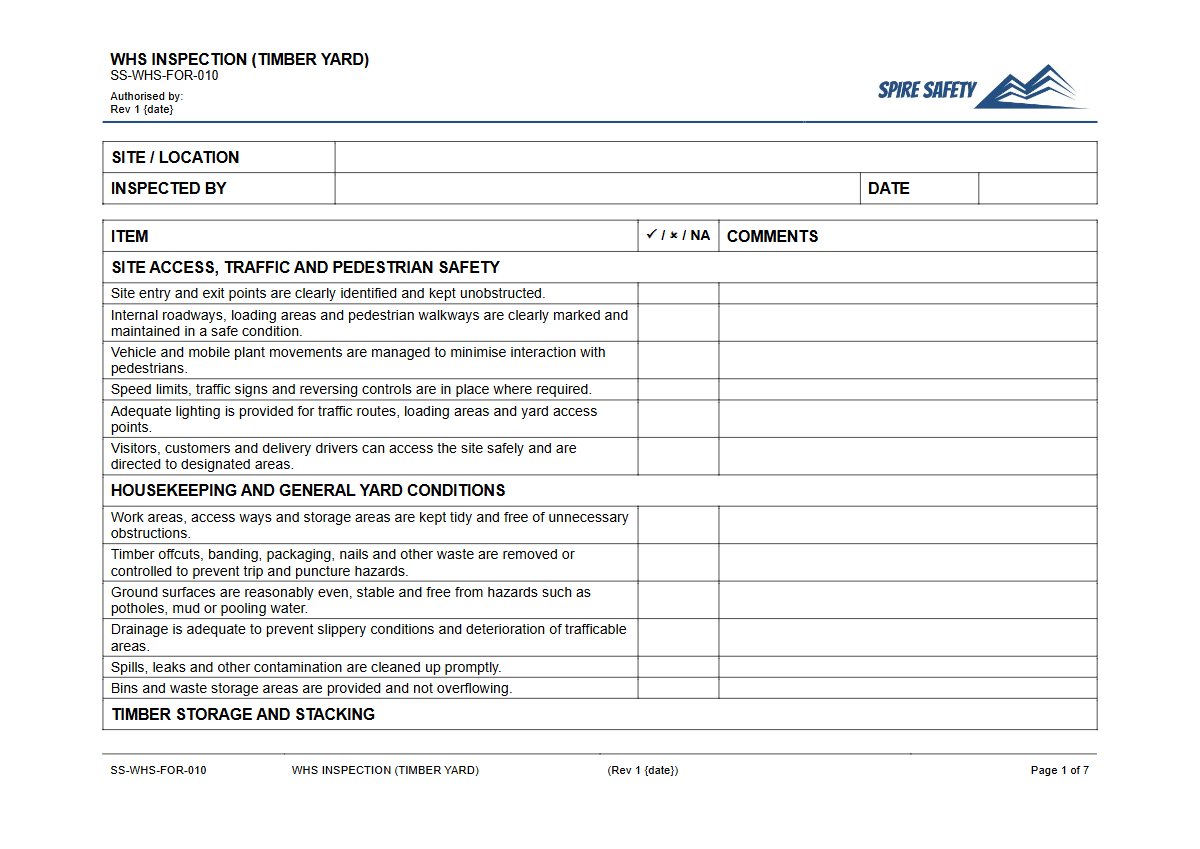
This Free WHS Inspection (Timber Yard) Template provides a structured starting point for your organisation to conduct thorough safety inspections. By using this template, you can proactively spot potential issues related to timber stacking, vehicle movement, machinery operation, dust, noise, and general housekeeping before they lead to an incident.
It serves as a practical tool to document findings, assign corrective actions, and demonstrate due diligence as part of your overall safety management processes.
Regular, documented inspections are a cornerstone of any effective safety program. They help ensure that control measures are working as intended and that safety standards are being consistently met.
Integrating this inspection process into your broader WHS management systems helps create a culture of continuous improvement and risk awareness across the workplace.
Video walkthrough
How to use the Free WHS Inspection (Timber Yard) Template
This resource is available for download as a DOCX file, which can be fully edited in Microsoft Word or other compatible programs, and a PDF version for easy printing. To begin, download the template and add your company’s logo and details.
Walk through the checklist items, adapting them to the specific layout, equipment, and processes of your timber yard.
Important: This template is a guide, not a complete solution. Every workplace is unique.
We cannot know the specific hazards of your site. You must customise this document by adding, removing, or modifying sections to ensure it comprehensively covers all relevant risks at your location.
We strongly recommend you consult with your workers and any Health and Safety Representatives (HSRs) during this customisation process to ensure the final checklist is practical and effective.
When to Conduct a Timber Yard Inspection
The frequency of your inspections should be determined by your own risk assessment. For a high-risk environment like a timber yard, a comprehensive site-wide inspection is often conducted monthly or quarterly.
However, this formal inspection should be supported by other checks. For example, daily pre-start checks on specific plant and equipment are crucial for catching immediate faults.
You might use a specific pre-start checklist for an electric hoist or other key machinery.
Additional ad-hoc inspections are also necessary in specific situations, such as:
- After an incident, accident, or near miss.
- When introducing new machinery, materials, or work processes.
- Following significant changes to the site layout.
- In response to concerns raised by workers or HSRs.
Who Should Use This Inspection Template
This template is designed for anyone responsible for workplace health and safety in a timber processing, storage, or sales environment. This includes:
- Business Owners and Directors (Persons Conducting a Business or Undertaking - PCBUs)
- WHS Managers and Safety Officers
- Site Supervisors and Foremen
- Health and Safety Representatives (HSRs)
It combines management oversight with on-the-ground operational knowledge. For an independent assessment, organisations may also engage external experts for periodic WHS compliance auditing to validate their internal processes.
Key Areas for Inspection in a Timber Yard
Your customised checklist should cover all aspects of your operation. Key areas to focus on include:
- Traffic Management: Assess the separation of pedestrians and vehicles (like forklifts and trucks). Check signage, designated walkways, and the condition of entry points. Ensure controls like automatic gates are functioning correctly, which can be verified with tools like our Free Pre-Start Checklist (Boom Gate) Template.
- Timber Storage: Inspect the stability of timber stacks. Check that racking is in good condition and not overloaded, and that stacking heights are within safe limits.
- Plant and Equipment: Verify that machinery (e.g., saws, planers, forklifts) has the correct guarding, emergency stops, and is in good working order. Check maintenance records and operator competency.
- Hazardous Substances & Dust Control: Review the storage and handling of chemicals (e.g., treatments, fuels). Assess the effectiveness of dust extraction systems to control exposure to wood dust.
- Noise Management: Identify high-noise areas and check that controls (e.g., acoustic enclosures, PPE) are in use and effective.
- Housekeeping: Look for trip hazards, clear access to emergency exits and equipment (like fire extinguishers and first aid kits), and general site tidiness.
By systematically reviewing these areas, you can build a comprehensive picture of your site's safety performance. For more tools to help you manage your safety obligations, explore our complete free WHS resources library.
Common mistakes
Common mistakes to avoid
- Using a generic checklist without customising it for the specific machinery and layout of the site.
- Failing to create and track corrective actions for hazards identified during the inspection.
- Conducting the inspection without involving workers or HSRs who have hands-on knowledge of the risks.
- Poor record-keeping, which prevents the analysis of safety trends and makes it difficult to prove due diligence.
Legal references
Legal considerations
The following legal requirements may be relevant to this type of work.
- Work Health and Safety Act (Harmonised) — Provides the primary duties for protecting workers and other people from work health and safety risks.
- Work Health and Safety Regulations (Harmonised) — Sets out requirements supporting the management of workplace hazards and risks.
The following codes may be relevant to this type of work.
- Managing WHS Risks Code of Practice — Provides practical guidance on identifying hazards, assessing risks and applying effective controls.
- Work Health and Safety Consultation, Cooperation and Coordination Code of Practice — Provides practical guidance on consulting workers and coordinating with other duty holders.
- Managing the Work Environment and Facilities Code of Practice — Provides practical guidance on safe work environments, workplace facilities and related controls.
Did you know
Wood Dust Hazard
Wood dust is not just a nuisance; it's a hazardous substance. Certain hardwood dusts are classified as 'carcinogenic to humans' (Group 1) by the International Agency for Research on Cancer (IARC).
Stack Stability
A single cubic metre of hardwood can weigh over 1,000 kilograms. Incorrectly stacked timber poses a significant crush risk, making stack stability a critical focus for any timber yard inspection.
FAQ
Frequently asked questions
01What are the most common hazards in a timber yard?
02How often should a timber yard be formally inspected for safety?
03Who is legally responsible for conducting workplace inspections?
04Can I use this template for any timber yard in Australia?
Share this resource
Free WHS Inspection (Timber Yard) Template
Browse Categories
How To Use It
- 1Download and open in Word or PDF.
- 2Replace the placeholders with your business details.
- 3Get it reviewed by a WHS specialist before rollout.
Need it customised?
Our WHS consultants can adapt this template to your site, run a gap analysis, or audit what you already have in place.
Book a Free Consultation WHS consulting servicesor call 1300 156 382