
Free WHS Inspection (Storage Facility) Template
Our Free WHS Inspection (Storage Facility) Template helps formalise site safety checks. Download this DOCX & PDF to manage hazards and improve safety.
Free WHS Inspection (Storage Facility) Template
DOCX • 128 KB + PDF
Updated Oct 2026
No signup required
Purpose of the Free WHS Inspection (Storage Facility) Template
A storage facility presents a unique set of workplace health and safety challenges, from moving vehicles and manual handling to the structural integrity of racking. This Free WHS Inspection (Storage Facility) Template provides a structured starting point for your organisation to identify, assess, and control hazards.
By formalising your inspection process, you can create a consistent method for checking key safety elements, promoting a safer environment for workers and visitors. This document is designed to help you proactively manage risks associated with storage operations, aligning with good Australian WHS practice.
Using a standardised checklist helps ensure that critical items are not overlooked. It prompts the inspector to systematically review areas such as traffic management, storage systems, emergency procedures, and general housekeeping.
A documented inspection trail is a vital component of any robust safety framework, demonstrating due diligence and a commitment to continuous improvement. Integrating regular, thorough checks is a foundational step in building effective WHS management systems.
Video walkthrough
How to use the Free WHS Inspection (Storage Facility) Template
This resource is available as both a DOCX file for easy editing and a PDF for straightforward printing and use. To begin, simply download your preferred format.
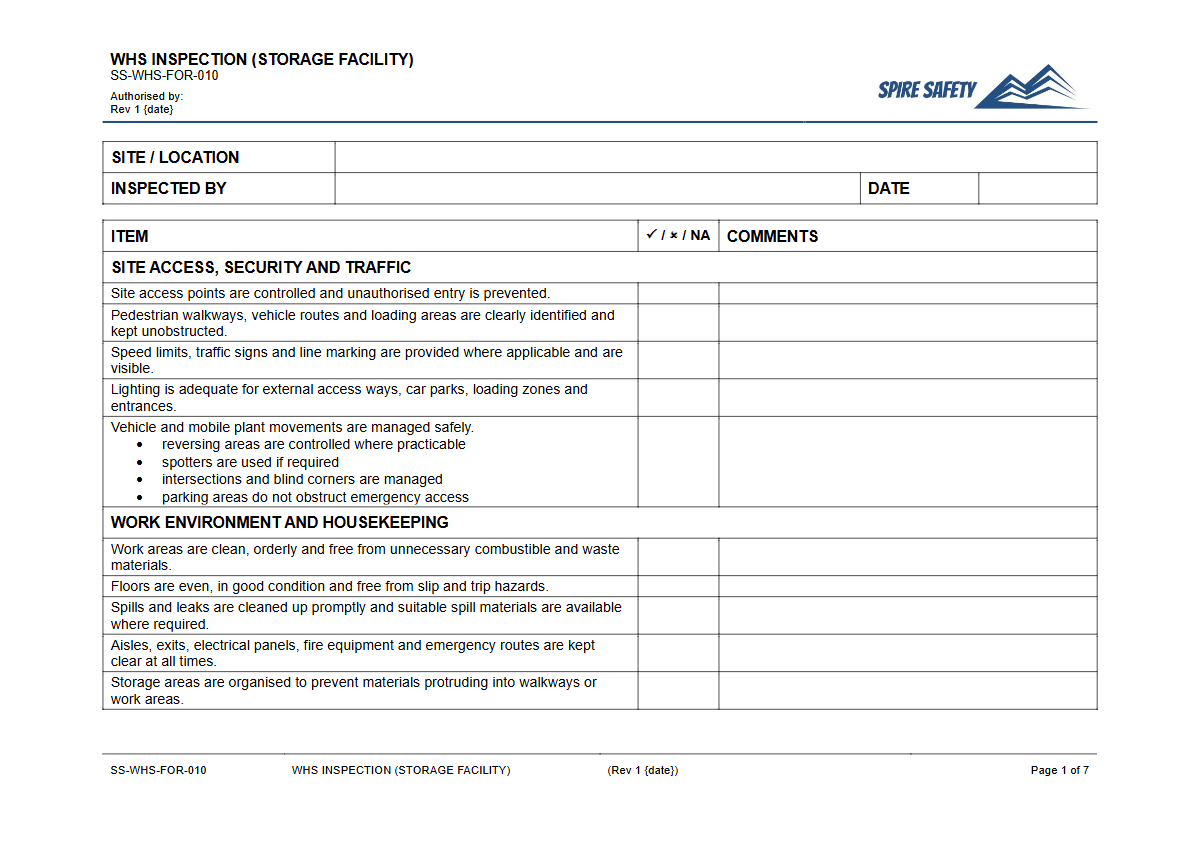
The template is logically structured with sections covering common hazards found in warehouses and storage environments. The inspector can then walk through the designated areas, ticking off items, and making detailed notes on any non-conformances or areas for improvement.
This structured approach helps in methodically covering all critical safety points during the walkthrough.
It is crucial to remember that this template is a guide, not an exhaustive, one-size-fits-all solution. We strongly recommend you customise this document to reflect the specific hazards, layout, equipment, and procedures of your workplace. Add your company logo, site-specific locations, and any unique machinery or processes relevant to your facility. You may need to add checks for specialised equipment, such as those covered in our Free Pre-Start Checklist (Electric Hoist) Template.
When to use it
The frequency of inspections should be determined by a risk assessment. High-traffic areas or zones with high-risk activities may require daily or weekly inspections.
Less dynamic areas might be suitable for monthly or quarterly review. It is good practice to conduct an inspection after any significant change, such as the installation of new racking, a change in layout, or after an incident or near miss.
Regular inspections ensure that safety controls remain effective and that new hazards are identified promptly.
For facilities with controlled entry, specific checks on access equipment should also be routine. If your site uses automated gates, consider incorporating elements from a resource like the Free Pre-Start Checklist (Boom Gate) Template to ensure their safe operation is also monitored.
Scheduled inspections should be part of your overall safety calendar.
Who should use it
This inspection template is designed for use by a range of personnel responsible for workplace safety. This includes Warehouse Managers, Site Supervisors, Team Leaders, Health and Safety Representatives (HSRs), and members of the WHS committee.
It can also be used by internal or external auditors as a basis for evaluating site safety standards. To ensure a comprehensive review, it is often beneficial for the inspection to be conducted by a team, such as a manager and an HSR, to bring different perspectives to the process.
Ultimately, anyone in a supervisory or management role within a PCBU (Person Conducting a Business or Undertaking) that operates a storage facility can benefit from this tool. Engaging workers in the inspection process can also provide valuable insights, as they have firsthand experience with the operational risks.
For specialised environments like cold storage, consider adapting checks from our Free Pre-Start Checklist (Freezer) Template to cover relevant hazards. The goal is to make safety a shared responsibility, and a clear inspection process supports this.
For organisations seeking to verify the effectiveness of their safety processes against legislative requirements, a formal WHS compliance auditing service can provide an independent and comprehensive assessment. You can also explore hundreds of other documents in our free WHS resources library to support your safety management system.
Common mistakes
Common mistakes to avoid
- Failing to customise the template for site-specific risks and equipment.
- Treating the inspection as a 'tick-and-flick' exercise without genuine observation.
- Not following up on identified hazards with corrective actions and tracking them to completion.
- Forgetting to consult with workers who use the storage areas daily during the inspection process.
Legal references
Legal considerations
The following legal requirements may be relevant to this type of work.
- Work Health and Safety Act (Harmonised) — Provides the primary duties for protecting workers and other people from work health and safety risks.
- Work Health and Safety Regulations (Harmonised) — Sets out requirements supporting the management of workplace hazards and risks.
The following codes may be relevant to this type of work.
- Managing WHS Risks Code of Practice — Provides practical guidance on identifying hazards, assessing risks and applying effective controls.
- Work Health and Safety Consultation, Cooperation and Coordination Code of Practice — Provides practical guidance on consulting workers and coordinating with other duty holders.
- Managing the Work Environment and Facilities Code of Practice — Provides practical guidance on safe work environments, workplace facilities and related controls.
Did you know
Forklift Incidents
Forklifts are a leading cause of serious injuries in storage and warehouse environments. According to Safe Work Australia, they are involved in approximately 1,400 accepted workers’ compensation claims for serious injury each year.
Racking Collapse
Incorrectly installed, modified, or maintained pallet racking is a primary cause of warehouse incidents. A racking collapse can be a catastrophic event, posing a significant risk of multiple fatalities and serious injuries.
FAQ
Frequently asked questions
01What hazards should a storage facility inspection cover?
02How often should I inspect our storage racking?
03Is this template suitable for cold storage facilities?
04Can I use this inspection template on a mobile device?
Share this resource
Free WHS Inspection (Storage Facility) Template
Browse Categories
How To Use It
- 1Download and open in Word or PDF.
- 2Replace the placeholders with your business details.
- 3Get it reviewed by a WHS specialist before rollout.
Need it customised?
Our WHS consultants can adapt this template to your site, run a gap analysis, or audit what you already have in place.
Book a Free Consultation WHS consulting servicesor call 1300 156 382