
Free WHS Inspection (Switchroom) Template
Formalise electrical safety checks with our free WHS inspection (switchroom) template. A structured starting point for identifying hazards. Download now.
Free WHS Inspection (Switchroom) Template
DOCX • 126 KB + PDF
Updated Oct 2026
No signup required
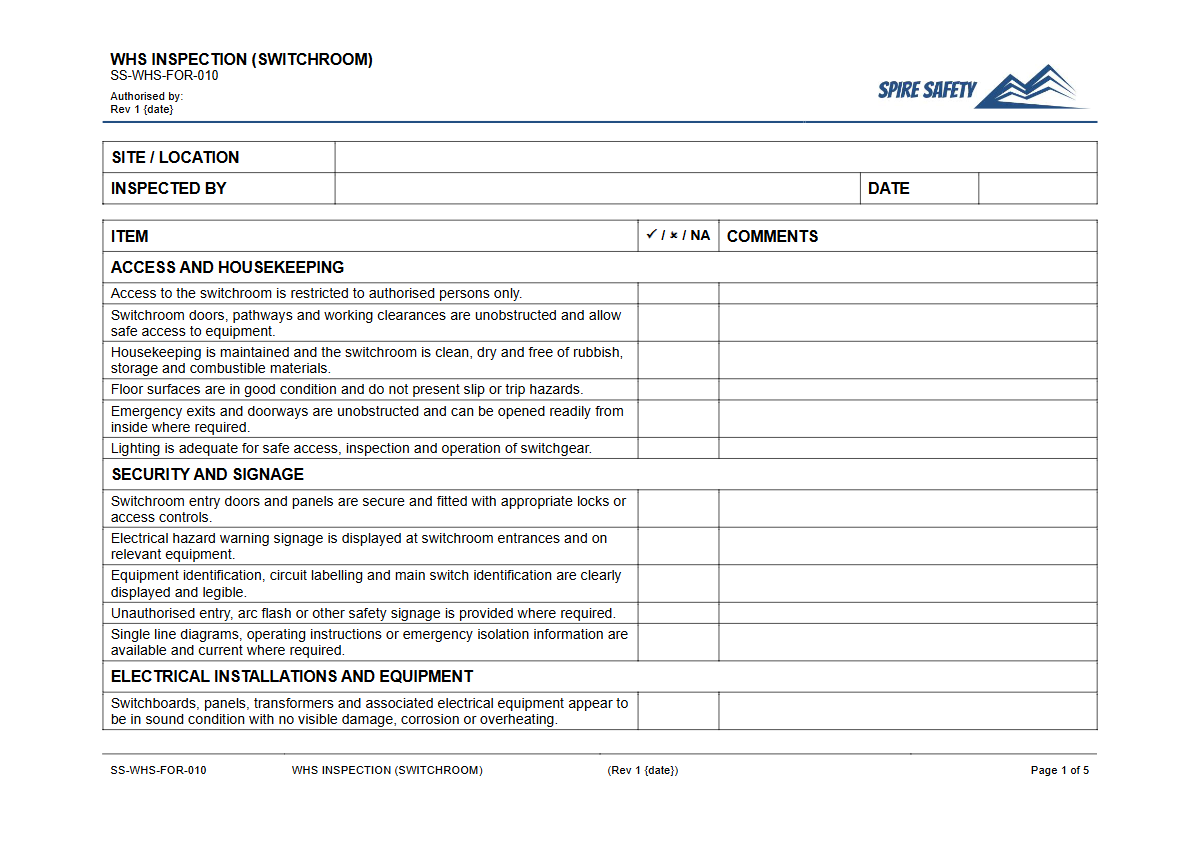
Purpose of the Free WHS Inspection (Switchroom) Template
Electrical switchrooms are high-risk environments that house critical infrastructure like switchgear, circuit breakers, and transformers. This free WHS Inspection (Switchroom) Template provides a structured starting point for systematically identifying and controlling the significant hazards present in these areas.
Regular, documented inspections are a fundamental part of managing risks such as electric shock, arc flash, fire, and unauthorised access. Using a formal checklist helps ensure that safety features—like signage, emergency lighting, fire suppression systems, and access controls—are functional and maintained.
Formalising this process helps a person conducting a business or undertaking (PCBU) meet their primary duty of care. These records become a key component of your overall safety framework, demonstrating proactive risk management. A robust inspection program is a critical element within effective WHS management systems.
Video walkthrough
How to use the Free WHS Inspection (Switchroom) Template
This template is provided in both DOCX and PDF formats. The DOCX file is fully editable, allowing you to tailor the checklist to the specific layout, equipment, and risks of your workplace's switchroom.
It is crucial that you customise this document; no two switchrooms are identical, and a generic checklist will not be sufficient. We recommend a competent person reviews and adapts the template to align with your site’s specific hazards and control measures before its first use.
Once customised, the template can be used by authorised personnel to conduct routine inspections. Observations and corrective actions should be clearly noted.
Completed inspection forms serve as important WHS records, which can be reviewed during safety meetings or formal audits. Using a site-specific checklist is essential for demonstrating due diligence during a WHS compliance auditing process.
When to use it
The frequency of switchroom inspections should be determined by a risk assessment. Factors to consider include the age and condition of the equipment, the operational environment, and the level of access.
As a general guide, a thorough inspection may be scheduled monthly, with more frequent visual checks for basic housekeeping and security. This template should also be used after any significant electrical work, maintenance, or equipment modification to verify that the area has been returned to a safe state.
Integrating these checks with your preventative maintenance schedule can create a more efficient workflow.
While this template focuses on the switchroom environment, specific pieces of equipment require their own pre-start checks. For example, our Free Pre-Start Checklist (Electric Hoist) Template is designed for daily inspections of electrically powered lifting equipment.
Who should use it
Switchroom inspections must be conducted by a competent person. This is typically a licensed electrician or an individual who has received specific training on the electrical hazards present, the function of the installed equipment, and emergency procedures.
They must be authorised by the PCBU to enter and inspect the area. General staff or untrained personnel should never be assigned this task due to the high-risk nature of the environment.
Supervisors, WHS managers, and maintenance planners can use the data from completed inspection forms to track safety performance, identify recurring issues, and schedule necessary repairs or upgrades. Defining the right competency levels and training requirements can be complex, and organisations may benefit from external WHS consulting to ensure their procedures are robust. Similar principles of competency apply to other electrically powered access systems, as outlined in resources like our Free Pre-Start Checklist (Boom Gate) Template.
Regular inspections are a core part of managing any type of workplace plant, not just high-voltage installations. Even common equipment requires checks, a principle demonstrated in our Free Pre-Start Checklist (Freezer) Template. To see a wider range of checklists and templates, you can browse our complete free WHS resources library.
Common mistakes
Common mistakes to avoid
- Using a generic checklist without customising it for site-specific equipment and hazards.
- Allowing untrained or unauthorised personnel to conduct the inspection.
- Failing to act on identified issues or close out corrective actions in a timely manner.
- Poor record-keeping, making it difficult to track trends or demonstrate due diligence.
Legal references
Legal considerations
The following legal requirements may be relevant to this type of work.
- Work Health and Safety Act (Harmonised) — Provides the primary duties for protecting workers and other people from work health and safety risks.
- Work Health and Safety Regulations (Harmonised) — Sets out requirements supporting the management of workplace hazards and risks.
The following codes may be relevant to this type of work.
- Managing WHS Risks Code of Practice — Provides practical guidance on identifying hazards, assessing risks and applying effective controls.
- Work Health and Safety Consultation, Cooperation and Coordination Code of Practice — Provides practical guidance on consulting workers and coordinating with other duty holders.
- Managing the Work Environment and Facilities Code of Practice — Provides practical guidance on safe work environments, workplace facilities and related controls.
Did you know
Arc Flash Danger
An arc flash can produce temperatures up to 20,000°C, four times hotter than the surface of the sun, posing extreme burn and blast risks to anyone nearby.
Lockout/Tagout
A significant percentage of electrical incidents occur during maintenance when equipment is thought to be de-energised but is not, highlighting the critical importance of lockout/tagout procedures.
FAQ
Frequently asked questions
01What is a switchroom inspection checklist for?
02How often should a switchroom be inspected?
03Who is a competent person to inspect a switchroom?
04Can I use this template for a small electrical switchboard?
Share this resource
Free WHS Inspection (Switchroom) Template
Browse Categories
How To Use It
- 1Download and open in Word or PDF.
- 2Replace the placeholders with your business details.
- 3Get it reviewed by a WHS specialist before rollout.
Need it customised?
Our WHS consultants can adapt this template to your site, run a gap analysis, or audit what you already have in place.
Book a Free Consultation WHS consulting servicesor call 1300 156 382