
Free WHS Inspection (Stone Workshop) Template
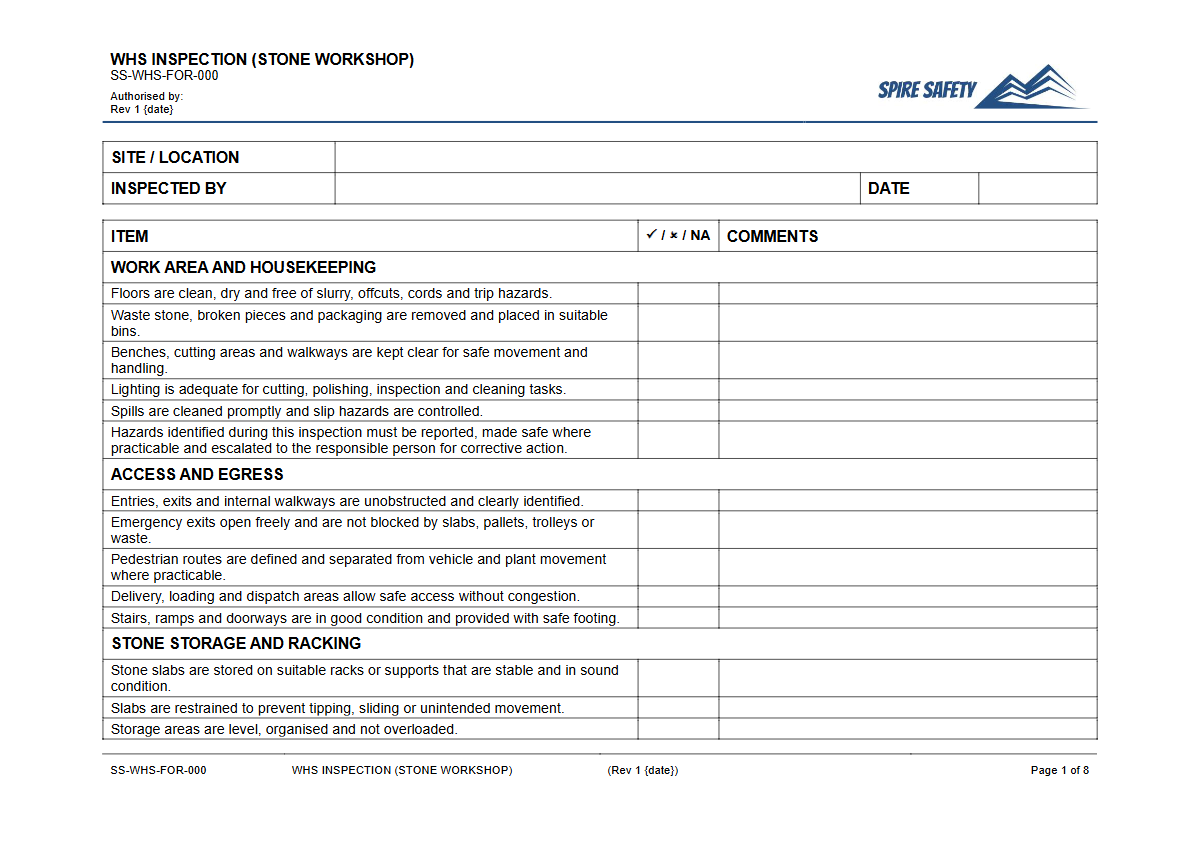
Download our free WHS Inspection (Stone Workshop) Template to identify and control silica dust, machine guarding and manual handling risks.
Free WHS Inspection (Stone Workshop) Template
DOCX • 129 KB + PDF
Updated Oct 2026
No signup required
Purpose of the Free WHS Inspection (Stone Workshop) Template
Operating a stone workshop involves significant health and safety risks, most notably the exposure to respirable crystalline silica (RCS) from cutting, grinding, and polishing engineered stone. This Free WHS Inspection (Stone Workshop) Template provides a structured starting point for systematically identifying, assessing, and controlling hazards in your facility.
Regularly conducting and documenting inspections helps your business meet its duty of care, prevent serious injuries and illnesses like silicosis, and maintain a safer working environment. The checklist prompts a thorough review of critical safety areas, from dust control systems to equipment safety and chemical storage.
A comprehensive inspection process is a cornerstone of any effective safety framework. By formalising your checks, you create a reliable record of your safety management efforts, which is essential for demonstrating due diligence.
This process supports the development of robust WHS management systems by providing critical data on hazard trends and control effectiveness, allowing for continuous improvement in your safety practices.
Video walkthrough
How to use the Free WHS Inspection (Stone Workshop) Template
This template is designed to be a practical tool for your business. First, download the document in your preferred format—DOCX for easy editing or PDF for straightforward printing.
The core of using this resource effectively lies in customisation. This document is a comprehensive guide, but every workshop has unique machinery, layouts, and processes.
You must review and adapt the checklist to align with your specific operational context.
Important Customisation Note
This is a template that provides a structured starting point. You must customise it to reflect the specific equipment, processes, and risks in your workplace. We recommend adding checkpoints for each piece of high-risk plant you operate, such as specific brands of bridge saws, waterjet cutters, or CNC machines. Also, ensure the Personal Protective Equipment (PPE) section matches the specific requirements for the materials you handle.
For example, you should detail checks for all lifting equipment used to move stone slabs. If you use overhead cranes, you may find our Free Pre-Start Checklist (Electric Hoist) Template a useful companion resource for formalising daily equipment checks.
When to conduct a Stone Workshop Inspection
The frequency of inspections depends on the level of risk and the nature of the equipment or process being checked. A combination of different inspection schedules is best practice.
Daily pre-start checks should be performed on high-risk machinery, vehicles, and critical safety systems like dust extraction units. Weekly or monthly inspections, using this more detailed template, allow for a broader review of the workshop environment, covering housekeeping, storage, emergency equipment, and worker practices.
You might also conduct a one-off inspection when commissioning new equipment, modifying a process, or investigating an incident.
Integrating regular checks for all areas of your site demonstrates a thorough approach to safety. For instance, even site access points require routine verification to ensure they are functioning correctly, which can be managed with tools like a Free Pre-Start Checklist (Boom Gate) Template for your site entrance.
Who should use this Inspection template
This template is designed for use by individuals with responsibility for workplace safety. This typically includes Workshop Managers, Supervisors, and Health and Safety Representatives (HSRs).
In a well-developed safety culture, experienced workers can also be trained and authorised to conduct inspections on equipment they operate. Whoever performs the inspection must be competent to do so—they need to understand the machinery, be familiar with the relevant hazards (especially RCS), and be trained in the inspection procedure itself.
The results of the inspection should be reviewed by management to ensure any identified hazards are addressed with appropriate corrective actions. These records become valuable inputs for management meetings and can be scrutinised during a formal WHS compliance auditing process to verify that safety procedures are being followed effectively.
A holistic approach to safety means considering all equipment within the workplace, not just the primary production machinery. Even items in communal areas like break rooms should be periodically checked for electrical safety and general condition.
Applying a consistent inspection mindset across the board, perhaps using a simple tool like a Free Pre-Start Checklist (Blender) Template for kitchen appliances, helps reinforce the importance of safety in all aspects of the work environment. For a wider range of checklists and forms, you can browse our complete free WHS resources library.
Common mistakes
Common mistakes to avoid
- Using a generic safety checklist not tailored to specific stone workshop hazards like RCS.
- "Pencil-whipping" the form without physically verifying each checkpoint.
- Failing to document, assign, and track corrective actions for identified safety issues.
- Neglecting to inspect critical dust control measures like water suppression systems and local exhaust ventilation (LEV).
Legal references
Legal considerations
The following legal requirements may be relevant to this type of work.
- Work Health and Safety Act (Harmonised) — Provides the primary duties for protecting workers and other people from work health and safety risks.
- Work Health and Safety Regulations (Harmonised) — Sets out requirements supporting the management of workplace hazards and risks.
The following codes may be relevant to this type of work.
- Managing WHS Risks Code of Practice — Provides practical guidance on identifying hazards, assessing risks and applying effective controls.
- Work Health and Safety Consultation, Cooperation and Coordination Code of Practice — Provides practical guidance on consulting workers and coordinating with other duty holders.
- Managing the Work Environment and Facilities Code of Practice — Provides practical guidance on safe work environments, workplace facilities and related controls.
Did you know
Silica Dust's Hidden Danger
Respirable crystalline silica (RCS) particles are approximately 100 times smaller than a grain of sand, allowing them to penetrate deep into the lungs undetected, leading to incurable diseases like silicosis.
FAQ
Frequently asked questions
01What is the biggest WHS risk in a stone workshop?
02How often should stone workshop equipment be inspected?
03What PPE is essential for working with engineered stone?
04Do I need to keep records of these WHS inspections?
Share this resource
Free WHS Inspection (Stone Workshop) Template
Browse Categories
How To Use It
- 1Download and open in Word or PDF.
- 2Replace the placeholders with your business details.
- 3Get it reviewed by a WHS specialist before rollout.
Need it customised?
Our WHS consultants can adapt this template to your site, run a gap analysis, or audit what you already have in place.
Book a Free Consultation WHS consulting servicesor call 1300 156 382