
Free WHS Inspection (Sports Club) Template
Download our Free WHS Inspection (Sports Club) Template to identify and manage safety risks. A structured starting point for Australian clubs. Get your DOCX.
Free WHS Inspection (Sports Club) Template
DOCX • 128 KB + PDF
Updated Oct 2026
No signup required
Purpose of the Free WHS Inspection (Sports Club) Template
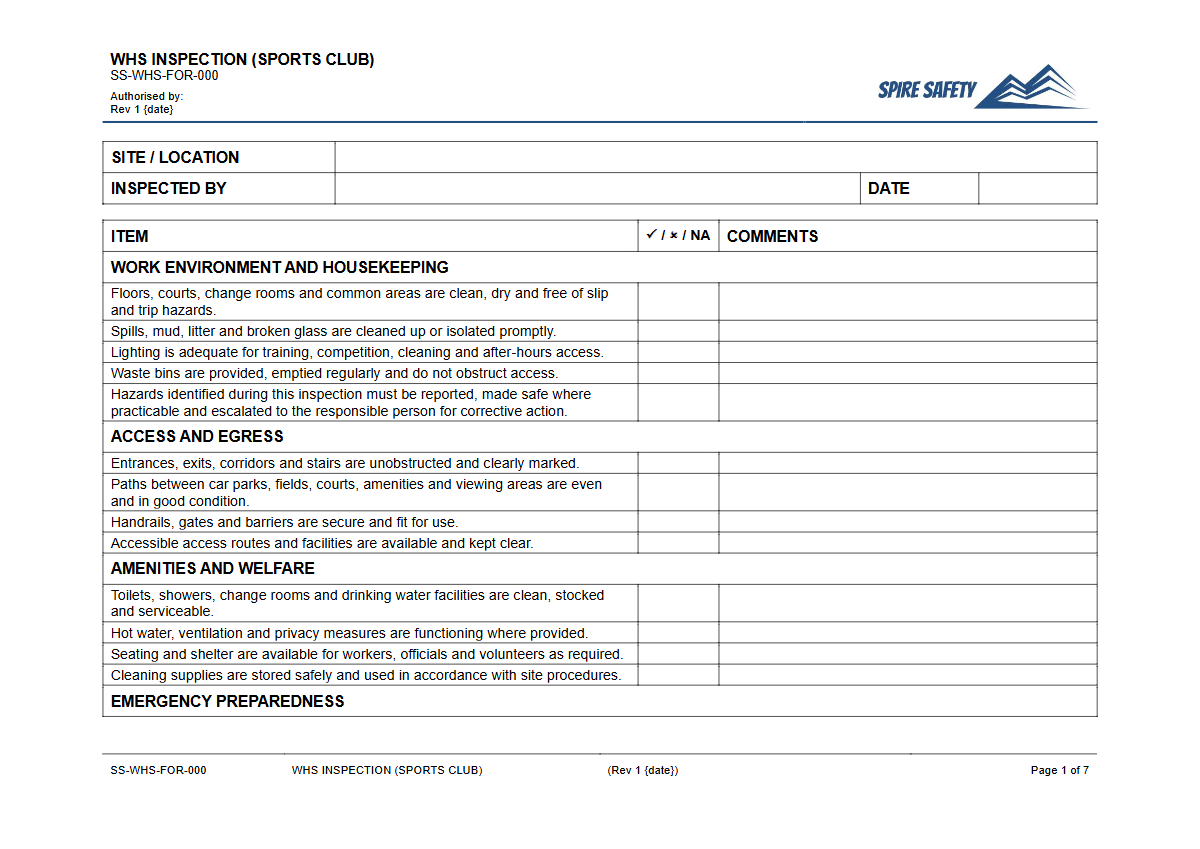
This Free WHS Inspection (Sports Club) Template provides a structured starting point for systematically checking your club's facilities, grounds, and equipment for health and safety hazards. Sports clubs, from local footy grounds to multi-purpose community centres, face a diverse range of risks affecting players, staff, volunteers, and the public.
Regular, documented inspections are a practical way to identify issues like trip hazards, faulty equipment, or inadequate safety measures before they cause an incident. Using a formal checklist helps demonstrate due diligence and is a fundamental component of an effective WHS management system.
Video walkthrough
How to use the Free WHS Inspection (Sports Club) Template
Using the Free WHS Inspection (Sports Club) Template involves a methodical walkthrough of your premises. The document is provided in DOCX format, allowing you to easily add, remove, or modify checklist items to suit your specific environment.
It prompts you to examine various zones, from the playing field to the car park, and assess the condition of key facilities and equipment.
Customisation is Essential
Please note: This template is a starting point and must be adapted to your club's unique operations. We've included common items, but you must walk through your own site to identify specific hazards and add them to the checklist.
Your club may have unique structures, equipment, or environmental factors that require specific attention.
Key Areas to Inspect
A thorough sports club inspection should cover all areas accessible to members, employees, volunteers, and visitors. Your customised checklist should include sections for:
- Playing Surfaces: Check for uneven ground, holes, foreign objects, and appropriate line markings.
- Spectator Areas: Inspect grandstands, benches, and viewing areas for structural integrity, broken seats, and clear access ways.
- Change Rooms & Amenities: Look for slip, trip, and fall hazards, adequate lighting, ventilation, and functioning plumbing.
- Canteen & Kitchen Facilities: Verify electrical appliance safety, hygiene standards, fire safety equipment, and clear emergency exits. For specialised equipment, a dedicated pre-start check is often more appropriate.
- Grounds & Pathways: Assess car parks, footpaths, and entry points for hazards like potholes, poor lighting, or obstructions. For specific machinery used in groundskeeping, consider a dedicated tool like our Free Pre-Start Checklist (Lawn Tractor) Template.
When to Conduct a Sports Club Inspection
The frequency of inspections depends on the level of use, the types of activities, and the overall risk profile of your club. A good practice is to establish a regular schedule, such as monthly or quarterly. Additionally, inspections should be performed:
- Before the start of a new season.
- Prior to hosting a major tournament or community event.
- After a significant weather event like a storm or flood.
- Following any reported incident or near miss.
- When new equipment or facilities are installed.
These scheduled reviews are a proactive measure and can form part of a broader WHS compliance auditing program to ensure ongoing safety management.
Who Should Use This Inspection Template
This template is designed for use by individuals responsible for safety and facility management within a sports club. This can include club managers, committee members with a safety portfolio, groundskeepers, or designated safety officers.
While volunteers can be tasked with conducting inspections, they must be deemed competent to do so—meaning they have the necessary knowledge and training to identify hazards effectively. Ultimately, the Person Conducting a Business or Undertaking (PCBU) holds the primary duty of care. If your club has an on-site gym, this general inspection should be supported by specific equipment checks using resources like our Free Pre-Start Checklist for Gym Treadmills.
After the Inspection
Identifying a hazard is only the first step. After completing the inspection, it's vital to document all findings, prioritise issues based on risk, and assign corrective actions with clear deadlines. This creates an auditable trail of your club's safety management activities. If you identify complex hazards or need help developing safe work procedures, engaging WHS consulting services can provide expert guidance and support. Explore our complete free WHS resources library for more templates and guides to support your safety efforts.
Common mistakes
Common mistakes to avoid
- Using a generic checklist without customising it for the club's specific grounds, equipment, and activities.
- Failing to document and follow up on corrective actions identified during the inspection.
- Neglecting to inspect less-frequented areas like storage sheds or plant rooms where hazards can develop unnoticed.
- Not providing any training or instruction to the person conducting the inspection.
Legal references
Legal considerations
The following legal requirements may be relevant to this type of work.
- Work Health and Safety Act (Harmonised) — Provides the primary duties for protecting workers and other people from work health and safety risks.
- Work Health and Safety Regulations (Harmonised) — Sets out requirements supporting the management of workplace hazards and risks.
The following codes may be relevant to this type of work.
- Managing WHS Risks Code of Practice — Provides practical guidance on identifying hazards, assessing risks and applying effective controls.
- Work Health and Safety Consultation, Cooperation and Coordination Code of Practice — Provides practical guidance on consulting workers and coordinating with other duty holders.
- Managing the Work Environment and Facilities Code of Practice — Provides practical guidance on safe work environments, workplace facilities and related controls.
Did you know
Volunteer Protection
Under model WHS laws, volunteers are considered 'workers'. This means the organisation they volunteer for owes them the same primary duty of care to ensure their health and safety as it does for paid employees.
Community Sport Injuries
According to the Australian Institute of Health and Welfare, around 1 in 6 sports injury hospitalisations result from falls. Many of these incidents are preventable through regular inspection and maintenance of grounds and facilities.
FAQ
Frequently asked questions
01Is a volunteer-run sports club considered a 'workplace' under WHS law?
02How often should we inspect our club's facilities?
03What is the difference between an inspection and a risk assessment?
04Can we be fined if we don't do safety inspections?
Share this resource
Free WHS Inspection (Sports Club) Template
Browse Categories
How To Use It
- 1Download and open in Word or PDF.
- 2Replace the placeholders with your business details.
- 3Get it reviewed by a WHS specialist before rollout.
Need it customised?
Our WHS consultants can adapt this template to your site, run a gap analysis, or audit what you already have in place.
Book a Free Consultation WHS consulting servicesor call 1300 156 382