
Free WHS Inspection (School Kitchen) Template
Download our Free WHS Inspection (School Kitchen) Template to formalise safety checks for food preparation areas. A structured starting point for WHS.
Free WHS Inspection (School Kitchen) Template
DOCX • 128 KB + PDF
Updated Oct 2026
No signup required
Purpose of the Free WHS Inspection (School Kitchen) Template
This Free WHS Inspection (School Kitchen) Template provides a structured starting point for identifying and managing health and safety risks in a school canteen or kitchen environment. School kitchens present a unique set of hazards, including risks of slips, trips, falls, cuts from knives, burns from hot surfaces and liquids, and faults with electrical appliances.
Regular, documented inspections are a fundamental part of a proactive safety culture, helping to ensure a safe workplace for staff, volunteers, and students.
Using a formal checklist helps an organisation demonstrate its commitment to safety and provides a consistent method for hazard identification. By systematically reviewing the workplace, you can address issues before they lead to an incident.
The process helps in maintaining equipment, ensuring good housekeeping, and verifying that safe work procedures are being followed. For example, while this template covers the general environment, specific high-risk equipment may require its own daily check, which you can manage with a dedicated resource like our Free Pre-Start Checklist (Freezer) Template.
Video walkthrough
How to use the Free WHS Inspection (School Kitchen) Template
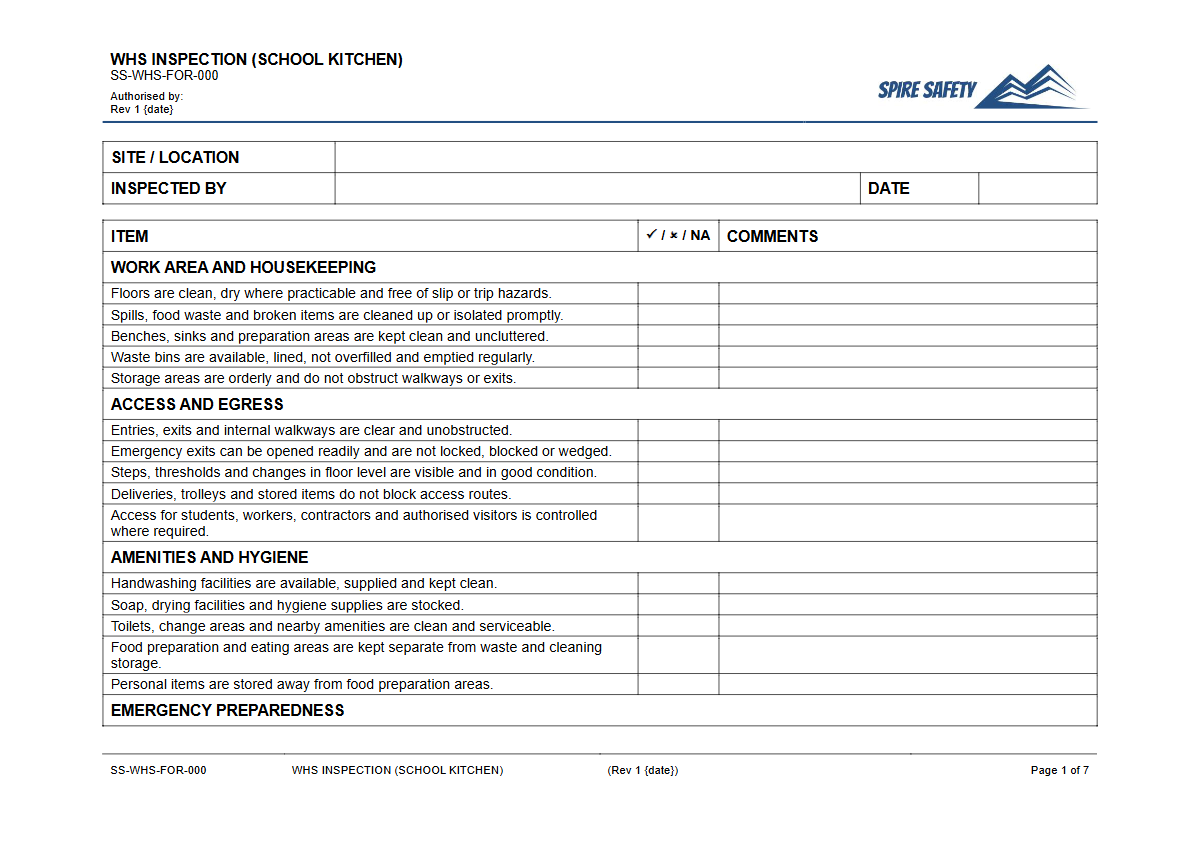
This resource is available as a DOCX file for easy customisation in Microsoft Word, and as a PDF for quick printing and use. The template is designed to be straightforward: a competent person walks through the kitchen area and assesses each item on the checklist, marking it as satisfactory, noting any required actions, and assigning responsibility for those actions.
Important: This document is a template and is not a complete solution out-of-the-box. We have provided a structured foundation based on common hazards, but you must customise it to suit the specific layout, equipment, tasks, and risk profile of your school kitchen.
Your final document should reflect your unique operational context.
Key Areas Covered in the Inspection
The template prompts a review of several critical areas, including:
- General Housekeeping: Assessing floors, walkways, and storage areas for trip hazards and clutter.
- Food Preparation Surfaces: Ensuring areas are clean, sanitised, and in good condition.
- Equipment and Appliances: Checking items like mixers, slicers, ovens, and microwaves for damage, correct guarding, and electrical safety. For equipment used daily, consider implementing a specific pre-start check, such as our Free Pre-Start Checklist (Blender) Template.
- Chemical Safety: Verifying cleaning chemicals are correctly stored, labelled, and have Safety Data Sheets (SDS) available.
- Fire Safety: Ensuring fire extinguishers, fire blankets, and alarms are accessible and serviced.
- First Aid: Checking that first aid kits are fully stocked and easily accessible.
These regular checks are a practical component of your overall safety framework. The findings can provide valuable data for your broader WHS management systems, helping to track trends and guide safety improvements.
When to conduct a School Kitchen Inspection
The frequency of inspections depends on the level of activity and risk in your kitchen. As a general guide:
- Informal Daily Checks: A quick visual scan for obvious hazards should be part of the daily opening procedure.
- Formal Weekly/Monthly Inspections: Use this template for a more detailed, documented inspection on a weekly or monthly basis.
- Additional Triggers: Conduct an inspection after any incident or near-miss, when new equipment is introduced, if the layout changes, or when new staff or volunteers start.
Regularly reviewing your safety performance through tools like this is a cornerstone of continuous improvement. For a more comprehensive evaluation, you might consider engaging professionals for a formal WHS compliance auditing service.
Who should use this Inspection Template
The inspection should be carried out by a person competent to recognise the hazards specific to a commercial or school kitchen environment. This could be:
- The Canteen Manager or Tuckshop Convenor.
- A nominated WHS Representative.
- A senior staff member with appropriate training and experience.
The designated person must be familiar with the kitchen's operations and equipment. For specialised equipment, such as deep fryers, ensuring the inspector understands its specific risks is vital.
If your facility uses such items, a dedicated checklist like our Free Pre-Start Checklist (Donut Fryer) Template can supplement this general inspection. If your team lacks the internal expertise to confidently identify all risks, seeking external WHS consulting can help bridge the gap.
We encourage you to browse our entire free WHS resources library for other useful templates.
Common mistakes
Common mistakes to avoid
- Using the template without customising it for the specific kitchen layout and equipment.
- Failing to follow up on corrective actions identified during the inspection.
- "Pencil-whipping" the checklist without physically verifying each item.
- Neglecting to check the condition of electrical cords and power boards for damage.
Legal references
Legal considerations
The following legal requirements may be relevant to this type of work.
- Work Health and Safety Act (Harmonised) — Provides the primary duties for protecting workers and other people from work health and safety risks.
- Work Health and Safety Regulations (Harmonised) — Sets out requirements supporting the management of workplace hazards and risks.
The following codes may be relevant to this type of work.
- Managing WHS Risks Code of Practice — Provides practical guidance on identifying hazards, assessing risks and applying effective controls.
- Work Health and Safety Consultation, Cooperation and Coordination Code of Practice — Provides practical guidance on consulting workers and coordinating with other duty holders.
- Managing the Work Environment and Facilities Code of Practice — Provides practical guidance on safe work environments, workplace facilities and related controls.
Did you know
Slips, Trips, and Falls
Slips, trips and falls are a leading cause of workplace injury in the hospitality industry, often resulting from wet or greasy floors, spills, and cluttered walkways.
Equipment Safety
A significant portion of kitchen incidents involve poorly maintained or improperly used equipment. Regular inspections help ensure safety guards are in place and electrical components are free from damage.
FAQ
Frequently asked questions
01What are the most common WHS hazards in a school kitchen?
02How often should a school kitchen be inspected for safety?
03Who is responsible for WHS in a school kitchen?
04Does this template cover food safety requirements?
Share this resource
Free WHS Inspection (School Kitchen) Template
Browse Categories
How To Use It
- 1Download and open in Word or PDF.
- 2Replace the placeholders with your business details.
- 3Get it reviewed by a WHS specialist before rollout.
Need it customised?
Our WHS consultants can adapt this template to your site, run a gap analysis, or audit what you already have in place.
Book a Free Consultation WHS consulting servicesor call 1300 156 382