
Free WHS Inspection (Road Depot) Template
Formalise safety checks at your transport facility with our Free WHS Inspection (Road Depot) Template. Download the DOCX and PDF to start today.
Free WHS Inspection (Road Depot) Template
DOCX • 129 KB + PDF
Updated Oct 2026
No signup required
Purpose of the Free WHS Inspection (Road Depot) Template
A road depot is a dynamic environment with significant health and safety risks, from vehicle movement to manual handling and storage of goods. Our Free WHS Inspection (Road Depot) Template provides a structured starting point for systematically identifying and controlling these hazards.
Using this template helps your organisation formalise its safety processes, demonstrate due diligence, and create a safer environment for workers, drivers, and visitors.
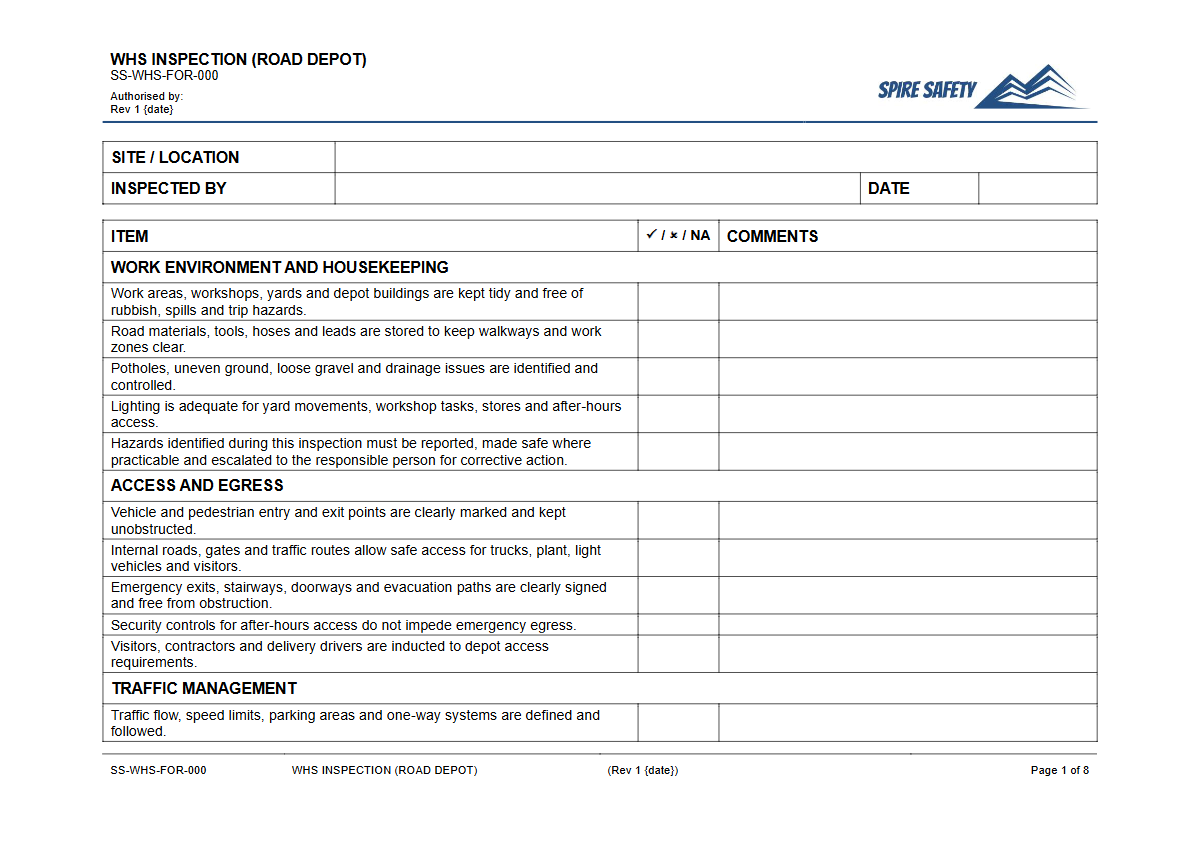
This Inspection template is designed to guide a thorough walkthrough of your facility. It prompts the user to assess key areas like traffic management, loading and unloading bays, vehicle maintenance workshops, storage and racking systems, chemical storage, and worker amenities.
By documenting observations, you create a clear record of the depot's safety status, identify trends, and provide evidence for safety-related decisions. The checklist covers general physical hazards as well as specific plant like automated gates; for detailed daily checks on such equipment, consider using a dedicated tool like our free pre-start checklist for boom gates.
What this Inspection covers
This template is aligned with Australian WHS principles and encourages a comprehensive review of common road depot hazards, including:
- Traffic Management (signage, speed limits, pedestrian segregation)
- Loading/Unloading Zones (dock levellers, vehicle restraints, communication)
- Plant and Equipment (forklifts, pallet jacks, hoists)
- Storage Systems (racking condition, load limits, stability)
- Hazardous Substances (storage, labelling, spill kits)
- Manual Tasks and Ergonomics
- Slips, Trips, and Falls (floor surfaces, housekeeping, lighting)
- Emergency Preparedness (exits, fire equipment, first aid)
- Worker Amenities (cleanliness, accessibility)
Video walkthrough
How to use the Free WHS Inspection (Road Depot) Template
To get the most value from this resource, download the DOCX file and adapt it to your specific workplace. A generic checklist cannot cover all site-specific risks.
First, walk through your depot and add or remove items to ensure the checklist accurately reflects your layout, equipment, and operational procedures. It is crucial that you customise this template to reflect the specific hazards and controls relevant to your depot.
We have provided a general framework, but you must adapt it to your unique circumstances and legal obligations.
Once customised, the inspection should be conducted by a competent person. For each item, they will assess the condition, note any non-conformances or hazards, and recommend corrective actions.
Ensure all findings are documented, actions are assigned to a specific person with a clear deadline, and the resolution is tracked to completion. These documented inspections should be filed as part of your safety records, feeding valuable data into your overarching comprehensive WHS management systems.
When to use it
The frequency of inspections should be determined by a risk assessment. High-traffic or high-risk areas, such as active loading docks or forklift operating zones, may require daily or weekly checks.
A full depot-wide inspection is typically conducted on a monthly or quarterly basis. Beyond a regular schedule, this inspection template should also be used after an incident or near miss, when new plant or work processes are introduced, or when there are significant changes to the depot's layout or operations.
Regular internal inspections are a proactive measure, but they can also be supplemented with periodic, independent reviews. These more in-depth assessments, such as formal WHS compliance auditing, can help identify systemic gaps that may be missed during routine checks and provide a higher level of assurance to management.
Who should use it
This template is designed for use by individuals with responsibility for workplace safety. This includes Depot Managers, Supervisors, WHS Officers, and Health and Safety Representatives (HSRs).
To be effective, the person conducting the inspection must be familiar with the depot's operations and have received adequate training on hazard identification and risk assessment principles.
Involving workers who operate in the areas being inspected can provide valuable insights, as they have direct experience with the tasks and associated risks. For example, when inspecting a workshop area, a mechanic's input is invaluable for assessing equipment like vehicle hoists.
A detailed inspection of such equipment may also require its own specific checklist, such as our free electric hoist pre-start checklist. You can find more templates like this in our complete free WHS resources library to build out your safety toolkit.
Common mistakes
Common mistakes to avoid
- Failing to customise the template for the depot's specific layout, equipment, and traffic flow.
- Treating the inspection as a 'tick and flick' exercise without genuine observation or worker consultation.
- Not assigning clear responsibility and deadlines for completing corrective actions.
- Neglecting to review and update the inspection checklist after an incident or a change in operations.
Legal references
Legal considerations
The following legal requirements may be relevant to this type of work.
- Work Health and Safety Act (Harmonised) — Provides the primary duties for protecting workers and other people from work health and safety risks.
- Work Health and Safety Regulations (Harmonised) — Sets out requirements supporting the management of workplace hazards and risks.
The following codes may be relevant to this type of work.
- Managing WHS Risks Code of Practice — Provides practical guidance on identifying hazards, assessing risks and applying effective controls.
- Work Health and Safety Consultation, Cooperation and Coordination Code of Practice — Provides practical guidance on consulting workers and coordinating with other duty holders.
- Managing the Work Environment and Facilities Code of Practice — Provides practical guidance on safe work environments, workplace facilities and related controls.
Did you know
Traffic Management
The most significant cause of serious injury and death in transport depots is the interaction between vehicles and pedestrians. A documented, implemented, and enforced Traffic Management Plan is a critical control.
Loading Dock Dangers
Falls from loading docks and incidents where a truck prematurely drives away from the dock are common and severe. Implementing procedures like vehicle restraints and driver/loader communication protocols is essential.
FAQ
Frequently asked questions
01What is the difference between a WHS inspection and an audit?
02How often should a road transport depot be inspected?
03Who is responsible for fixing hazards found during an inspection?
04Can this template be used for a rail or port depot?
Share this resource
Free WHS Inspection (Road Depot) Template
Browse Categories
How To Use It
- 1Download and open in Word or PDF.
- 2Replace the placeholders with your business details.
- 3Get it reviewed by a WHS specialist before rollout.
Need it customised?
Our WHS consultants can adapt this template to your site, run a gap analysis, or audit what you already have in place.
Book a Free Consultation WHS consulting servicesor call 1300 156 382