
Free Inspection & Test Plan (Mosaic Feature Tiling) Template
Download our Free Inspection & Test Plan (Mosaic Feature Tiling) Template. Aligned with Australian WHS standards, it helps ensure quality and safety.
Free Inspection & Test Plan (Mosaic Feature Tiling) Template
DOCX • 137 KB + PDF
Updated Oct 2026
No signup required
Purpose of the Free Inspection & Test Plan (Mosaic Feature Tiling) Template
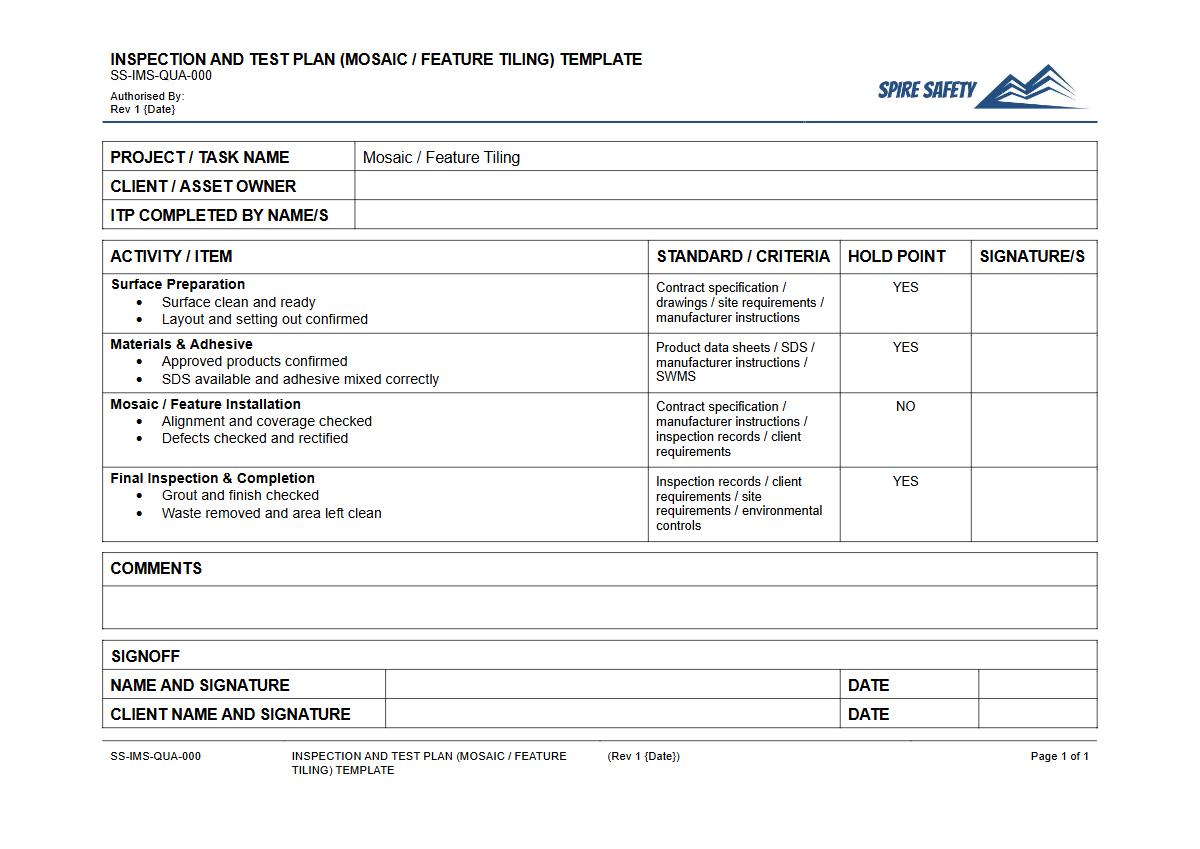
This Free Inspection & Test Plan (Mosaic Feature Tiling) Template provides a structured framework for ensuring your decorative tiling projects meet all quality, design, and safety specifications. An Inspection & Test Plan (ITP) is a formal quality assurance document that outlines the critical checkpoints, tests, and verification stages required to control a specific work process.
For mosaic feature tiling, this ensures every stage—from substrate preparation to final clean-down—is executed correctly, minimising defects and ensuring a durable, high-quality finish.
Using a formal ITP helps manage project risks by systematically addressing potential issues before they become costly problems. It covers key safety considerations inherent in tiling, such as the manual handling of tile sheets, exposure to chemical adhesives and grouts, and the control of respirable crystalline silica dust during any necessary cutting.
Integrating this ITP is a crucial part of developing comprehensive WHS management systems for any construction or fit-out business.
Video walkthrough
How to use the Free Inspection & Test Plan (Mosaic Feature Tiling) Template
This Inspection & Test Plan is provided as a downloadable DOCX file that you can easily edit and adapt to your specific project needs. It includes sections for defining inspection criteria, acceptance standards, responsible personnel, and verification records for each key activity in the tiling process.
To use it effectively, you should review each line item and customise it based on your project's architectural drawings, material specifications, and the manufacturer's technical data sheets for the tiles, adhesives, and grouts being used.
It is essential to identify the 'Hold Points' and 'Witness Points' relevant to your job. A Hold Point is a mandatory verification stage where work cannot proceed without formal approval, such as checking substrate flatness or waterproofing integrity before tiling begins. For high-risk elements like silica dust control, your customisations should align with established hazard management principles, similar to those outlined in guides for Principal Mining Hazard Management Plans.
Please note: This document is a template we provide as a structured starting point. You must customise it to suit the specific mosaic materials, substrate, project specifications, and your own safe work procedures.
When to use it
An ITP for mosaic feature tiling should be prepared before any site work commences. It forms part of the initial project planning and quality management documentation. It is actively used throughout the project lifecycle at key milestones, including:
- Pre-commencement: To confirm all materials have been approved and the work area is ready.
- Substrate Preparation: To verify the surface is clean, sound, and meets flatness tolerances.
- Waterproofing (if applicable): To inspect and sign off on membrane application and thickness before it is covered.
- Set-out & Installation: To confirm tile layout matches the design intent and that installation practices are correct.
- Grouting & Cleaning: To check for consistent joint finish and ensure no residue remains on the tile face.
- Project Handover: As part of the quality documentation package provided to the client or principal contractor.
Who should use it
This Inspection & Test Plan template is designed for use by personnel responsible for managing quality and ensuring compliance on construction and renovation projects. This includes:
- Project Managers: To oversee quality control and ensure project specifications are met.
- Site Supervisors & Forepersons: To manage the day-to-day work on site and conduct inspections.
- Quality Assurance / Quality Control (QA/QC) Officers: To formally document and verify that the installation meets the required standards. For larger projects, the completed ITP records become key evidence during internal or third-party WHS compliance auditing.
- Tiling Contractors & Leading Hands: To guide their work and ensure their team adheres to a consistent, high-quality process.
While this ITP focuses on the tiling task, remember to consider the overall safety of the work area, especially in public-facing spaces like lobbies or retail stores. You might find our Free WHS Inspection (Art Gallery) Template useful for assessing the broader environment where feature tiling is often installed.
By systematically planning and verifying each stage, you reduce rework, manage risks, and deliver a high-quality finish that meets client expectations. Explore our complete free WHS resources library for more tools to support your safety and quality systems.
Common mistakes
Common mistakes to avoid
- Failing to properly inspect and prepare the substrate, leading to tile delamination or cracking.
- Not allowing adequate curing time for adhesives and grouts as per manufacturer specifications.
- Neglecting to get formal sign-off at critical hold points, creating contractual risk.
- Using inconsistent batch numbers for tiles or grout, resulting in noticeable colour variations.
Legal references
Legal considerations
The following legal requirements may be relevant to this type of work.
- Work Health and Safety Act (Harmonised) — Provides the primary duties for protecting workers and other people from work health and safety risks.
- Work Health and Safety Regulations (Harmonised) — Sets out requirements supporting the management of workplace hazards and risks.
The following codes may be relevant to this type of work.
- Managing WHS Risks Code of Practice — Provides practical guidance on identifying hazards, assessing risks and applying effective controls.
- Work Health and Safety Consultation, Cooperation and Coordination Code of Practice — Provides practical guidance on consulting workers and coordinating with other duty holders.
- Managing the Work Environment and Facilities Code of Practice — Provides practical guidance on safe work environments, workplace facilities and related controls.
Did you know
An Ancient Art
Mosaic tiling is an art form dating back thousands of years. The ancient Greeks and Romans used intricate mosaics made of stone and glass to decorate floors and walls, with many examples surviving to this day.
Dust Dangers
Cutting ceramic or porcelain tiles can generate respirable crystalline silica, a hazardous dust that can cause serious lung diseases. Effective dust control measures, such as on-tool water suppression or dust extraction, are essential.
FAQ
Frequently asked questions
01What is the difference between an ITP and a SWMS?
02Does this template cover waterproofing inspections for wet areas?
03Is this ITP template suitable for large-scale commercial projects?
04What are the most critical hold points in a tiling ITP?
Share this resource
Free Inspection & Test Plan (Mosaic Feature Tiling) Template
Browse Categories
How To Use It
- 1Download and open in Word or PDF.
- 2Replace the placeholders with your business details.
- 3Get it reviewed by a WHS specialist before rollout.
Need it customised?
Our WHS consultants can adapt this template to your site, run a gap analysis, or audit what you already have in place.
Book a Free Consultation WHS consulting servicesor call 1300 156 382
Related templates
- Free Inspection & Test Plan (O&M Manual Handover) Template
- Free Inspection & Test Plan (Painting) Template
- Free Inspection & Test Plan (Passive Fire Protection Firestopping) Template
- Free Inspection & Test Plan (Pavement Road Base) Template
- Free Inspection & Test Plan (Piling and Pier Installation) Template
- Free Inspection & Test Plan (Pipeline Installation) Template