
Free Inspection & Test Plan (Hydraulic Services) Template
Download our free Inspection & Test Plan (Hydraulic Services) template to formalise quality control for hydraulic systems.
Free Inspection & Test Plan (Hydraulic Services) Template
DOCX • 138 KB + PDF
Updated Oct 2026
No signup required
Purpose of the Free Inspection & Test Plan (Hydraulic Services) Template
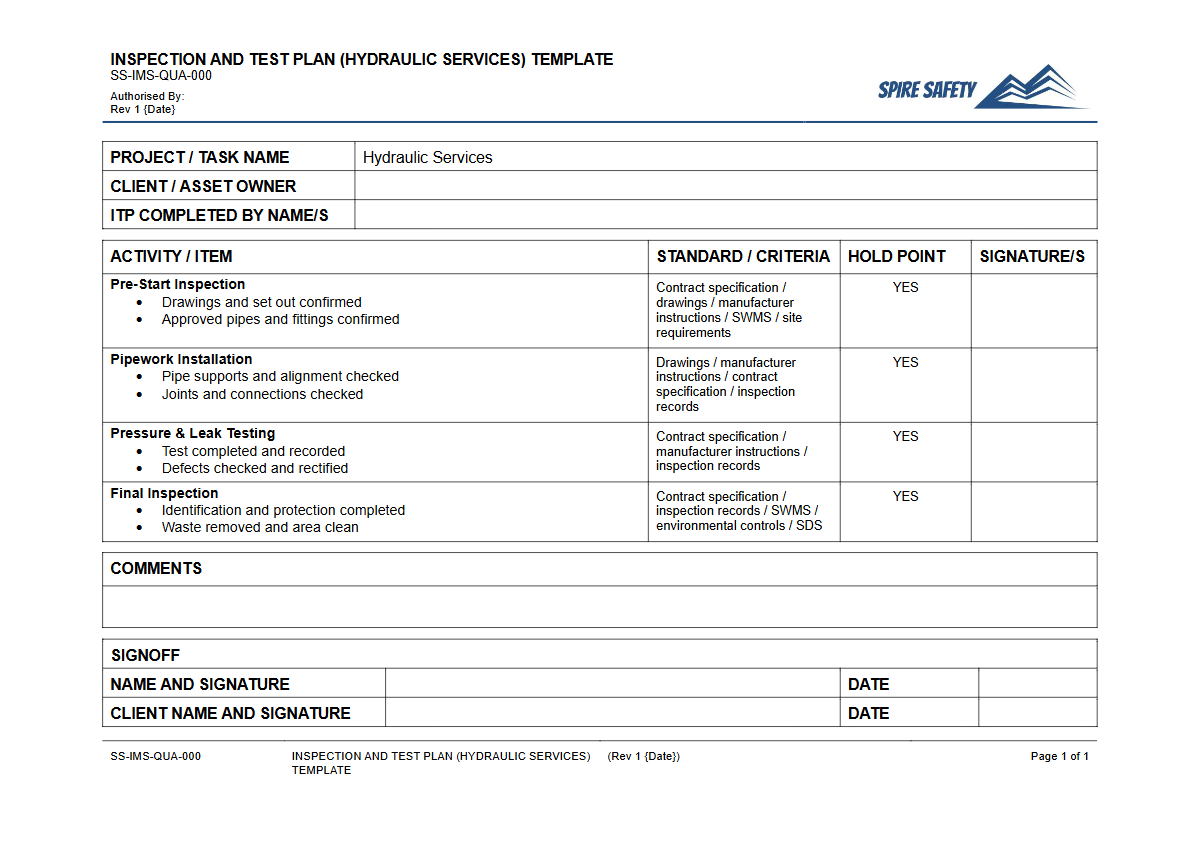
This Free Inspection & Test Plan (Hydraulic Services) Template provides a structured framework for documenting quality control and verification activities for hydraulic systems. An Inspection and Test Plan (ITP) is a critical quality management tool used to outline the sequence of inspections and tests required to ensure that work meets specified requirements.
It acts as a roadmap for all verification activities, from material receiving to final commissioning, ensuring every critical step is checked, witnessed, and approved. Properly implemented, it helps projects adhere to Australian standards, engineering specifications, and client expectations.
Integrating ITPs into broader WHS management systems is a key practice for demonstrating due diligence and maintaining high standards of quality and safety.
The primary purpose of this document is to provide clear, actionable steps for quality assurance. It defines the inspection points, responsible personnel, acceptance criteria, and the records to be maintained.
This systematic approach minimises the risk of defects, rework, and potential safety incidents associated with hydraulic system failures. It also serves as an essential communication tool between project teams, contractors, and clients.
Video walkthrough
How to use the Free Inspection & Test Plan (Hydraulic Services) Template
Our Free Inspection & Test Plan (Hydraulic Services) Template is provided as a customisable DOCX and PDF file. To use it effectively, you should first identify all the critical stages of your hydraulic services project, from design verification and material procurement to installation, pressure testing, and final handover.
For each stage, define the specific inspections and tests that need to be performed. This might include checking material certificates, verifying installation dimensions, witnessing pressure tests, or inspecting for leaks.
The template includes columns for detailing the activity, acceptance criteria, inspection type (e.g., Hold, Witness, Surveillance), and the records to be generated.
Important: This document is a template and must be customised to suit the specific requirements of your project, plant, and workplace. We are not responsible for any legislative breaches.
You must adapt it to align with your specific machinery, operational procedures, and the relevant Australian Standards and codes of practice.
A well-maintained ITP is an essential piece of evidence during regulatory checks or third-party evaluations. It demonstrates a systematic approach to quality and safety, forming a key part of the documentation reviewed during WHS compliance auditing.
Key Components of a Hydraulic Services ITP
Inspection Types
An ITP typically categorises inspections to define the level of involvement required from different parties (e.g., the client, a third-party inspector). Common types include:
- Hold Point (H): A mandatory verification point where work cannot proceed without the inspection being performed and approved by the designated authority. This is for the most critical activities, such as final pressure testing.
- Witness Point (W): An identified point in the process where the designated authority must be notified of the inspection and given the opportunity to witness it. Work can proceed if they choose not to attend.
- Surveillance Point (S): A point where inspections may be carried out on a random basis. No formal notification is required.
Documentation and Records
The ITP specifies the records that must be created and maintained to provide evidence of conformity. This can include material traceability certificates, welder qualifications, test reports, inspection checklists, and photographs.
For specific daily checks on equipment, resources like our Free Pre-Start Checklist (Breaker) Template can supplement the formal ITP process by ensuring equipment is safe for use before each shift.
When to use an Inspection & Test Plan
An ITP should be developed during the project planning phase, well before any physical work commences. It is a live document that is used throughout the project lifecycle.
It is particularly crucial for projects involving new hydraulic system installations, major modifications, or significant repairs in sectors like construction, manufacturing, mining, and transport. For example, in a vehicle repair facility, an ITP would govern the installation of a new hydraulic vehicle hoist, complementing routine safety checks managed with a resource like our free WHS Inspection (Vehicle Workshop) Template.
Who should use this template
This template is designed for use by a range of personnel responsible for project quality and safety. This includes Project Managers, Site Engineers, Quality Assurance/Quality Control (QA/QC) Managers, Supervisors, and WHS Advisors.
It provides a formal structure for managing inspections and ensures all stakeholders understand their roles and responsibilities. Ensuring that the personnel operating and testing the equipment are competent is also vital, a process which can be formalised using a document like our Verification of Competency (Hydraulic Impact Wrench) template for specific tools.
The development of an ITP often requires input from multiple stakeholders, including designers, suppliers, and the end-user. The process aligns with the principles of safety management that are central to WHS consultation services in Australia, ensuring that risks are identified and controlled through a collaborative process.
Common mistakes
Common mistakes to avoid
- Using generic, non-project-specific acceptance criteria.
- Failing to assign clear responsibility for each inspection and sign-off.
- Not updating the ITP when the project scope or design changes.
- Poor record-keeping, making it impossible to prove inspections were completed.
Legal references
Legal considerations
The following legal requirements may be relevant to this type of work.
- Work Health and Safety Act (Harmonised) — Provides the primary duties for protecting workers and other people from work health and safety risks.
- Work Health and Safety Regulations (Harmonised) — Sets out requirements supporting the management of workplace hazards and risks.
The following codes may be relevant to this type of work.
- Managing WHS Risks Code of Practice — Provides practical guidance on identifying hazards, assessing risks and applying effective controls.
- Work Health and Safety Consultation, Cooperation and Coordination Code of Practice — Provides practical guidance on consulting workers and coordinating with other duty holders.
- Managing the Work Environment and Facilities Code of Practice — Provides practical guidance on safe work environments, workplace facilities and related controls.
Did you know
Pascal's Principle
Hydraulic systems operate on Pascal's Principle, which states that pressure applied to an enclosed fluid is transmitted undiminished to every portion of the fluid and the walls of the containing vessel. This allows small forces to be multiplied into much larger ones.
Fluid Contamination
Over 75% of hydraulic system failures are caused by fluid contamination. A single teaspoon of dirt in a 200-litre drum of hydraulic fluid can be enough to cause significant wear and component failure.
FAQ
Frequently asked questions
01What is the difference between an ITP and a Safe Work Method Statement (SWMS)?
02Does this Hydraulic Services ITP template cover all legal requirements?
03What are 'acceptance criteria' in an ITP?
04Can I use this ITP for maintenance as well as new installations?
Share this resource
Free Inspection & Test Plan (Hydraulic Services) Template
Browse Categories
How To Use It
- 1Download and open in Word or PDF.
- 2Replace the placeholders with your business details.
- 3Get it reviewed by a WHS specialist before rollout.
Need it customised?
Our WHS consultants can adapt this template to your site, run a gap analysis, or audit what you already have in place.
Book a Free Consultation WHS consulting servicesor call 1300 156 382
Related templates
- Free Inspection & Test Plan (Internal Door Installation) Template
- Free Inspection & Test Plan (Internal Wall Framing) Template
- Free Inspection & Test Plan (Kitchen Cabinetry Installation) Template
- Free Inspection & Test Plan (Landscaping Civil Works) Template
- Free Inspection & Test Plan (Lift Elevator Installation) Template
- Free Inspection & Test Plan (Light Gauge Steel Framing) Template