
Free Inspection & Test Plan (Hydraulic Lift Pit) Template
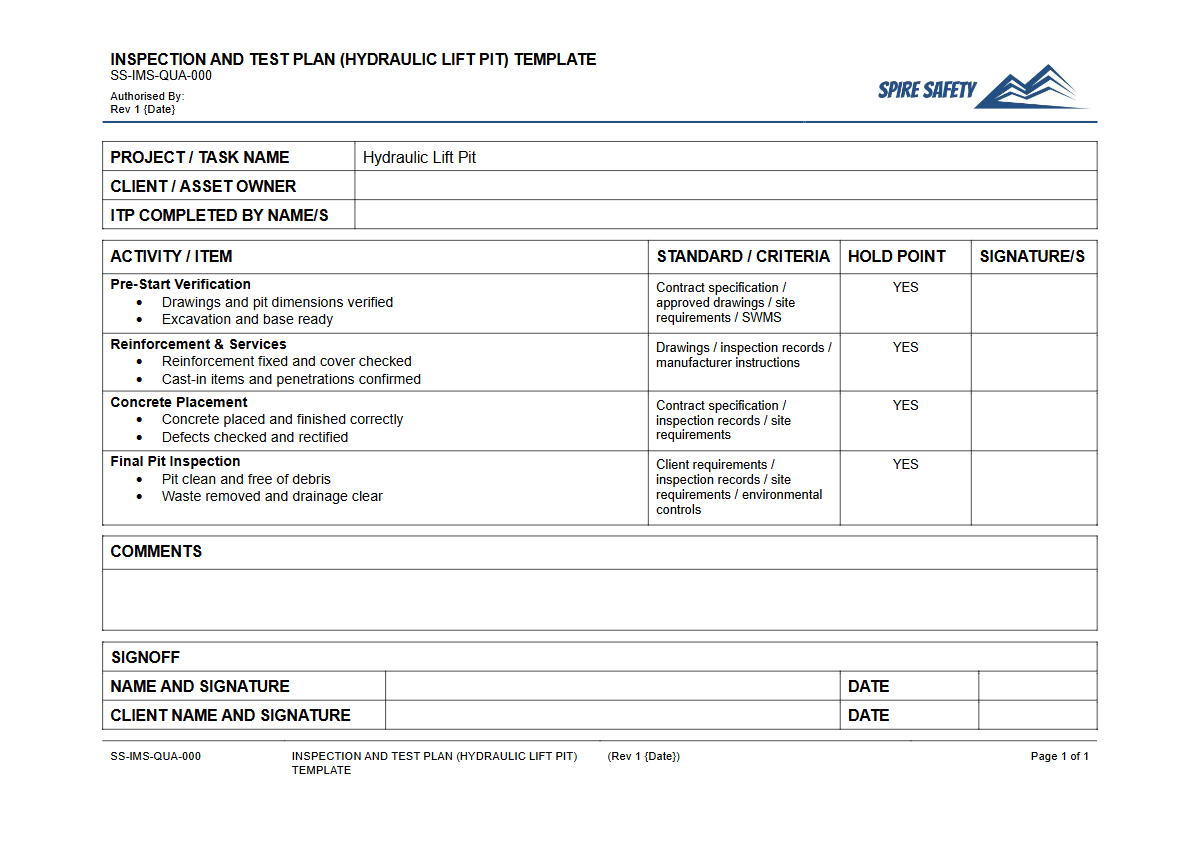
Download our Free Inspection & Test Plan (Hydraulic Lift Pit) Template. This structured DOCX & PDF helps formalise quality and safety checks. Download now.
Free Inspection & Test Plan (Hydraulic Lift Pit) Template
DOCX • 142 KB + PDF
Updated Oct 2026
No signup required
Purpose of the Free Inspection & Test Plan (Hydraulic Lift Pit) Template
Ensuring the safe and correct installation, maintenance, or modification of a hydraulic lift requires a structured approach to quality assurance and safety verification. Our Free Inspection & Test Plan (Hydraulic Lift Pit) Template provides a framework for documenting the critical checkpoints throughout the project lifecycle.
This document serves as a formal record of inspections, tests, and verifications, ensuring all activities meet engineering specifications, Australian standards, and WHS regulations.
An Inspection & Test Plan (ITP) is a cornerstone document that outlines the sequence of checks, defines acceptance criteria, and assigns responsibilities for each stage of work. Using this template helps demonstrate due diligence and forms an essential part of a project's quality and safety records.
Integrating ITPs into your projects supports the broader framework of your organisation's WHS management systems, providing tangible evidence of proactive risk control.
Video walkthrough
How to use the Free Inspection & Test Plan (Hydraulic Lift Pit) Template
This template is a starting point designed for easy customisation. To effectively use this Free Inspection & Test Plan (Hydraulic Lift Pit) Template, follow these steps:
- Download: Choose between the DOCX file for easy editing or the PDF for straightforward printing and viewing.
- Customise: Populate the header with project-specific details, including the project name, location, ITP number, and relevant parties.
- Review and Adapt: The template includes common inspection stages for hydraulic lift pit works, such as excavation, formwork, reinforcement, concrete pour, and waterproofing. Review these stages and their corresponding checks, acceptance criteria, and verification methods. Add, remove, or modify these items to align precisely with your project's scope and engineering design.
- Assign Responsibilities: Clearly define who is responsible for performing inspections (e.g., Site Supervisor, Engineer) and who needs to witness or approve them (e.g., Client Representative, Third-Party Inspector).
Important: This document must be customised to your specific workplace, project scope, and the specific model of hydraulic lift being installed or serviced. We are not responsible for any incidents arising from the use of an unmodified or improperly customised template.
The final ITP should be reviewed and approved by a competent person before work commences. For related facility checks, consider our Free WHS Inspection (Vehicle Workshop) Template to cover broader workshop safety.
Understanding ITP Checkpoints
An ITP typically uses three main types of checkpoints:
- Surveillance Point (S): Regular monitoring of an activity to ensure it meets requirements. Work may continue without a formal stop.
- Witness Point (W): The inspector must be notified and given the opportunity to witness the test or inspection. If the inspector does not attend, the work may proceed.
- Hold Point (H): A mandatory verification point where work cannot proceed without inspection and formal approval from the designated authority. This is the strictest level of control, reserved for critical stages like pre-pour reinforcement checks or load testing.
When to use it
An Inspection & Test Plan for a hydraulic lift pit is not just for new construction. It is a vital document for a range of activities, including:
- New Installations: From initial excavation to final commissioning of the lift system within the pit.
- Major Refurbishments: When upgrading an existing lift system, which may involve structural changes to the pit itself.
- Significant Repairs: For any work that could affect the structural integrity or waterproofing of the pit.
- Decommissioning: To safely dismantle and remove a lift system and backfill the pit.
While this ITP covers structural and installation milestones, daily equipment safety is managed differently. For mobile plant, a document like our Free Pre-Start Checklist (Boom Lift) Template is used for operator-level checks before each shift.
Who should use it
This template is designed for use by various personnel responsible for overseeing, managing, and executing construction and maintenance projects involving hydraulic lift pits. Key users include:
- Project Managers: For overall project quality and compliance oversight.
- Site Supervisors & Forepersons: For managing day-to-day activities and ensuring checkpoints are met on the ground.
- Quality Assurance/Control (QA/QC) Officers: For implementing and verifying the project's quality plan.
- WHS Advisors and Officers: To ensure safety-critical steps are formally verified and documented.
- Engineers (Civil, Structural, Mechanical): For verifying that work complies with technical specifications and designs.
The completed ITP becomes a critical piece of evidence during a formal WHS compliance auditing process, demonstrating a systematic approach to managing quality and safety risks. Furthermore, ensuring that personnel operating associated equipment are properly assessed is also crucial; our Verification of Competency (Hydraulic Impact Wrench) template can assist with this process for specific tools.
This ITP is one of many documents available to help you build a more robust safety and quality system. Explore our complete free WHS resources library for more templates, checklists, and guides.
Common mistakes
Common mistakes to avoid
- Using a generic template without customising it for the project's specific engineering requirements and site conditions.
- Failing to define clear, measurable, and objective acceptance criteria for each inspection point.
- Not allocating sufficient time for Hold Point inspections, causing project delays or pressure to skip critical checks.
- Poor record-keeping, including incomplete sign-offs or failing to attach supporting evidence like photos and test certificates.
Legal references
Legal considerations
The following legal requirements may be relevant to this type of work.
- Work Health and Safety Act (Harmonised) — Provides the primary duties for protecting workers and other people from work health and safety risks.
- Work Health and Safety Regulations (Harmonised) — Sets out requirements supporting the management of workplace hazards and risks.
The following codes may be relevant to this type of work.
- Managing WHS Risks Code of Practice — Provides practical guidance on identifying hazards, assessing risks and applying effective controls.
- Work Health and Safety Consultation, Cooperation and Coordination Code of Practice — Provides practical guidance on consulting workers and coordinating with other duty holders.
- Managing the Work Environment and Facilities Code of Practice — Provides practical guidance on safe work environments, workplace facilities and related controls.
Did you know
The Role of Hold Points
Hold Points are the most critical control in an ITP. Missing a Hold Point, such as proceeding with a concrete pour before the reinforcement steel has been inspected and approved, can lead to costly and dangerous structural defects that may be impossible to verify later.
Pit Waterproofing
Water ingress is a major cause of hydraulic lift failure, leading to corrosion of components, contamination of hydraulic fluid, and electrical faults. A robust ITP must include detailed checks for the waterproofing system's integrity.
FAQ
Frequently asked questions
01What is an Inspection & Test Plan (ITP)?
02What are the key inspection points for a hydraulic lift pit?
03What is the difference between a Witness Point and a Hold Point?
04Who is responsible for signing off an Inspection & Test Plan?
Share this resource
Free Inspection & Test Plan (Hydraulic Lift Pit) Template
Browse Categories
How To Use It
- 1Download and open in Word or PDF.
- 2Replace the placeholders with your business details.
- 3Get it reviewed by a WHS specialist before rollout.
Need it customised?
Our WHS consultants can adapt this template to your site, run a gap analysis, or audit what you already have in place.
Book a Free Consultation WHS consulting servicesor call 1300 156 382
Related templates
- Free Inspection & Test Plan (Hydraulic Services) Template
- Free Inspection & Test Plan (Internal Door Installation) Template
- Free Inspection & Test Plan (Internal Wall Framing) Template
- Free Inspection & Test Plan (Kitchen Cabinetry Installation) Template
- Free Inspection & Test Plan (Landscaping Civil Works) Template
- Free Inspection & Test Plan (Lift Elevator Installation) Template