
Free Inspection & Test Plan (Grease Trap Installation) Template
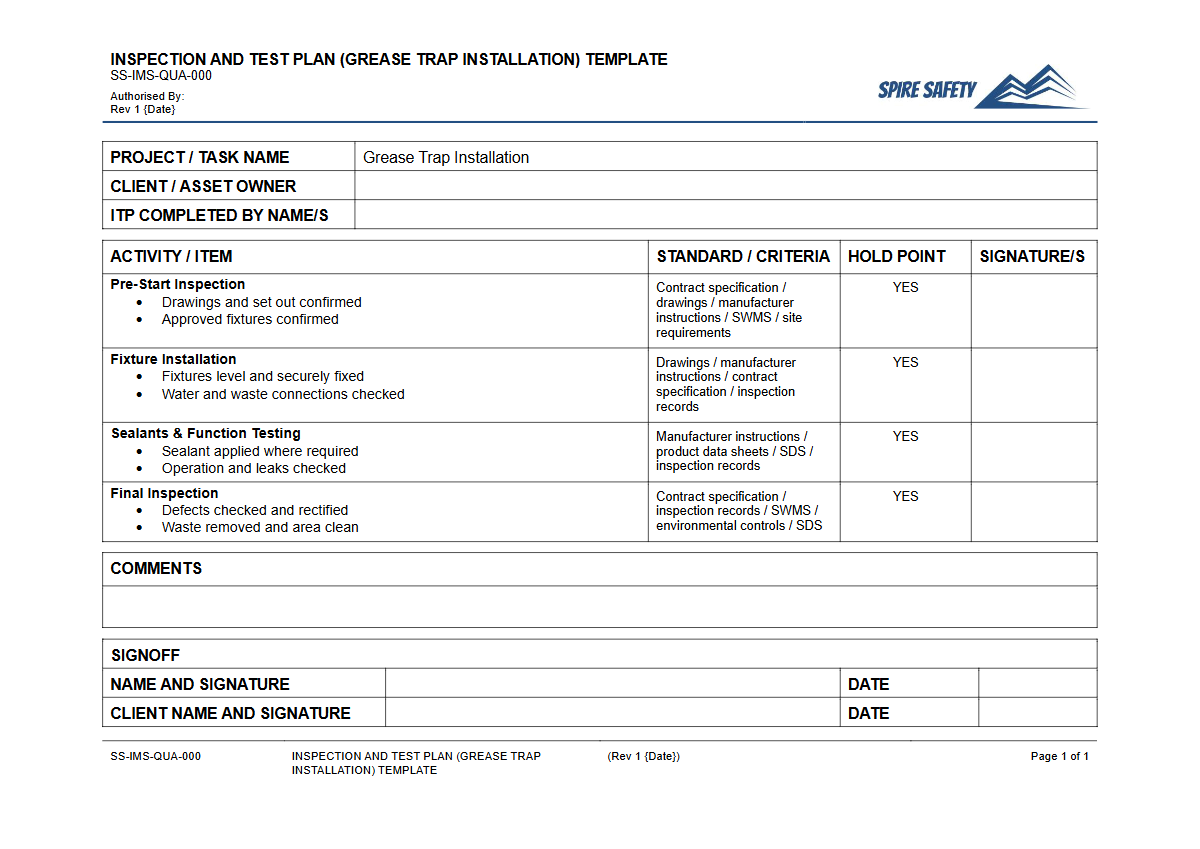
Download our free Inspection & Test Plan (Grease Trap Installation) template. This structured DOCX and PDF resource helps ensure quality and compliance.
Free Inspection & Test Plan (Grease Trap Installation) Template
DOCX • 138 KB + PDF
Updated Oct 2026
No signup required
Purpose of the Free Inspection & Test Plan (Grease Trap Installation) Template
An Inspection and Test Plan (ITP) is a critical quality assurance document that outlines the sequence of inspections and tests required to verify that an installation meets project specifications and regulatory standards. Our free Inspection & Test Plan (Grease Trap Installation) template provides a structured framework for ensuring every stage of the installation—from pre-delivery checks to final commissioning—is properly controlled and documented.
Using a formal ITP helps prevent costly rework, demonstrates due diligence, and ensures the final installation is safe, functional, and compliant with relevant plumbing and environmental codes.
This template serves as a formal record, detailing what will be checked, who is responsible, and what acceptance criteria must be met. It integrates quality control directly into the construction process, making it an essential component of robust WHS management systems. By systematically planning and recording verification activities, contractors and project managers can provide clear evidence to clients and authorities that the work has been completed to the required standard.
Video walkthrough
How to use the Free Inspection & Test Plan (Grease Trap Installation) Template
This template is provided as a customisable DOCX file, with a PDF version also available for easy printing and distribution. It is designed as a comprehensive starting point, not a finished document.
You must adapt it to the specific requirements of your project, site, and jurisdiction. This involves identifying the correct standards, specifications, and client requirements, then populating the ITP with the relevant inspection points, hold points, and witness points.
A 'hold point' is a mandatory verification point beyond which work cannot proceed without approval.
To effectively use the template, begin by reviewing all project documentation, including engineering drawings, supplier data, and local water authority regulations. Customise the checklist items to reflect the specific type of grease trap being installed, the site conditions, and any unique environmental or safety risks.
Effective customisation is key to ensuring the plan is practical and relevant, and may form part of a broader WHS compliance auditing process to verify all legal obligations are being met.
Key Sections to Customise
- Pre-Installation Checks: Verify correct model delivery, check for damage, and confirm all components are present. Ensure the site is prepared, including excavation, base preparation, and surrounding safety measures. You can complement this with broader site safety checks using a tool like our Free WHS Inspection (Vehicle Workshop) Template if the installation is in a similar environment.
- Installation Process: Document key stages like lifting and positioning the unit, connecting pipework (inlet, outlet, ventilation), ensuring correct fall and grade, and installing ancillary components like sampling points.
- Post-Installation Testing: Detail procedures for hydrostatic testing (leak testing), checking flow rates, and verifying the function of baffles and other internal components.
- Commissioning & Handover: Record the final checks, compilation of all records into the handover package, and formal acceptance by the client or principal contractor.
When to use an Inspection & Test Plan
An ITP for grease trap installation should be developed during the project planning phase, well before any work commences on site. It should be reviewed and approved by all relevant stakeholders, including the project manager, site supervisor, and potentially the client or their representative.
The ITP is then used as a live document throughout the installation lifecycle, with inspectors signing off on each stage as it is completed. It's a key tool for managing project quality from start to finish.
This includes planning for the disposal of any construction waste or old units, a process that can be informed by principles found in waste management and resource recovery plans. For facilities that handle such waste, a specific free WHS inspection (resource recovery) template can ensure safety during disposal and recycling operations.
Who should use this ITP Template
This resource is designed for a range of personnel involved in the specification, installation, and approval of trade waste systems. This includes:
- Project Managers: To plan and control project quality.
- Site Supervisors & Forepersons: To manage day-to-day work and ensure procedures are followed correctly.
- Plumbers & Drainage Contractors: To understand the quality requirements and ensure their work meets the standard.
- Quality Assurance/Control Officers: To conduct inspections and manage the documentation process.
- WHS Advisors: To ensure safety controls are integrated into the work sequence.
Effectively implementing this plan often requires a collaborative effort between teams to ensure every checkpoint is met. For organisations needing support in developing and implementing such procedural documents, engaging with external WHS consulting services can provide the necessary expertise and oversight.
You can also explore our wider free WHS resources library for more templates and guides to support your safety management system.
Common mistakes
Common mistakes to avoid
- Failing to customise the template for specific site conditions and local regulations.
- Not clearly defining 'Hold Points' and 'Witness Points', leading to critical stages being missed.
- Using inexperienced personnel to sign off on technical checks.
- Poor record-keeping, resulting in an incomplete or unverifiable quality file at project handover.
Legal references
Legal considerations
The following legal requirements may be relevant to this type of work.
- Work Health and Safety Act (Harmonised) — Provides the primary duties for protecting workers and other people from work health and safety risks.
- Work Health and Safety Regulations (Harmonised) — Sets out requirements supporting the management of workplace hazards and risks.
The following codes may be relevant to this type of work.
- Managing WHS Risks Code of Practice — Provides practical guidance on identifying hazards, assessing risks and applying effective controls.
- Work Health and Safety Consultation, Cooperation and Coordination Code of Practice — Provides practical guidance on consulting workers and coordinating with other duty holders.
- Managing the Work Environment and Facilities Code of Practice — Provides practical guidance on safe work environments, workplace facilities and related controls.
Did you know
The FOG Menace
Fats, Oils, and Grease (FOG) discharged from commercial kitchens congeal in sewer pipes, creating hard masses known as 'fatbergs'. These blockages cause sewer overflows, environmental damage, and are extremely costly to remove.
FAQ
Frequently asked questions
01What is an Inspection and Test Plan (ITP) in construction?
02What are the key hold points for a grease trap installation?
03Who is responsible for approving a grease trap installation ITP?
04Does this template cover specific council or water authority requirements?
Share this resource
Free Inspection & Test Plan (Grease Trap Installation) Template
Browse Categories
How To Use It
- 1Download and open in Word or PDF.
- 2Replace the placeholders with your business details.
- 3Get it reviewed by a WHS specialist before rollout.
Need it customised?
Our WHS consultants can adapt this template to your site, run a gap analysis, or audit what you already have in place.
Book a Free Consultation WHS consulting servicesor call 1300 156 382
Related templates
- Free Inspection & Test Plan (Green Flat Roof System) Template
- Free Inspection & Test Plan (Guttering and Downpipes) Template
- Free Inspection & Test Plan (Hot Water System Installation) Template
- Free Inspection & Test Plan (HVAC Installation) Template
- Free Inspection & Test Plan (Hydraulic Balancing) Template
- Free Inspection & Test Plan (Hydraulic Lift Pit) Template