
Free Inspection & Test Plan (Format) Template
Download our Free Inspection & Test Plan (Format) Template to formalise your quality and safety verification processes.
Free Inspection & Test Plan (Format) Template
DOCX • 140 KB + PDF
Updated Oct 2026
No signup required
Purpose of the Free Inspection & Test Plan (Format) Template
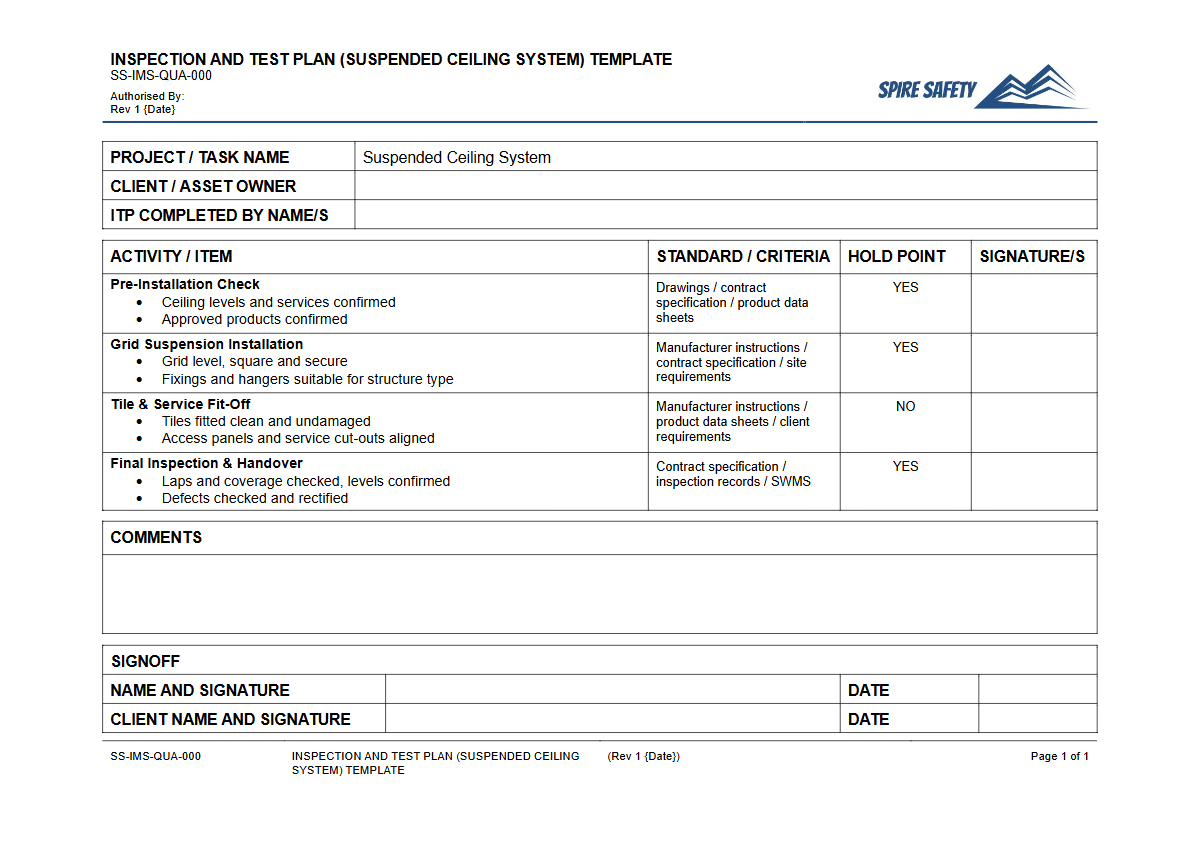
An Inspection and Test Plan (ITP) is a critical document that outlines the quality control and assurance activities required for a specific process, project, or piece of equipment. This Free Inspection & Test Plan (Format) Template provides a structured framework to plan, document, and verify that work meets required specifications and safety standards.
By systematically defining inspection points, tests, acceptance criteria, and responsibilities, an ITP ensures consistency and provides objective evidence that requirements have been met. It serves as a roadmap for your quality and safety verification process, helping to prevent defects, rework, and safety incidents before they occur.
Implementing ITPs is a proactive measure that integrates quality management directly into your project workflow. It helps ensure that from raw material receival to final handover, every critical stage is checked and verified.
This level of organisation is fundamental to robust WHS management systems, demonstrating due diligence and a commitment to delivering safe, high-quality outcomes.
Video walkthrough
How to use the Free Inspection & Test Plan (Format) Template
This template is provided in both DOCX and PDF formats for your convenience. To begin, download the DOCX file and open it in your preferred word processor.
The plan is structured with columns for detailing each task, the type of inspection or test required, the standards or specifications to be met, acceptance criteria, the frequency of the check, and the person responsible. You should populate the ITP during the project planning phase, before work commences.
For each major activity or component of your project, list the corresponding checks. For example, a fabrication project might include checks for material certification, weld preparations, visual weld inspections, and final dimensional accuracy.
Each check should reference a specific procedure or standard where applicable, such as a company procedure or an Australian Standard. This ensures clarity and consistency in how tests are performed.
In manufacturing contexts, this might involve referencing a document like a Free Brake Press SOP (Safe Operating Procedure) Template to ensure the machine operation itself is standardised before its output is inspected.
Important: It is crucial to understand that this is a template, not a finished document. We have designed it to be a starting point, and you must customise it to reflect the specific tasks, equipment, materials, and regulatory requirements of your project and workplace.
Failure to tailor the ITP to your specific context will render it ineffective.
When to use an Inspection & Test Plan
ITPs are versatile documents applicable across many industries and scenarios. They are particularly vital in situations where quality and compliance are non-negotiable.
Common applications include construction projects (for civil, structural, mechanical, and electrical works), manufacturing and fabrication, equipment installation and commissioning, software development, and the implementation of high-risk work processes. An ITP should be developed for any activity where a failure to meet specifications could result in significant safety risks, financial loss, or contractual disputes.
For instance, when commissioning new machinery, an ITP ensures that all installation checks, safety feature tests, and performance trials are completed and signed off before the equipment is put into service. This process often follows the initial hazard identification documented in a Water Pump Risk Assessment or similar document, with the ITP serving to verify the effectiveness of the implemented controls.
Who should use an Inspection & Test Plan
The development and use of an Inspection & Test Plan involves several key roles within an organisation. Typically, a Project Manager, Quality Manager, or Engineer is responsible for drafting the ITP, ensuring it aligns with project specifications, client requirements, and relevant standards.
They work with technical experts and WHS advisors to identify the critical inspection points and define realistic acceptance criteria. Frontline supervisors and team leaders are the primary users of the completed ITP, guiding their teams to ensure all required checks are performed at the correct stages of the work.
Technicians, tradespeople, and operators are responsible for carrying out the work to the specified quality and participating in the inspection process. In many cases, an ITP will specify that a worker's competency must be confirmed before they undertake a task, a process managed with tools like our Free Drill Press VOC (Verification of Competency) Template. Finally, clients or independent third-party inspectors may also use the ITP to conduct their own verification and surveillance activities, making it a key document for stakeholder transparency and accountability.
Regular reviews of completed ITPs are essential for continuous improvement. These reviews, often part of a formal WHS compliance auditing program, help identify recurring issues, refine inspection processes, and improve overall project delivery.
The records generated from the ITP become part of the project's quality records, providing a permanent account of the verification activities performed. You can find more templates and tools to support your safety and quality processes in our comprehensive free WHS resources library.
Common mistakes
Common mistakes to avoid
- Using a generic template without customising it for the specific project, materials, and risks involved.
- Failing to define clear, measurable, and objective acceptance criteria for each inspection point.
- Not assigning specific, named roles and responsibilities for conducting, witnessing, and signing off checks.
- Neglecting to update the ITP when project specifications, materials, or work methods change.
Legal references
Legal considerations
The following legal requirements may be relevant to this type of work.
- Work Health and Safety Act (Harmonised) — Provides the primary duties for protecting workers and other people from work health and safety risks.
- Work Health and Safety Regulations (Harmonised) — Sets out requirements supporting the management of workplace hazards and risks.
The following codes may be relevant to this type of work.
- Managing WHS Risks Code of Practice — Provides practical guidance on identifying hazards, assessing risks and applying effective controls.
- Work Health and Safety Consultation, Cooperation and Coordination Code of Practice — Provides practical guidance on consulting workers and coordinating with other duty holders.
- Managing the Work Environment and Facilities Code of Practice — Provides practical guidance on safe work environments, workplace facilities and related controls.
Did you know
ISO 9001 Connection
Inspection and Test Plans are a cornerstone of quality management systems that conform to AS/NZS ISO 9001, providing the documented evidence required for quality control and verification activities.
Project Tiers
ITPs can be tiered. A high-level 'Master' ITP can cover an entire project, while more detailed 'Sub-ITPs' can be created for specific complex components or subcontractor work packages.
FAQ
Frequently asked questions
01What is the difference between an ITP and a Quality Plan?
02Do I need an ITP for a small construction project?
03How detailed should my Inspection & Test Plan be?
04Can an ITP be used for WHS purposes?
Share this resource
Free Inspection & Test Plan (Format) Template
Browse Categories
How To Use It
- 1Download and open in Word or PDF.
- 2Replace the placeholders with your business details.
- 3Get it reviewed by a WHS specialist before rollout.
Need it customised?
Our WHS consultants can adapt this template to your site, run a gap analysis, or audit what you already have in place.
Book a Free Consultation WHS consulting servicesor call 1300 156 382
Related templates
- Free Inspection & Test Plan (Formwork) Template
- Free Inspection & Test Plan (Glazing) Template
- Free Inspection & Test Plan (Grease Trap Installation) Template
- Free Inspection & Test Plan (Green Flat Roof System) Template
- Free Inspection & Test Plan (Guttering and Downpipes) Template
- Free Inspection & Test Plan (Hot Water System Installation) Template