
Free Inspection & Test Plan (Fire Sprinkler System) Template
A structured starting point for ensuring your fire sprinkler systems are safe and functional. Download our free Inspection & Test Plan template today.
Free Inspection & Test Plan (Fire Sprinkler System) Template
DOCX • 138 KB + PDF
Updated Oct 2026
No signup required
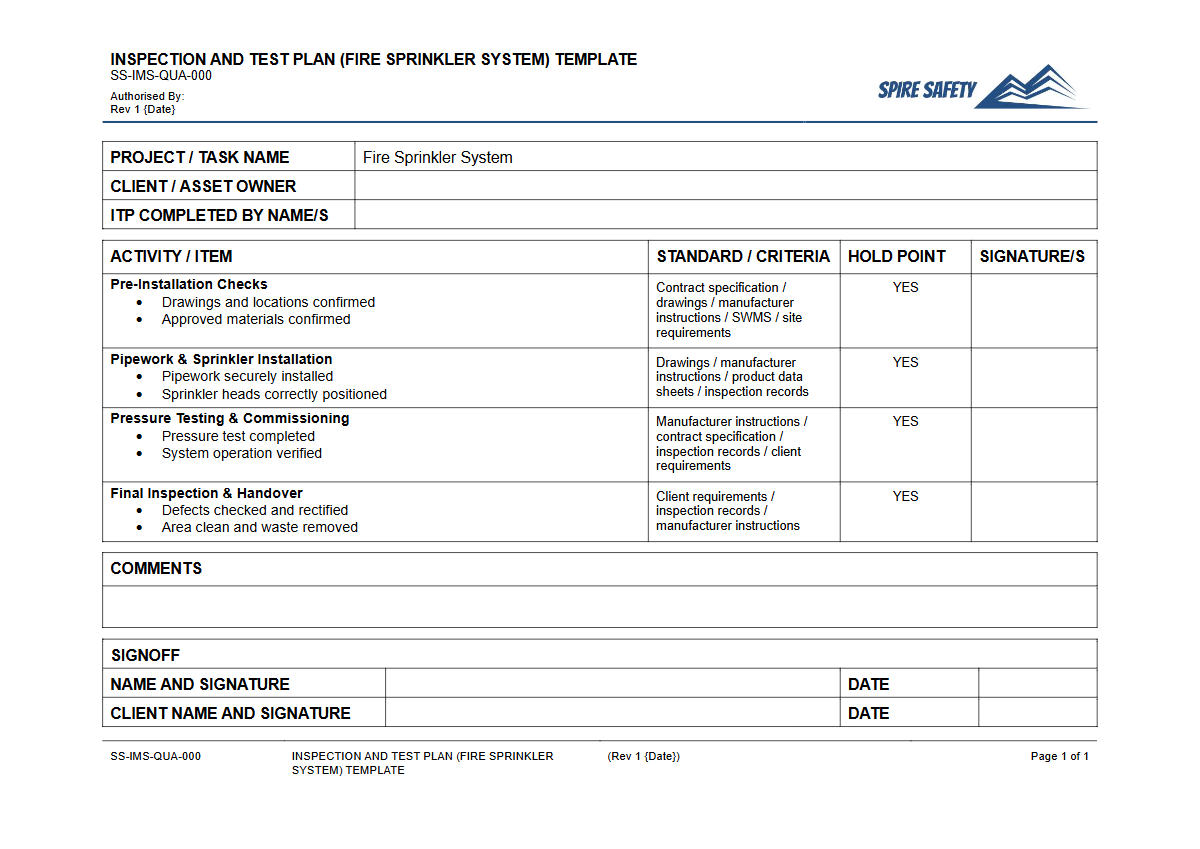
Purpose of the Free Inspection & Test Plan (Fire Sprinkler System) Template
A functional fire sprinkler system is a non-negotiable part of building safety. This Free Inspection & Test Plan (Fire Sprinkler System) Template provides a structured framework for systematically verifying that your automatic fire sprinkler system is installed, commissioned, and maintained according to project specifications and relevant Australian standards.
Using an Inspection & Test Plan (ITP) helps building owners and managers demonstrate due diligence, ensuring that all necessary quality and safety checks are planned, executed, and documented correctly.
This template is designed as a comprehensive starting point, aligned with Australian WHS best practices. It helps formalise the quality assurance and quality control process, providing a clear record of compliance activities.
Properly implemented, an ITP ensures that potential issues are identified and rectified before they can compromise the system's ability to protect people and property during a fire event. It provides a clear and auditable trail of all inspection and testing activities performed on the system throughout its lifecycle.
Video walkthrough
How to use the Free Inspection & Test Plan (Fire Sprinkler System) Template
This resource is provided as a customisable DOCX file for easy editing. To use it effectively, follow these steps:
- Download: Get your copy of the template in DOCX or PDF format.
- Customise: Adapt the document to your specific project or facility. This includes adding project details, company information, and specific details about the fire sprinkler system (e.g., wet pipe, dry pipe, pre-action), and referencing the relevant Australian Standards and engineering specifications.
- Review and Approve: Have the ITP reviewed and approved by a competent person, such as a fire systems engineer or project manager, before work commences.
- Implement: Use the ITP to guide and record all inspection and testing activities at each stage, from pre-construction to final commissioning and ongoing maintenance. Ensure all personnel understand their responsibilities as outlined in the plan.
Important: This template provides a solid foundation, but it is not a complete, ready-to-use document. We have designed it to be customised to your specific workplace, equipment, and legal obligations. For day-to-day checks that feed into this broader plan, consider using our free Pre-Start Checklist for Fire Panels.
When to use an Inspection & Test Plan
An ITP for a fire sprinkler system is a lifecycle document used at several key stages. It is essential during the initial installation and commissioning phase to ensure the system is built and functions as designed.
Beyond installation, the ITP is a critical tool for scheduling and managing ongoing routine service and maintenance activities as mandated by Australian Standard AS 1851. It should be referenced during weekly, monthly, six-monthly, and annual inspections.
The plan must also be reviewed and potentially updated following any system modifications, repairs, or changes in the building's use or layout to ensure its continued effectiveness.
Who should use this template
This Inspection & Test Plan is designed for use by a range of personnel responsible for workplace safety and asset management. Key users include:
- Facility and Building Managers: To oversee and document the maintenance and compliance of building safety systems.
- WHS Managers and Safety Officers: To integrate fire system testing into the broader safety management framework.
- Project Managers and Engineers: To manage quality control during the construction and commissioning of new sprinkler systems.
- Fire Protection Technicians and Contractors: As a guide and record for the services they provide.
This document is a critical piece of evidence during formal WHS compliance audits, demonstrating a systematic approach to managing a critical safety asset. It also forms a key component of comprehensive WHS management systems, helping organisations meet their duty of care. In facilities with specific risk profiles, such as healthcare, this ITP complements broader safety protocols, like those outlined in a WHS inspection for an aged care home. For specific advice on adapting this template, you may need to seek advice from professional WHS consultants. You can explore our entire catalogue of templates in our free WHS resources library.
Common mistakes
Common mistakes to avoid
- Failing to document all tests, inspections, and maintenance activities.
- Using unqualified or unlicensed personnel for testing and servicing.
- Not updating the ITP after system modifications or a change in building use.
- Ignoring 'minor' defects which can escalate into major system failures.
Legal references
Legal considerations
The following legal requirements may be relevant to this type of work.
- Work Health and Safety Act (Harmonised) — Provides the primary duties for protecting workers and other people from work health and safety risks.
- Work Health and Safety Regulations (Harmonised) — Sets out requirements supporting the management of workplace hazards and risks.
The following codes may be relevant to this type of work.
- Managing WHS Risks Code of Practice — Provides practical guidance on identifying hazards, assessing risks and applying effective controls.
- Work Health and Safety Consultation, Cooperation and Coordination Code of Practice — Provides practical guidance on consulting workers and coordinating with other duty holders.
- Managing the Work Environment and Facilities Code of Practice — Provides practical guidance on safe work environments, workplace facilities and related controls.
Did you know
Sprinkler Reliability
Modern, properly maintained fire sprinkler systems have a remarkable reliability rate, operating effectively in over 96% of fires where they are present.
Heat Activated
Contrary to movie depictions, fire sprinklers are not activated by smoke. Each sprinkler head has a heat-sensitive element that activates individually only when it reaches a specific temperature.
FAQ
Frequently asked questions
01What is an Inspection and Test Plan (ITP) for fire sprinklers?
02How often should fire sprinkler systems be tested in Australia?
03Who is qualified to test a fire sprinkler system?
04Is this template compliant with AS 1851 and AS 2118.1?
Share this resource
Free Inspection & Test Plan (Fire Sprinkler System) Template
Browse Categories
How To Use It
- 1Download and open in Word or PDF.
- 2Replace the placeholders with your business details.
- 3Get it reviewed by a WHS specialist before rollout.
Need it customised?
Our WHS consultants can adapt this template to your site, run a gap analysis, or audit what you already have in place.
Book a Free Consultation WHS consulting servicesor call 1300 156 382
Related templates
- Free Inspection & Test Plan (Floor Levelling Screeding) Template
- Free Inspection & Test Plan (Floor Tiling) Template
- Free Inspection & Test Plan (Format) Template
- Free Inspection & Test Plan (Formwork) Template
- Free Inspection & Test Plan (Glazing) Template
- Free Inspection & Test Plan (Grease Trap Installation) Template