
Free Inspection & Test Plan (Fire Detection and Alarm System) Template
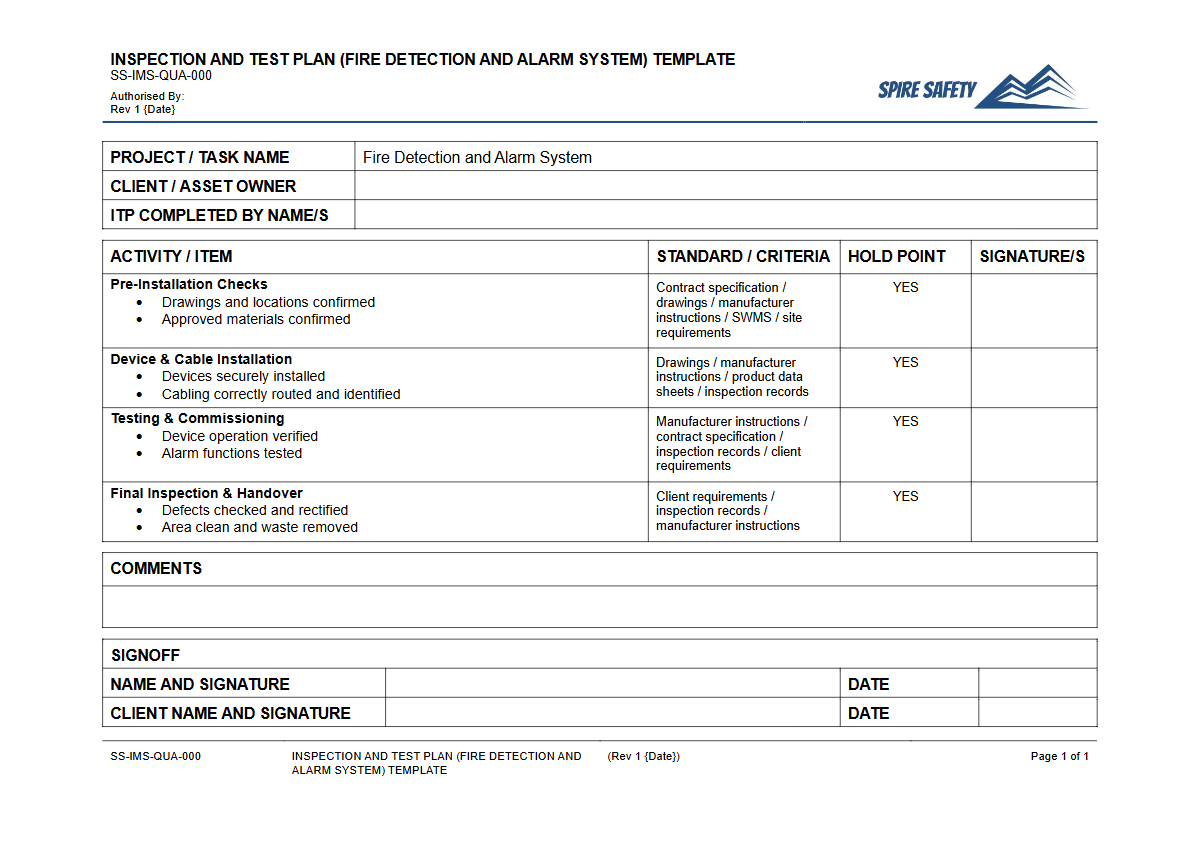
Download our free Inspection & Test Plan (Fire Detection and Alarm System) template. A structured starting point for Australian WHS. Get your free DOCX & PDF.
Free Inspection & Test Plan (Fire Detection and Alarm System) Template
DOCX • 139 KB + PDF
Updated Oct 2026
No signup required
Purpose of the Free Inspection & Test Plan (Fire Detection and Alarm System) Template
A functioning fire detection and alarm system is a critical component of any building’s safety infrastructure. This free Inspection & Test Plan (ITP) for Fire Detection and Alarm Systems provides a structured framework for documenting and verifying that your system is installed, commissioned, and maintained in accordance with project specifications and Australian standards.
An ITP serves as a quality assurance tool, outlining key inspection points, tests, responsible personnel, and acceptance criteria throughout the lifecycle of the system. It creates an auditable trail to demonstrate that all necessary checks and verifications have been completed by competent persons.
Using a formal ITP helps ensure that nothing is overlooked, from the initial cable installation to the final commissioning tests. It bridges the gap between design specifications and the final, operational system, ensuring the safety of all building occupants.
For routine operational checks, you may also find our free Pre-Start Checklist for Fire Panels a useful supplementary tool to ensure daily readiness.
Video walkthrough
How to use the Free Inspection & Test Plan (Fire Detection and Alarm System) Template
This Inspection & Test Plan for Fire Detection and Alarm Systems is a starting point designed to be adapted to your specific project and workplace. To use it effectively, download the DOCX file and begin by populating the project details, including the site name, project number, and relevant personnel.
You must then review each stage of the plan—from pre-installation checks to final handover—and customise the inspection points, tests, and acceptance criteria to align with your system's design, the manufacturer’s requirements, and the applicable Australian Standards (such as the AS 1670 series and AS 1851).
You will need to assign responsibility for each inspection and test point (hold points and witness points) to specific roles or individuals. The template includes columns for recording results, signing off on completed tasks, and noting any non-conformances.
It is crucial to understand that this is a template; we are not WHS professionals for your business. You must customise this document to suit the specific hazards, risks, and legal requirements of your site and the particular fire system being installed or serviced.
In high-risk environments like those covered in our free WHS Inspection Template for Service Stations, customisation is especially critical.
When to use it
An ITP for fire systems is not a one-off document; it is used throughout various stages of the system's life. It should be developed during the planning phase of an installation project and implemented from the moment materials arrive on site.
It is used during the installation, commissioning, and handover phases. For existing systems, a modified ITP is essential for managing major upgrades, repairs, or the routine servicing and maintenance activities mandated by standards like AS 1851.
It provides a consistent framework for testing detectors, sounders, and panel functions, ensuring the system remains reliable over its entire operational life.
Integrating this ITP into your broader safety framework is key to demonstrating due diligence. These documented processes are a vital part of a comprehensive safety strategy, forming part of the evidence base for your WHS management systems and ensuring ongoing safety.
Who should use it
This ITP template is designed for use by a range of personnel involved in the lifecycle of fire detection and alarm systems. This includes:
- Project Managers: To oversee and verify the quality and completeness of the installation.
- Electrical Contractors & Technicians: As a guide and record for carrying out installation and testing work according to standards.
- Fire Safety Professionals: For designing testing protocols and verifying system performance.
- Commissioning Engineers: To formally document that the system operates as designed before handover.
- Building & Facility Managers: To manage and record periodic maintenance and testing, ensuring ongoing compliance and safety.
- WHS Advisors and Officers: To verify that safety-critical systems are installed and maintained correctly, particularly in complex facilities like those detailed in our free WHS Inspection Template for Aged Care Homes.
Ultimately, a robust ITP supports a culture of accountability and quality. Proper record-keeping is not just good practice; it is a critical component of demonstrating safety compliance.
Should you require third-party verification, Spire Safety offers expert WHS compliance auditing services to assess your systems and processes against legislative requirements.
For more templates to support your safety management, explore our complete free WHS resources library, which includes a wide range of checklists, plans, and policies.
Common mistakes
Common mistakes to avoid
- Failing to customise the ITP for the specific project, system, and relevant Australian Standards.
- Using personnel who are not competent or appropriately licensed to carry out specific tests or inspections.
- Incomplete or illegible record-keeping, making it impossible to provide an auditable trail of verification.
- Neglecting to reference the correct versions of key standards, such as the AS 1670 series for design and installation.
Legal references
Legal considerations
The following legal requirements may be relevant to this type of work.
- Work Health and Safety Act (Harmonised) — Provides the primary duties for protecting workers and other people from work health and safety risks.
- Work Health and Safety Regulations (Harmonised) — Sets out requirements supporting the management of workplace hazards and risks.
The following codes may be relevant to this type of work.
- Managing WHS Risks Code of Practice — Provides practical guidance on identifying hazards, assessing risks and applying effective controls.
- Work Health and Safety Consultation, Cooperation and Coordination Code of Practice — Provides practical guidance on consulting workers and coordinating with other duty holders.
- Managing the Work Environment and Facilities Code of Practice — Provides practical guidance on safe work environments, workplace facilities and related controls.
Did you know
The Guiding Standard
Australian Standard AS 1851 is the primary document governing the routine inspection, testing, and maintenance of fire protection systems, including alarms. It sets out minimum performance requirements to ensure systems remain functional and reliable.
False Alarm Costs
Fire and Rescue NSW reports attending over 46,000 automatic fire alarm activations annually, with approximately 97% being unwanted alarms. These incidents carry significant costs for businesses and divert emergency services from genuine emergencies.
FAQ
Frequently asked questions
01What is the difference between an ITP and a SWMS?
02How often should a fire detection system be tested?
03Is this ITP template suitable for all types of fire alarm systems?
04Who is responsible for signing off on an Inspection and Test Plan?
Share this resource
Free Inspection & Test Plan (Fire Detection and Alarm System) Template
Browse Categories
How To Use It
- 1Download and open in Word or PDF.
- 2Replace the placeholders with your business details.
- 3Get it reviewed by a WHS specialist before rollout.
Need it customised?
Our WHS consultants can adapt this template to your site, run a gap analysis, or audit what you already have in place.
Book a Free Consultation WHS consulting servicesor call 1300 156 382
Related templates
- Free Inspection & Test Plan (Fire Doors and Hardware) Template
- Free Inspection & Test Plan (Fire Hydrant Hose Reel System) Template
- Free Inspection & Test Plan (Fire Services Installation) Template
- Free Inspection & Test Plan (Fire Sprinkler System) Template
- Free Inspection & Test Plan (Floor Levelling Screeding) Template
- Free Inspection & Test Plan (Floor Tiling) Template