
Free Inspection & Test Plan (Fire Doors and Hardware) Template
Streamline quality control with our Free Inspection & Test Plan (Fire Doors and Hardware) Template. A structured starting point for Australian projects.
Free Inspection & Test Plan (Fire Doors and Hardware) Template
DOCX • 143 KB + PDF
Updated Oct 2026
No signup required
Purpose of the Free Inspection & Test Plan (Fire Doors and Hardware) Template
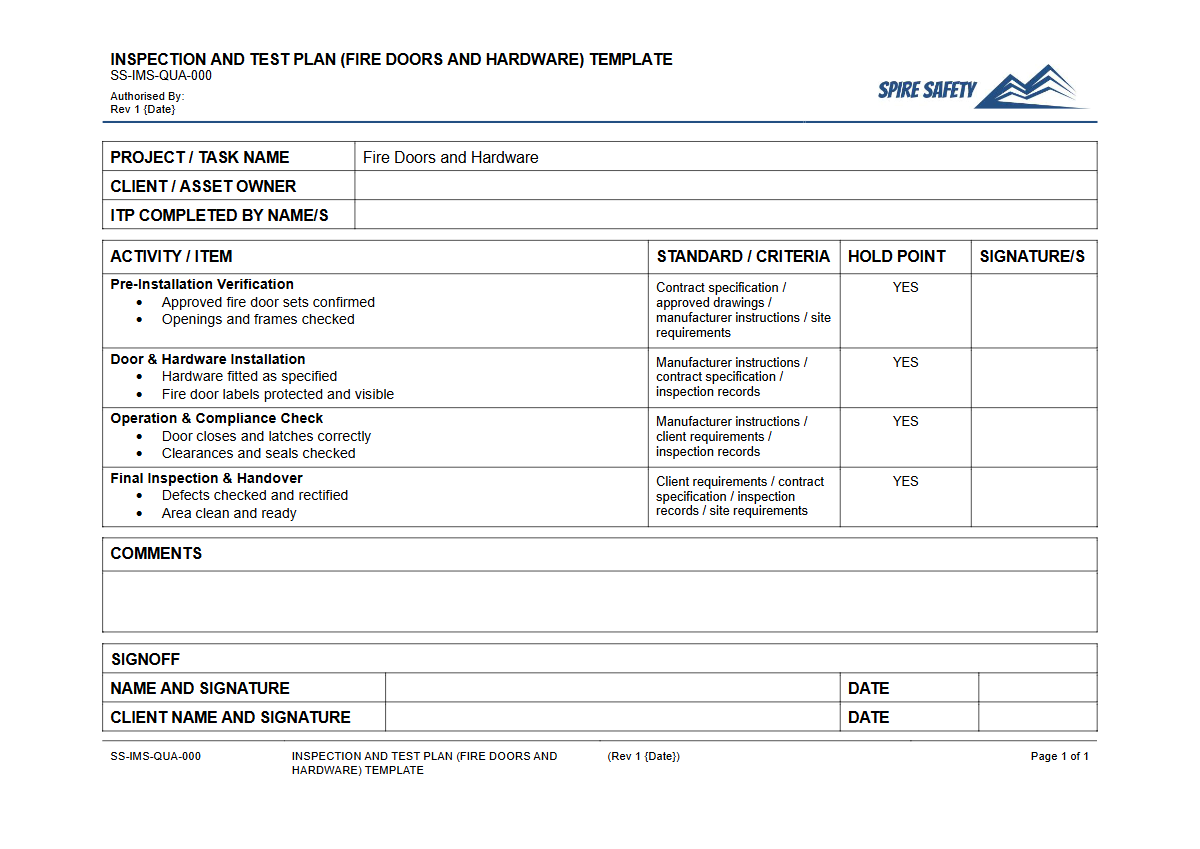
Ensuring fire doors and their associated hardware are correctly installed and maintained is a critical component of passive fire protection. This free Inspection & Test Plan (Fire Doors and Hardware) Template provides a structured framework for verifying that all stages of installation, testing, and handover meet the project's specifications and regulatory expectations.
An ITP serves as a formal quality assurance document, outlining the sequence of checks, responsible parties, acceptance criteria, and the records required to demonstrate conformity.
Using a detailed ITP helps project teams methodically track progress and quality, creating a clear audit trail. It ensures that every door set is subject to consistent verification, from frame installation and seal placement to the final function tests of closers and latches. This process is fundamental to achieving compliance and is a key focus during any formal WHS compliance auditing.
What is an Inspection and Test Plan?
An Inspection and Test Plan (ITP) is a project-specific quality control document that outlines the critical inspection and testing activities required to ensure a product, component, or system meets defined standards. For fire doors, this includes hold points for inspections by supervisors or third-party certifiers, witness points for specific tests, and a list of records (like delivery dockets or test certificates) to be collected.
It effectively maps out the entire quality verification journey for each fire door assembly.
Video walkthrough
How to use the Free Inspection & Test Plan (Fire Doors and Hardware) Template
This template is provided in both DOCX and PDF formats for your convenience. The DOCX file is fully editable, allowing you to tailor the plan to your specific project needs, while the PDF serves as a ready-to-use reference.
To get started, download the file and open the DOCX version. Review each section and adapt the line items, responsibilities, acceptance criteria, and codes to align with your project’s technical specifications, architectural drawings, and the specific fire door products being used.
A well-rounded fire safety verification process often includes multiple checks. This ITP can be used alongside other specific tools, such as our Free Pre-Start Checklist (Fire Panel) Template, to build a more comprehensive safety system.
Please note: This template provides a solid foundation, but it is not a complete, off-the-shelf solution. We have designed it to be customised to your specific project, site conditions, regulatory requirements, and the types of fire doors and hardware being used.
You must review and modify the document to ensure it is fit for your purpose.
When to use it
An ITP for fire doors is a living document used throughout the construction or maintenance lifecycle. Its application is crucial during several key phases:
- New Construction & Fit-outs: Implement the ITP from the commencement of door frame installation through to the final commissioning of the building. It ensures quality is built-in, not inspected-in at the end.
- Major Refurbishments: When existing buildings are upgraded, an ITP ensures new or altered fire door sets comply with current standards, not just the standards of the original build.
- Routine Maintenance & Replacement: For facilities managers, this plan provides a framework for the routine inspection and replacement of fire doors, ensuring ongoing safety and compliance. This is especially vital in high-occupancy buildings where regular safety reviews are paramount, and our Free WHS Inspection (Aged Care Home) Template can provide a broader context for such environments.
Who should use it
This template is designed for use by various personnel involved in the construction, management, and maintenance of buildings. Key users include:
- Project Managers & Site Supervisors: To manage quality control, assign responsibilities, and ensure project milestones are met with the required evidence of compliance.
- Building & Facilities Managers: To oversee routine maintenance schedules, manage contractors, and maintain a building’s passive fire safety systems over its operational life.
- Fire Safety Professionals & Certifiers: As a tool to conduct third-party inspections and verify that installations adhere to the National Construction Code (NCC) and relevant Australian Standards.
- Installation Contractors: To understand the quality expectations and inspection points they will be subject to, promoting a 'right first time' approach.
Integrating this ITP into your organisation's processes helps embed quality control into daily operations. This is a core principle of effective WHS management systems, which aim to systematise safety and quality rather than treating them as afterthoughts.
For more specific guidance on implementing such frameworks, consider engaging with a professional WHS consulting service.
Common mistakes
Common mistakes to avoid
- Using non-compliant or mismatched hardware on a certified fire door, which voids its rating.
- Painting over intumescent fire seals, which can prevent them from expanding correctly when exposed to heat.
- Failing to check that the door closer is adjusted to properly latch the door from any position, every time.
- Propping fire doors open with wedges, fire extinguishers, or other unapproved devices, defeating their purpose.
Legal references
Legal considerations
The following legal requirements may be relevant to this type of work.
- Work Health and Safety Act (Harmonised) — Provides the primary duties for protecting workers and other people from work health and safety risks.
- Work Health and Safety Regulations (Harmonised) — Sets out requirements supporting the management of workplace hazards and risks.
The following codes may be relevant to this type of work.
- Managing WHS Risks Code of Practice — Provides practical guidance on identifying hazards, assessing risks and applying effective controls.
- Work Health and Safety Consultation, Cooperation and Coordination Code of Practice — Provides practical guidance on consulting workers and coordinating with other duty holders.
- Managing the Work Environment and Facilities Code of Practice — Provides practical guidance on safe work environments, workplace facilities and related controls.
Did you know
The 'Gap' Matters
The gap between a fire door leaf and its frame or the floor should typically be no more than 3mm. This tiny detail is critical for stopping the passage of smoke and flames during a fire.
Tag, You're It
All compliant fire doors in Australia must have a tag or label affixed, providing key information like its Fire Resistance Level (FRL), manufacturer, and year of manufacture. A missing or damaged tag can render the door non-compliant.
FAQ
Frequently asked questions
01What is an ITP for fire doors?
02How often should fire doors be inspected in Australia?
03Does this template cover all types of fire door hardware?
04Is this template a legal document?
Share this resource
Free Inspection & Test Plan (Fire Doors and Hardware) Template
Browse Categories
How To Use It
- 1Download and open in Word or PDF.
- 2Replace the placeholders with your business details.
- 3Get it reviewed by a WHS specialist before rollout.
Need it customised?
Our WHS consultants can adapt this template to your site, run a gap analysis, or audit what you already have in place.
Book a Free Consultation WHS consulting servicesor call 1300 156 382
Related templates
- Free Inspection & Test Plan (Fire Hydrant Hose Reel System) Template
- Free Inspection & Test Plan (Fire Services Installation) Template
- Free Inspection & Test Plan (Fire Sprinkler System) Template
- Free Inspection & Test Plan (Floor Levelling Screeding) Template
- Free Inspection & Test Plan (Floor Tiling) Template
- Free Inspection & Test Plan (Format) Template