
Free Inspection & Test Plan (Fire Hydrant Hose Reel System) Template
Download our free Inspection & Test Plan for fire hydrant hose reel systems. This DOCX template helps formalise your testing regime. Customise it today.
Free Inspection & Test Plan (Fire Hydrant Hose Reel System) Template
DOCX • 138 KB + PDF
Updated Oct 2026
No signup required
Purpose of the Free Inspection & Test Plan (Fire Hydrant Hose Reel System) Template
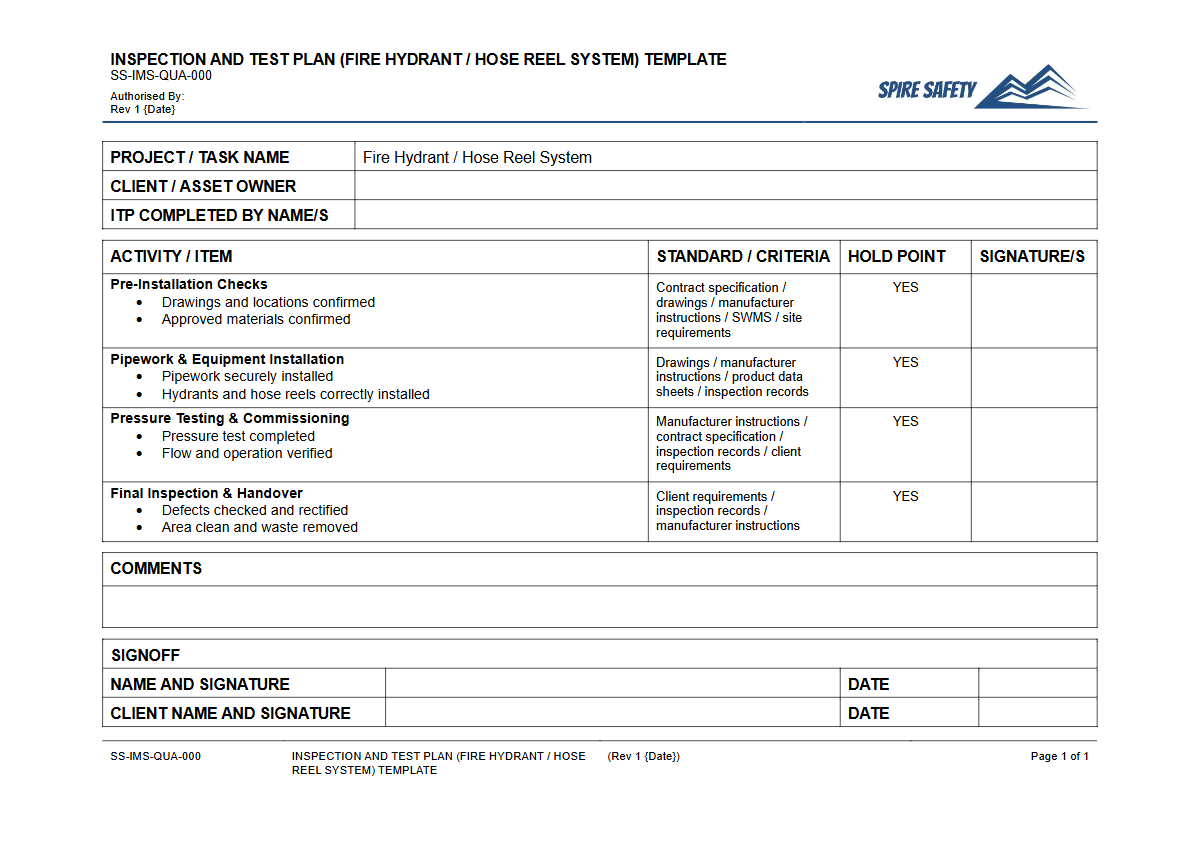
This free Inspection & Test Plan (Fire Hydrant Hose Reel System) template provides a structured framework for documenting the inspection, testing, and maintenance activities for your site's fire safety equipment. Ensuring these critical assets are functional and compliant with Australian Standards is a key part of any organisation's emergency preparedness and overall safety management.
An ITP serves as a formal record, demonstrating due diligence in maintaining safety equipment. It outlines specific checks, testing criteria, frequencies, and responsibilities, helping to ensure that nothing is missed.
This systematic approach is a cornerstone of effective robust WHS management systems, providing clear evidence of proactive safety measures.
Video walkthrough
How to use the Free Inspection & Test Plan (Fire Hydrant Hose Reel System) Template
To use this template, download the DOCX file and begin customising it for your specific workplace. Fill in the project and site details, then review the pre-filled inspection points, adding or removing items to match the exact type of hydrant and hose reel systems installed at your facility.
It’s crucial to reference the manufacturer's instructions and relevant Australian Standards (such as AS 1851) to ensure your Inspection & Test Plan is comprehensive and fit for purpose.
Important: This document is a starting-point template, not a finished safety document. We cannot be responsible for its application as it must be customised by a competent person familiar with your specific equipment, site risks, and legal obligations.
For related daily checks, you might also use our free Pre-Start Checklist for Fire Panels to complement your broader fire safety program.
When to use this Inspection & Test Plan
This Inspection & Test Plan should be integrated into your regular maintenance schedule, as dictated by AS 1851 for routine servicing. It is primarily used to guide and record the six-monthly and annual service activities, which involve more detailed checks than simple visual inspections.
Beyond routine checks, the ITP is also valuable during the commissioning of new systems, after major repairs or modifications, and as part of periodic safety audits to verify system readiness and compliance.
Regular verification ensures that your emergency equipment will perform as expected when needed most. Scheduling periodic WHS compliance auditing can help validate that these ITPs are being implemented correctly and that your records are complete and up to date.
Who should use it
This template is designed for use by competent personnel responsible for workplace safety and facility management. This includes roles such as:
- Building Managers and Owners
- Facility Maintenance Supervisors
- WHS and OHS Officers
- Fire Safety Officers
- Third-party fire protection service technicians
These individuals can use the plan to either conduct inspections themselves (if qualified) or to verify that work carried out by specialist contractors meets the required standards. The principles of systematic inspection apply across many different workplace types, from commercial buildings to industrial sites. Maintaining clear access to fire equipment is a key check item in settings from workshops to retail spaces, as covered in resources like our WHS Inspection for Vehicle Workshops.
By formalising your processes with structured documents, you create a safer and more organised workplace. Explore our complete free WHS resources library for more templates and guides to support your safety management system.
Common mistakes
Common mistakes to avoid
- Neglecting accessibility by allowing vehicles, equipment, or vegetation to block hydrants or hose reels.
- Using unqualified or inexperienced personnel to conduct the six-monthly and annual functional tests.
- Failing to keep complete and accurate records of all inspection, testing, and maintenance activities.
- Only checking the physical hydrant or reel without testing water pressure, flow rate, or valve operation.
Legal references
Legal considerations
The following legal requirements may be relevant to this type of work.
- Work Health and Safety Act (Harmonised) — Provides the primary duties for protecting workers and other people from work health and safety risks.
- Work Health and Safety Regulations (Harmonised) — Sets out requirements supporting the management of workplace hazards and risks.
The following codes may be relevant to this type of work.
- Managing WHS Risks Code of Practice — Provides practical guidance on identifying hazards, assessing risks and applying effective controls.
- Work Health and Safety Consultation, Cooperation and Coordination Code of Practice — Provides practical guidance on consulting workers and coordinating with other duty holders.
- Managing the Work Environment and Facilities Code of Practice — Provides practical guidance on safe work environments, workplace facilities and related controls.
Did you know
Water Supply is Critical
A key part of a hydrant system test isn't just the hydrant itself, but confirming it has adequate water pressure and flow rate from the mains. A hydrant without sufficient water supply is ineffective in an emergency.
Standardised Fittings
Fire hydrant outlets in Australia are standardised to ensure that fittings from any fire brigade vehicle can connect to any hydrant, enabling a rapid and effective response.
FAQ
Frequently asked questions
01What is the difference between an inspection and a test for a fire hydrant system?
02How often should fire hydrant hose reels be inspected in Australia?
03Who is qualified to test a fire hydrant system?
04Does this template cover both hydrant and hose reel systems?
Share this resource
Free Inspection & Test Plan (Fire Hydrant Hose Reel System) Template
Browse Categories
How To Use It
- 1Download and open in Word or PDF.
- 2Replace the placeholders with your business details.
- 3Get it reviewed by a WHS specialist before rollout.
Need it customised?
Our WHS consultants can adapt this template to your site, run a gap analysis, or audit what you already have in place.
Book a Free Consultation WHS consulting servicesor call 1300 156 382
Related templates
- Free Inspection & Test Plan (Fire Services Installation) Template
- Free Inspection & Test Plan (Fire Sprinkler System) Template
- Free Inspection & Test Plan (Floor Levelling Screeding) Template
- Free Inspection & Test Plan (Floor Tiling) Template
- Free Inspection & Test Plan (Format) Template
- Free Inspection & Test Plan (Formwork) Template