
Free Inspection & Test Plan (External Site Lighting) Template
Download our Free Inspection & Test Plan for External Site Lighting. This template provides a structured starting point for verifying lighting systems.
Free Inspection & Test Plan (External Site Lighting) Template
DOCX • 138 KB + PDF
Updated Oct 2026
No signup required
Purpose of the Free Inspection & Test Plan (External Site Lighting) Template
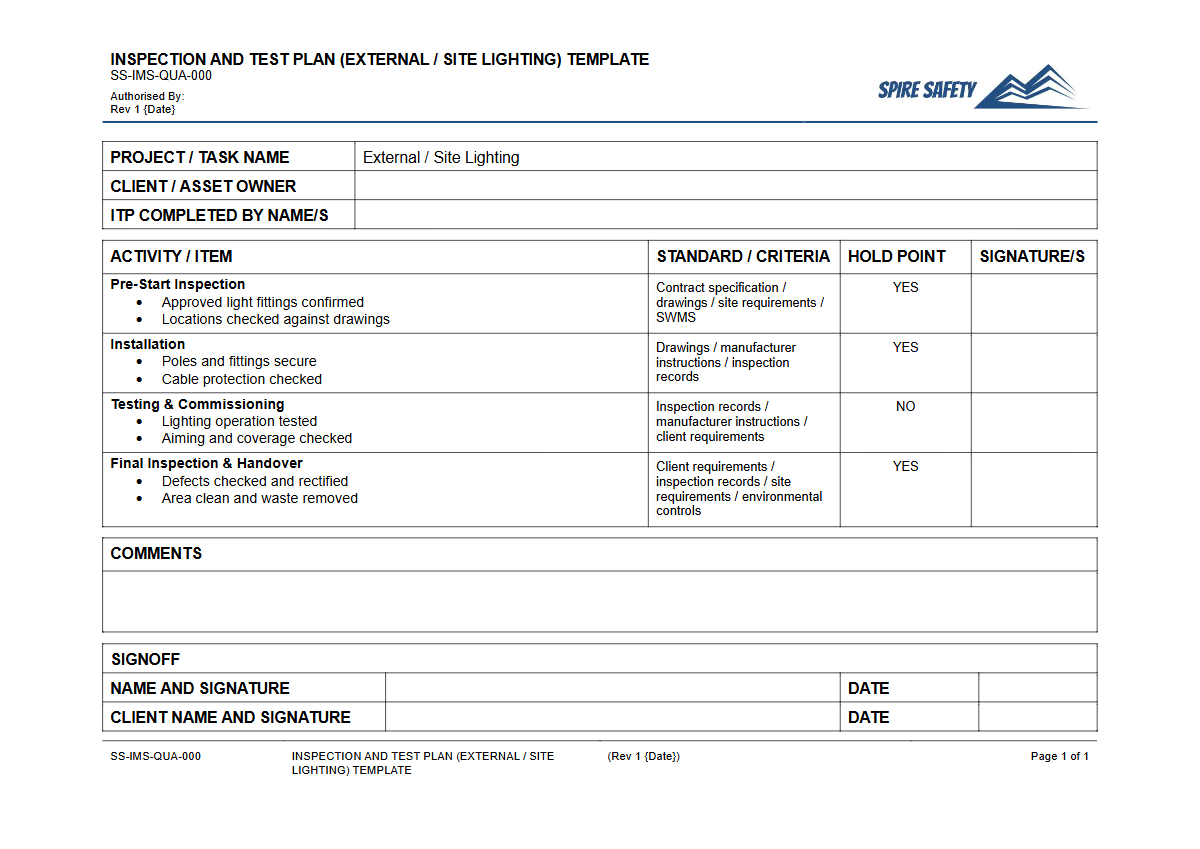
Ensuring adequate and reliable external site lighting is crucial for safety, security, and operational efficiency. This Free Inspection & Test Plan (External Site Lighting) Template provides a structured framework for verifying that lighting systems are installed correctly and performing as designed.
Using an ITP helps prevent common hazards like slips, trips, and falls in poorly lit areas, deters unauthorised access, and ensures the safe movement of vehicles and personnel during night-time or low-light conditions. It formalises the quality assurance process, creating a verifiable record that demonstrates systematic risk management and adherence to project specifications.
Proper site illumination is a fundamental component of the key WHS requirements for construction site safety and applies to any operational workplace.
Video walkthrough
How to use the Free Inspection & Test Plan (External Site Lighting) Template
This template is designed for ease of use. Simply download the DOCX file and adapt it to your specific project or facility.
It guides you through the critical checkpoints, from verifying component installation against design drawings to conducting functional tests and measuring light levels (lux). You can use it to create hold points and witness points for client or superintendent sign-off.
The document serves as a live record throughout the commissioning and handover phase, and can be integrated into your ongoing maintenance schedule.
Customising Your ITP
Important: We've designed this template as a comprehensive starting point. You must customise it to reflect the specific lighting systems (e.g., LED, metal halide), hazards, control systems (e.g., PE cells, timers), and operational requirements of your workplace.
Ensure you reference the correct Australian Standards and project-specific technical specifications within the document. Integrating this process into your broader WHS management systems ensures lighting safety is managed consistently and effectively.
When to use it
An Inspection & Test Plan for external lighting is essential at several key stages of a site's lifecycle. It should be implemented during the construction and commissioning phase of new projects to ensure installations meet the required standards before handover.
It is also a vital tool for planned preventative maintenance programs in operational facilities, providing a structured way to periodically verify system performance and identify degradation. Additionally, this ITP should be used following major repairs, after significant weather events that may have caused damage, or as a corrective action following an incident or near miss related to poor illumination.
For sites with high public interaction, such as those covered by our WHS Inspection Template for Service Stations, regular lighting verification is even more critical.
Who should use it
This template is valuable for a range of personnel responsible for workplace safety and asset management. Project Managers and Site Engineers will use it to manage quality control during construction.
Facility Managers and Maintenance Supervisors can adopt it for their scheduled maintenance routines to ensure ongoing safety and compliance. It is also an essential tool for Electricians and Electrical Contractors performing installation and testing, providing them with clear criteria for success.
Furthermore, WHS Advisors and Safety Officers can use the completed ITPs as evidence during safety audits and to verify that risks associated with lighting have been effectively controlled. The records produced are a key input for processes like WHS compliance auditing.
Benefits of a Formalised Lighting ITP
A formal ITP provides clear, documented evidence that you are proactively managing safety risks. It helps standardise the inspection process, ensuring no critical checks are missed, regardless of who performs the task. This systematic approach reduces the likelihood of equipment failure, minimises workplace incidents, lowers potential liability, and contributes to overall operational excellence. Just as with disciplines like stormwater and waterway protection planning, a formal plan demonstrates a commitment to managing all aspects of site impact and safety. Explore our complete free WHS resources library to find more templates to support your safety management system.
Common mistakes
Common mistakes to avoid
- Relying solely on visual checks without using a calibrated light meter (lux meter) to verify performance.
- Failing to account for environmental factors like dust, foliage growth, or weather that can degrade lighting effectiveness over time.
- Not keeping adequate records of inspections, tests, and maintenance activities, making it difficult to prove due diligence.
- Forgetting to inspect emergency and egress lighting systems that are part of the external infrastructure.
Legal references
Legal considerations
The following legal requirements may be relevant to this type of work.
- Work Health and Safety Act (Harmonised) — Provides the primary duties for protecting workers and other people from work health and safety risks.
- Work Health and Safety Regulations (Harmonised) — Sets out requirements supporting the management of workplace hazards and risks.
The following codes may be relevant to this type of work.
- Managing WHS Risks Code of Practice — Provides practical guidance on identifying hazards, assessing risks and applying effective controls.
- Work Health and Safety Consultation, Cooperation and Coordination Code of Practice — Provides practical guidance on consulting workers and coordinating with other duty holders.
- Managing the Work Environment and Facilities Code of Practice — Provides practical guidance on safe work environments, workplace facilities and related controls.
Did you know
The Cost of Darkness
Poor lighting is a contributing factor in a significant percentage of workplace slip, trip, and fall incidents, which are a leading cause of serious injury claims in Australia.
Light Pollution
Modern external lighting design often considers 'light trespass' and 'sky glow' to minimise environmental impact, a key consideration in planning approvals for many industrial sites.
FAQ
Frequently asked questions
01What are typical lux level requirements for external areas?
02How often should external site lighting be inspected?
03Is an ITP a legal requirement for site lighting?
04What is the difference between an ITP and a simple checklist?
Share this resource
Free Inspection & Test Plan (External Site Lighting) Template
Browse Categories
How To Use It
- 1Download and open in Word or PDF.
- 2Replace the placeholders with your business details.
- 3Get it reviewed by a WHS specialist before rollout.
Need it customised?
Our WHS consultants can adapt this template to your site, run a gap analysis, or audit what you already have in place.
Book a Free Consultation WHS consulting servicesor call 1300 156 382
Related templates
- Free Inspection & Test Plan (Fibre Cement Cladding) Template
- Free Inspection & Test Plan (Final Handover Defects Inspection) Template
- Free Inspection & Test Plan (Fire Detection and Alarm System) Template
- Free Inspection & Test Plan (Fire Doors and Hardware) Template
- Free Inspection & Test Plan (Fire Hydrant Hose Reel System) Template
- Free Inspection & Test Plan (Fire Services Installation) Template