
Free Inspection & Test Plan (External Render) Template
Download our Free Inspection & Test Plan (External Render) Template to formalise quality and safety checks for rendering projects.
Free Inspection & Test Plan (External Render) Template
DOCX • 136 KB + PDF
Updated Oct 2026
No signup required
Purpose of the Free Inspection & Test Plan (External Render) Template
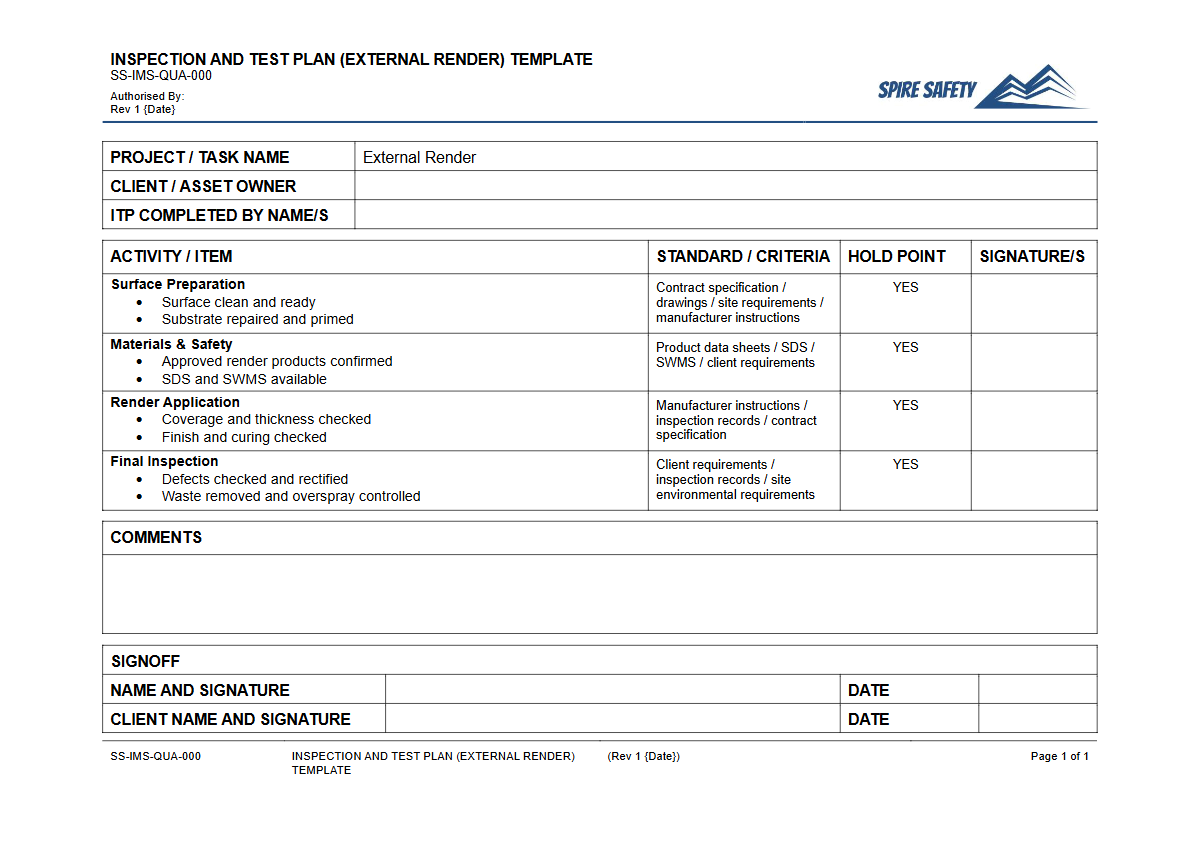
Achieve a high-quality, durable finish on your next project with our Free Inspection & Test Plan (External Render) Template. This document provides a structured framework for monitoring and verifying each stage of the rendering process, from substrate preparation to final curing.
An effective Inspection & Test Plan (ITP) is a critical quality assurance tool that helps prevent costly defects like cracking, delamination, and inconsistent finishes before they occur. It formalises key checkpoints, including hold points (work must stop for inspection) and witness points (inspection occurs as work continues), ensuring work does not proceed until quality standards are met.
Beyond quality, this template helps integrate safety considerations directly into the project workflow. For example, it prompts checks related to managing airborne contaminants like crystalline silica during surface grinding, or ensuring scaffolding is safe for use.
For significant hazards, a more detailed risk assessment may be required, similar to the process for developing principal hazard management plans. A completed ITP serves as a permanent record of quality control activities, providing evidence of due diligence for clients, builders, and regulatory bodies.
Video walkthrough
How to use the Free Inspection & Test Plan (External Render) Template
Begin by downloading the template in your preferred format (DOCX for easy editing or PDF). Before implementation, it is essential to review and customise the document for your specific project.
The plan should be tailored to the substrate being rendered (e.g., brickwork, blockwork, fibre cement sheet), the type of render system specified (e.g., cement, acrylic), and the unique environmental conditions of the site.
During customisation, you will define the stages of work, inspection criteria, responsible personnel, and the standards or specifications to be met. It is critical to clearly identify project-specific hold and witness points.
Please note: We strongly recommend you customise this template to your specific workplace, project scope, materials, and local regulatory requirements. It is a starting point, not a complete solution. Once tailored, this ITP can be integrated into your project's broader quality and WHS management systems to ensure a seamless approach to compliance and quality control.
When to use it
An Inspection & Test Plan for external rendering should be developed during the project planning and setup phase, well before any physical work begins. It should be reviewed and agreed upon by all relevant parties, including the project manager, site supervisor, and rendering contractor.
It is a live document used throughout the project lifecycle to guide and record quality control activities. Use it in pre-start meetings to communicate quality expectations and at each key stage to document verifications and obtain sign-offs before proceeding to the next step.
The completed ITP also serves as a valuable handover document upon project completion. To ensure the processes outlined in the ITP are being followed consistently and effectively, some organisations choose to engage independent experts for periodic WHS compliance auditing, which provides an objective assessment of site practices against documented procedures.
Who should use it
This template is designed for use by a range of personnel involved in construction and building projects to ensure rendering work meets specified quality and durability standards. Key users include:
- Project Managers & Construction Managers: To oversee quality control and ensure project specifications are met.
- Site Supervisors & Forepersons: For day-to-day management and verification of rendering activities on site.
- Rendering Contractors: To plan their work, guide their teams, and demonstrate compliance with quality standards.
- Quality Assurance / Quality Control (QA/QC) Officers: To formally conduct inspections, witness tests, and maintain records.
- Builders & Developers: To ensure the final product delivered by subcontractors meets their standards and contractual obligations.
Using a standardised ITP facilitates clear communication and establishes accountability between all parties. While this ITP is specific to rendering, other site activities also require formal checks.
For example, a template for a WHS Inspection for a Vehicle Workshop can be adapted to manage the maintenance area for plant and equipment on a large construction site. If you require assistance adapting these documents for your specific needs, consider engaging specialist WHS consulting services. You can find many other helpful documents in our free WHS resources library.
Common mistakes
Common mistakes to avoid
- Using the generic template without customising it for the specific project, substrate, and render system.
- Failing to conduct and document pre-render surface preparation checks, leading to bond failure.
- Inadequate documentation of inspections, dates, and sign-offs, creating a poor audit trail.
- Not clearly defining the acceptance criteria for each inspection point, leading to disputes.
Legal references
Legal considerations
The following legal requirements may be relevant to this type of work.
- Work Health and Safety Act (Harmonised) — Provides the primary duties for protecting workers and other people from work health and safety risks.
- Work Health and Safety Regulations (Harmonised) — Sets out requirements supporting the management of workplace hazards and risks.
The following codes may be relevant to this type of work.
- Managing WHS Risks Code of Practice — Provides practical guidance on identifying hazards, assessing risks and applying effective controls.
- Work Health and Safety Consultation, Cooperation and Coordination Code of Practice — Provides practical guidance on consulting workers and coordinating with other duty holders.
- Managing the Work Environment and Facilities Code of Practice — Provides practical guidance on safe work environments, workplace facilities and related controls.
Did you know
Render Delamination
Incorrect surface preparation is the leading cause of render delamination, where layers of render peel away from the substrate. A thorough ITP with a dedicated hold point for substrate inspection can prevent this costly defect.
FAQ
Frequently asked questions
01What is an Inspection & Test Plan (ITP) for external rendering?
02Is this ITP template suitable for all types of render?
03What is the difference between a hold point and a witness point in an ITP?
04How does an ITP relate to a Safe Work Method Statement (SWMS)?
Share this resource
Free Inspection & Test Plan (External Render) Template
Browse Categories
How To Use It
- 1Download and open in Word or PDF.
- 2Replace the placeholders with your business details.
- 3Get it reviewed by a WHS specialist before rollout.
Need it customised?
Our WHS consultants can adapt this template to your site, run a gap analysis, or audit what you already have in place.
Book a Free Consultation WHS consulting servicesor call 1300 156 382
Related templates
- Free Inspection & Test Plan (External Sealing Jointing) Template
- Free Inspection & Test Plan (External Site Lighting) Template
- Free Inspection & Test Plan (Fibre Cement Cladding) Template
- Free Inspection & Test Plan (Final Handover Defects Inspection) Template
- Free Inspection & Test Plan (Fire Detection and Alarm System) Template
- Free Inspection & Test Plan (Fire Doors and Hardware) Template