
Free Inspection & Test Plan (Earthworks Excavation) Template
Download our Free Inspection & Test Plan (Earthworks Excavation) Template.
Free Inspection & Test Plan (Earthworks Excavation) Template
DOCX • 140 KB + PDF
Updated Oct 2026
No signup required
Purpose of the Free Inspection & Test Plan (Earthworks Excavation) Template
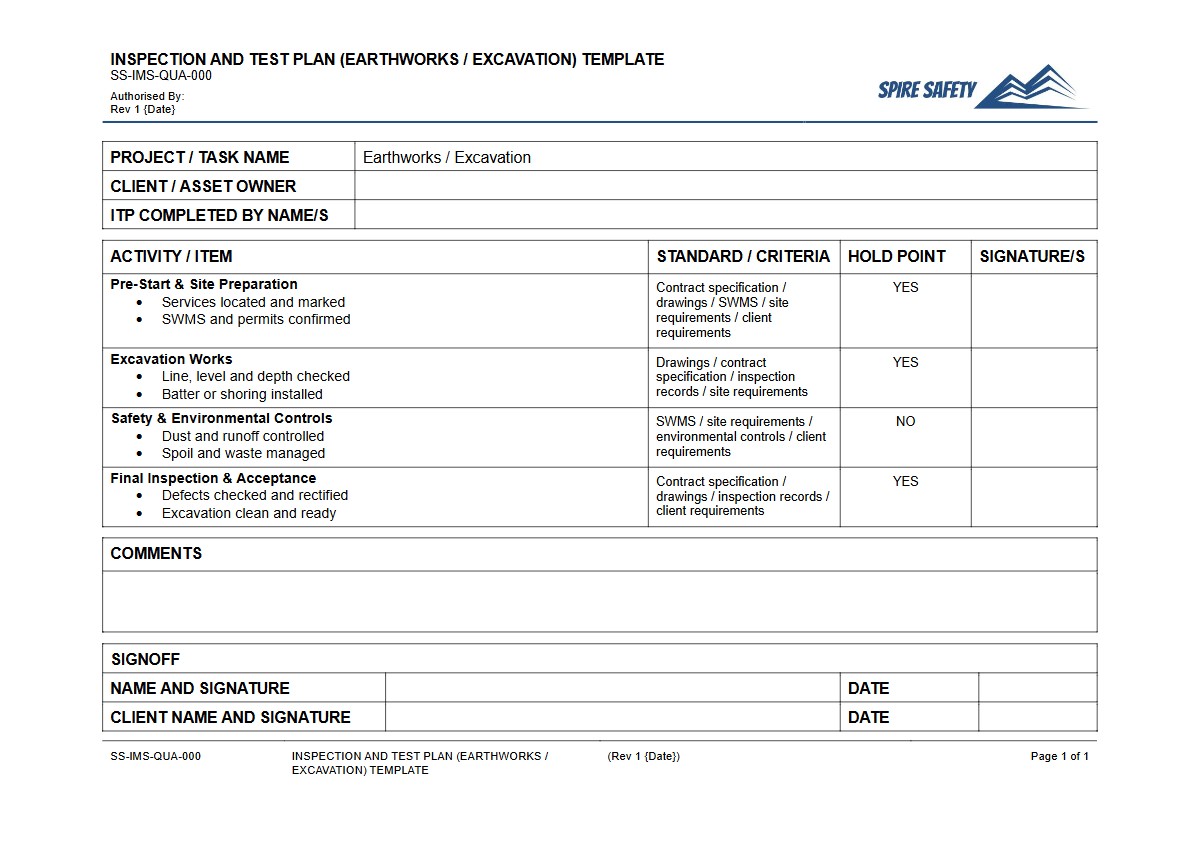
This free Inspection & Test Plan (Earthworks Excavation) Template provides a structured framework for managing quality and safety throughout your excavation project. An ITP is a critical project management tool that details the specific inspections, tests, and checks required at various stages of the work, from initial site clearing to final reinstatement.
It outlines the 'who, what, and when' of your quality assurance process, ensuring that all activities comply with project specifications, engineering standards, and WHS requirements.
Using a formal ITP helps to proactively identify potential issues, prevent defects, and create a verifiable record of compliance. It demonstrates due diligence and provides objective evidence that the work has been completed to the required standard.
For organisations seeking to improve their safety protocols, an ITP is a fundamental component for implementing comprehensive WHS management systems that are both practical and effective.
Video walkthrough
How to use the Free Inspection & Test Plan (Earthworks Excavation) Template
Our free Inspection & Test Plan (Earthworks Excavation) Template is provided in an easily editable DOCX format, along with a PDF for reference. To use it effectively, you should first review the entire document to understand its structure, which typically includes hold points, witness points, and surveillance checks.
Next, you must systematically adapt the template to your specific project. This involves adding or removing inspection points based on the project's scope, geotechnical reports, engineering designs, and the plant and equipment being used.
This process is similar to how a tyre workshop inspection template formalises checks for specific equipment and tasks within that environment. Be sure to assign clear responsibilities and specify the acceptance criteria for each activity, referencing relevant standards or drawings.
Please note: This template is a starting point. We have designed it to be comprehensive, but you must customise it to reflect the specific hazards, control measures, and legal requirements of your workplace and project.
When to use an Inspection & Test Plan
An Inspection & Test Plan should be developed during the project planning and mobilisation phase, well before any excavation work commences. It is a live document that should be used consistently throughout the project lifecycle.
It serves as a key reference during daily pre-start meetings, toolbox talks, and site walkthroughs to ensure everyone is aware of upcoming quality and verification requirements.
The ITP is particularly crucial for high-risk activities or projects in sensitive environments, where the consequences of failure are significant. In many large-scale civil or mining contexts, these plans are mandatory.
The principles outlined are consistent with those found in detailed guides on Principal Mining Hazard Management Plans, which also emphasise proactive planning and verification for managing significant risks.
Who should use this ITP Template
This template is designed for use by a range of personnel involved in civil construction, building, and mining projects. Key users include:
- Project Managers and Site Engineers: For overall project quality control and contractual compliance.
- Site Supervisors and Forepersons: For managing day-to-day activities and ensuring crews adhere to the plan.
- WHS Advisors and Safety Officers: For integrating safety checks and verifying that risk controls for high-risk work like excavation are being implemented.
- Quality Assurance (QA) Personnel: For conducting and documenting formal inspections and tests.
Ultimately, the ITP serves as a communication tool that aligns project stakeholders—including clients, contractors, and regulators—on quality expectations. Completed ITP records are essential documents that can be reviewed during a formal WHS compliance auditing process to demonstrate a systematic approach to managing project quality and safety.
For more tools to support your safety and compliance framework, you can browse our entire free WHS resources library, which includes a wide range of checklists, templates, and guides.
Common mistakes
Common mistakes to avoid
- Failing to customise the ITP for specific site conditions and project scope.
- Using the ITP as a 'tick-and-flick' exercise without genuine verification of the work.
- Not clearly defining responsibilities for inspection, testing, and sign-off.
- Inadequate record-keeping, making it difficult to prove compliance or trace defects later.
Legal references
Legal considerations
The following legal requirements may be relevant to this type of work.
- Work Health and Safety Act (Harmonised) — Provides the primary duties for protecting workers and other people from work health and safety risks.
- Work Health and Safety Regulations (Harmonised) — Sets out requirements supporting the management of workplace hazards and risks.
The following codes may be relevant to this type of work.
- Managing WHS Risks Code of Practice — Provides practical guidance on identifying hazards, assessing risks and applying effective controls.
- Work Health and Safety Consultation, Cooperation and Coordination Code of Practice — Provides practical guidance on consulting workers and coordinating with other duty holders.
- Managing the Work Environment and Facilities Code of Practice — Provides practical guidance on safe work environments, workplace facilities and related controls.
Did you know
Geotechnical Risks
Unforeseen ground conditions, such as unexpected rock or unstable soil, are a leading cause of delays and safety incidents in earthworks projects, reinforcing the need for thorough planning and inspection.
High-Risk Work
Under Australian WHS Regulations, excavation work is often classified as 'high-risk construction work' when the depth exceeds 1.5 metres, requiring a Safe Work Method Statement (SWMS) in addition to other planning documents like an ITP.
FAQ
Frequently asked questions
01What is an Inspection & Test Plan (ITP) for earthworks?
02Is an ITP a legal requirement for excavation in Australia?
03What should be included in an earthworks ITP?
04Can I use this template for any excavation project?
Share this resource
Free Inspection & Test Plan (Earthworks Excavation) Template
Browse Categories
How To Use It
- 1Download and open in Word or PDF.
- 2Replace the placeholders with your business details.
- 3Get it reviewed by a WHS specialist before rollout.
Need it customised?
Our WHS consultants can adapt this template to your site, run a gap analysis, or audit what you already have in place.
Book a Free Consultation WHS consulting servicesor call 1300 156 382
Related templates
- Free Inspection & Test Plan (Electrical Installation) Template
- Free Inspection & Test Plan (Electrical Rough-In (First Fix)) Template
- Free Inspection & Test Plan (Electrical Second Fix Fit off) Template
- Free Inspection & Test Plan (Emergency and Exit Lighting) Template
- Free Inspection & Test Plan (Epoxy Resin Floor Coating) Template
- Free Inspection & Test Plan (External Cladding) Template