
Free Inspection & Test Plan (Waterproofing) Template
Download our free Inspection & Test Plan (Waterproofing) Template. A structured DOCX and PDF to help you formalise quality and safety checks. Get yours now.
Free Inspection & Test Plan (Waterproofing) Template
DOCX • 140 KB + PDF
Updated Oct 2026
No signup required
Purpose of the Free Inspection & Test Plan (Waterproofing) Template
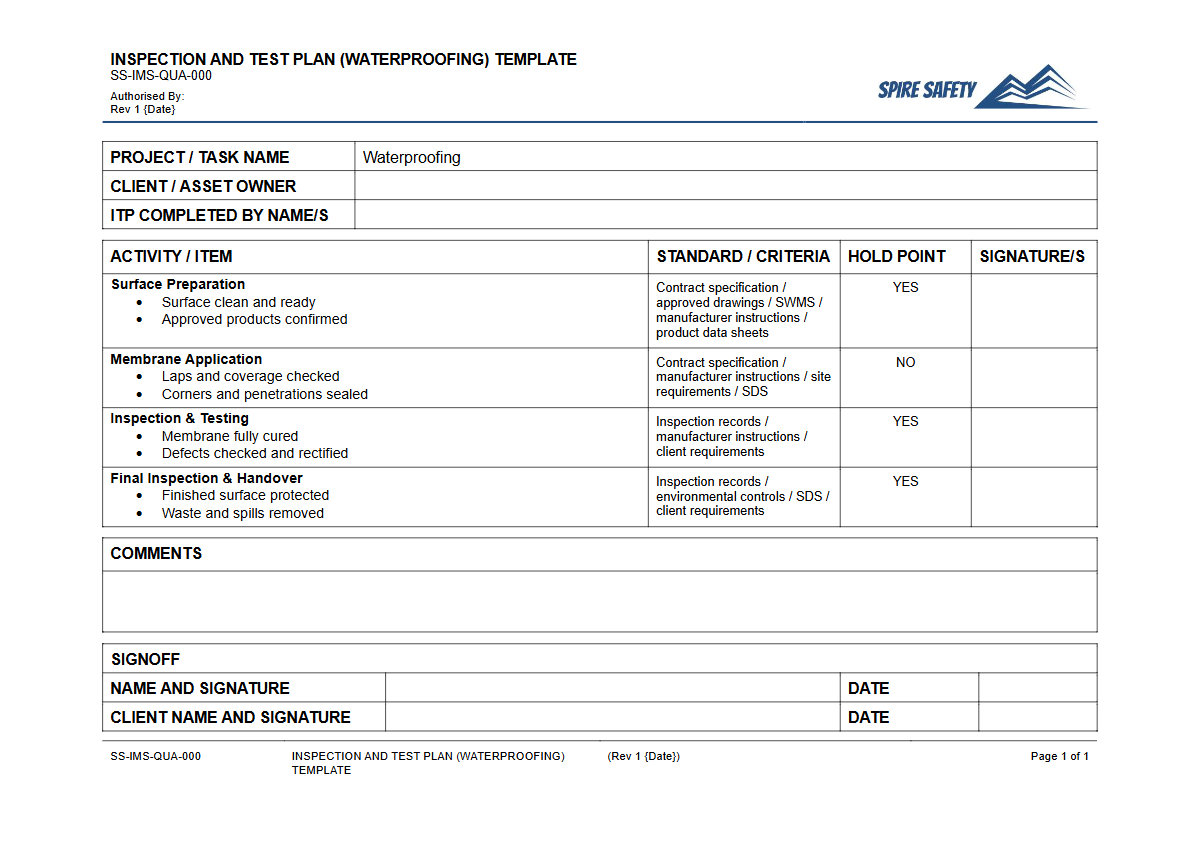
An Inspection and Test Plan (ITP) is a critical quality assurance document that outlines the specific checks, tests, and verification steps required to ensure a task meets project specifications and regulatory standards. Our Free Inspection & Test Plan (Waterproofing) Template provides a structured framework for systematically managing waterproofing works on construction projects.
It helps ensure that all membrane applications, substrate preparations, and detailing are executed correctly from the start, preventing costly defects and water damage down the line. Using a formal ITP demonstrates a commitment to quality control and provides auditable evidence that work complies with the required standards and design intent.
This template helps you define key milestones in the waterproofing process, known as hold points and witness points, ensuring that critical stages are independently verified before subsequent work proceeds. It serves as a vital communication tool between the builder, waterproofing contractor, and project manager.
Consistent application of an ITP improves project outcomes, reduces rework, and enhances client satisfaction. To further support site safety during these activities, you can supplement this ITP with our waterproofing safety toolbox talk template to brief teams on specific hazards.
Video walkthrough
How to use the Free Inspection & Test Plan (Waterproofing) Template
This ITP template is designed for ease of use and customisation. It organises the waterproofing process into logical stages, from pre-start checks to final inspection.
For each stage, you can specify the inspection criteria, applicable standards (e.g., AS 3740, AS 4654.2), acceptance criteria, and the records to be produced. The document includes columns to define the type of intervention required: surveillance, witness points (where work can proceed after inspection), and hold points (where work must stop until the inspection is cleared).
Simply download the DOCX or PDF and adapt it to your project's unique requirements, including the specific waterproofing system, substrate, and environmental conditions.
Important: This document is a template and must be customised for your specific needs. The effectiveness of an ITP depends on its relevance to the actual work being performed.
We have provided a structured starting point, but you are responsible for populating it with the correct technical specifications, standards, and risk controls for your project. Integrating this document into a robust WHS management system ensures it is used effectively as part of your overall safety and quality framework.
When to use an Inspection & Test Plan
An ITP for waterproofing should be developed during the project planning phase, well before any work commences on site. It should be used throughout the construction lifecycle to guide and record quality assurance activities. Key times to use the ITP include:
- Pre-construction: To confirm that the specified materials are correct, applicators are appropriately qualified, and substrate conditions meet the manufacturer's requirements.
- During installation: To verify each step of the process, such as substrate preparation, primer application, membrane thickness, and detailing around penetrations and joints.
- Post-installation: To conduct final inspections, flood testing (where specified), and to collate all necessary documentation for handover.
Regularly reviewing the ITP during project meetings ensures all stakeholders are aligned on quality expectations and progress. It also forms a key part of your quality records for any internal or external WHS compliance auditing activities.
Who should use this Inspection & Test Plan
This template is valuable for several roles involved in construction and project management who are responsible for ensuring quality and compliance. Key users include:
- Project Managers: To oversee quality control processes and ensure project specifications are being met.
- Site Supervisors and Foremen: For day-to-day management and verification of waterproofing works on site.
- Waterproofing Contractors: To plan their work, demonstrate compliance, and ensure their team follows a consistent, high-quality process.
- Quality Assurance/Quality Control (QA/QC) Officers: To formally conduct and document inspections and tests as per the project plan.
- Builders and Principal Contractors: To ensure their subcontractors are meeting the required quality standards and to manage project risk effectively.
Proper customisation of this document requires input from someone with technical knowledge of waterproofing systems. For complex projects or if you lack in-house expertise, seeking expert WHS consulting services can help ensure your ITP is comprehensive and effective.
You can also browse our free WHS resources library for other templates and guides to support your projects.
Common mistakes
Common mistakes to avoid
- Using a generic ITP without customising it for specific project materials and conditions.
- Failing to reference the correct and most current Australian Standards for the application.
- Inadequate record-keeping, with missed sign-offs for critical hold points.
- Not involving the waterproofing applicator in the development and review of the ITP.
Legal references
Legal considerations
The following legal requirements may be relevant to this type of work.
- Work Health and Safety Act (Harmonised) — Provides the primary duties for protecting workers and other people from work health and safety risks.
- Work Health and Safety Regulations (Harmonised) — Sets out requirements supporting the management of workplace hazards and risks.
The following codes may be relevant to this type of work.
- Managing WHS Risks Code of Practice — Provides practical guidance on identifying hazards, assessing risks and applying effective controls.
- Work Health and Safety Consultation, Cooperation and Coordination Code of Practice — Provides practical guidance on consulting workers and coordinating with other duty holders.
- Managing the Work Environment and Facilities Code of Practice — Provides practical guidance on safe work environments, workplace facilities and related controls.
Did you know
The Cost of Failure
Waterproofing defects are one of the most common and costly issues in new buildings, with some industry reports suggesting they account for over 80% of building defect complaints.
FAQ
Frequently asked questions
01What is the difference between a witness point and a hold point in an ITP?
02Does this waterproofing ITP cover all Australian Standards?
03Can I use this ITP for both internal and external waterproofing?
04Who is responsible for signing off on an Inspection and Test Plan?
Share this resource
Free Inspection & Test Plan (Waterproofing) Template
Browse Categories
How To Use It
- 1Download and open in Word or PDF.
- 2Replace the placeholders with your business details.
- 3Get it reviewed by a WHS specialist before rollout.
Need it customised?
Our WHS consultants can adapt this template to your site, run a gap analysis, or audit what you already have in place.
Book a Free Consultation WHS consulting servicesor call 1300 156 382
Related templates
- Free Inspection & Test Plan (Welding Fabrication) Template
- Free Inspection & Test Plan (Wet Area Lining Villaboard) Template
- Free Inspection & Test Plan (Wet Area Waterproofing) Template
- Free Inspection & Test Plan (Window and Door Frame Installation) Template
- Free Inspection & Test Plan (Access Flooring System) Template
- Free Inspection & Test Plan (Air Conditioning Unit Installation) Template